Inadequate OFCOM

I am astonished that for the third time, I think, OFCOM are peddling a completely vacuous document as something significant and indeed once again claiming it is a new “publication”.

Very little has been added since it first appeared as a draft document in 2019, and even then, it simply puts into writing current practice alreday used on reality TV shows. It was the result of a hastily convened and then equally hastily disbanded committee meeting of the Digital, Culture, media and sports committee- this is hardly the “wide-ranging” investigation that Adam Baxter claims. To be more precise, the committee heard testimony from 4 “contestants” or participants who came from 2 reality tv shows. That is hardly what I would term “wide-ranging”.

It fails absolutely to define what Reality TV might be and indeed also what might constitute “vulnerable”, the two major planks of the text and of the recent publicity. I will add more details tomorrow.

Meanwhile, here is the text of an interview I did for “the Independent” today which will be printed in tomorrow’s edition (6th April):

https://inews.co.uk/news/media/ofcom-rules-broadcasters-due-care-mental-health-insufficient-former-contestants-943036

Ofcom rules for broadcasters to take ‘due care’ over mental health are insufficient, say contestants

Exclusive

There is a lot of concern after the deaths of Love Island stars Mike Thalassitis, Sophie Gradon and Caroline Flack

EMBARGOED TO 0001 FRIDAY MARCH 12 File photo dated 22/1/2019 of Caroline Flack whose mother has said social media companies "fail to protect" people from abuse and comments on the platforms had a big impact on her daughter. Issue date: Friday March 12, 2021. PA Photo. The Love Island presenter took her own life at the age of 40, on February 15 2020. A new Channel 4 documentary is to tell the story of her life and death, as well as her experience of having issues with her mental health. See PA story SHOWBIZ Flack. Photo credit should read: Matt Crossick/PA Wire
Caroline Flack, whose mother has said social media companies ‘fail to protect’ people from abuse (Photo: PA)
author avatar image

By Benjamin ButterworthLate Editor and Senior ReporterApril 5, 2021 9:17 pm(Updated 9:18 pm)

Former reality TV contestants have warned Ofcom that new rules designed to protect their wellbeing do not go far enough.

The guidance introduced on Monday requires the makers of some of TV’s biggest show to take “due care” over the welfare of people who “might be at risk of significant harm as a result of taking part in a programme”.

The change comes amid heightened concern after the deaths of Love Island stars Mike Thalassitis and Sophie Gradon, and the show’s presenter Caroline Flack.

But contestants of some of TV’s most successful reality shows say the change in rules will do little to help.

Tim Wilson, who appeared on Channel 4’s The Circle in 2019, told i: “Production has got used to controlling its participants and continued to do so long after the show is over.

Tim on The Circle
Tim Wilson was voted the People’s Champion (Photo: Channel 4)

“Indeed, the Ofcom legislation gives them further licence to do this. It is absurd to think that the same team of psychologists who are used in casting should be offering support afterwards.”

The Oxford-educated professor is now calling on Studio Lambert, the production company behind his series, to ask the Culture Secretary to “rethink of the Ofcom rules and recognise that what is now trumpeted is not fit for purpose”.

He added: “We have to buy into the illusion, which means we must rely on another body to protect us from genuine exploitation.”

Luke Marsden, who shot to fame on Big Brother, aged 20, now speaks regularly with reality TV stars who have struggled with their post-reality TV lives.

Davina McCall leads Big Brother evictee Luke Marsden from outside the house (Photo: Getty)

“I’ve spoken to ex housemates who signed on to the dole a few years after Big Brother because they didn’t know what to do. In their heads, they were thinking I can’t sit in an office, I was on a big show,” he said.

“Some of these contestants come out and they tell me they are very depressed a few months later, when nobody cares about them.”

He added: “They [Ofcom] need to set a very clear plan, where you talk to phycologists at key points, and they force you to have it, because some people don’t realise what they’re going through. It’s all very fluffy what Ofcom has released.”

Adam Baxter, Ofcom’s director of standards and audience protection, said the changes were made following a wide-ranging review with affected parties.

“People taking part in TV and radio programmes deserve to be properly looked after,” he said. “Our new protections set a clear standard of care for broadcasters to meet – striking a careful balance between broadcasters’ creative freedom and the welfare of the people they feature.”

A link to the OFCOM text:

Statement: Protecting participants in TV and radio programmes (ofcom.org.uk)

and a recent news story from SKY:

https://news.sky.com/story/new-ofcom-protections-for-tv-contestants-require-broadcasters-to-take-due-care-over-their-mental-health-12266294


Further clarification from me-

To be more precise, it seems wrong to throw psychiatry at a problem in the hope of fixing it. Psychiatry has a valable role to play but here it is compromised. For teh very same Psychiatrists who are used to cast the show are also used to provide counselling afterwards. Either that or we are fobbed off to organisations whose psychiatric support staff prove entirely inaccessible.

2)There is no effort in the OFCOM report to define reality tv. This was actually the first question my MP asked me- he is on the ball while others are not. Is it a game show, a constructed drama, unscripted entertainment, a variety show?

3) there is no definition of vulnerability and this, anyway, was already part of the OFCOM remit to protect both participants in tv production and to protect the audience, especially the vulnerable.

4) Much of the OFCOM document is simply well-meaning and vacuous words- verbiage to disguise a hastily published document. These words effectively try to demonstrate that any decision belongs, and any ills that happen as a consequence of participating in a show belong, entirely to the participant whether recruited or applying for the show. No amount of box-ticking psychology, however, can deal with the fallout when things go wrong, especially if the psychology team is run by the production company itself (as OFCOM seems to recommend). This is either onanistic or delusional. It also avoids responsibility. It is not about care- it is “careless” in every sense of the word.


-the only new content in the document is that shows are obliged to inform participants but that information in practice is likely to be misleading

– things change in production and it is perhaps as inappropriate as getting a magician to explain how a magic trick works before submitting it to a paying audience.

-we have to buy into the illusion which means we must rely on another body to protect us from genuine exploitation.

-That body exists! It is called Equity. Equity, therefore, needs to decide whether its role is primarily to validate a performer’s training or to protect all performers from the possibly irresponsible and unfair activity of management. The old Variety Artistes Federation understood this fully and accepted that many performers came into the business in different ways- and were, therefore, all open to exploitation by theatre bosses and, therefore, deserving of protection. The VAE merged with Equity in the early 1960s and accordingly lost its distinctive and very worthwhile remit.

-We have a situation now where upwards of 30% TV scheduling is filled with reality tv and therefore with performers often working for expenses or a derisory “displacement free”- less than minimal wage and, yet, at the same time, commanding prime time slots on TV channels for an extended period- they are utterly at the mercy of a production company that controls  the edit, the hours they work as well as their access to media and proper representation after the show has ended.


It is for this reason that I have now formally asked top executives of Studio Lambert to join me in approaching the secretary of state, the Rt Hon Oliver Dowden, to urge a rethink of the OFCOM “rules” and recognise that what is now trumpeted as new is not fit for purpose – it is the result of a half-completed job and the DCMS committee must, therefore, be reconvened and admit proper evidence that must be given by those who have experienced what it is truly like to take part in these shows.

The Independent

Last year I won the public vote on Channel 4’s social-media-inspired reality series The Circle. It was new to me and I had a blast. I was awed by the way editors jigsawed together the unrehearsed activities of the performers, myself included, to create coherent and compelling drama.

My experience has inspired me to look more closely at the phenomenon of reality TV. I’ve binge-watched numerous shows and spoken to dozens of contestants, particularly from the longer shows where the cast members are isolated together for a period and attract prime-time audiences such as Love Island or The Circle. This is TV that allows us to “see ourselves as others see us”.

Reality TV is about character. Prize money might seem important but when it comes to making a watchable series only two things really matter – that the cast is vibrant and that the editors know what they are doing. When I was in The Circle, I felt at home. I trusted production completely and it did me proud.

But the psychological effect can also be harsh. I know of many participants who have struggled and reached for proffered help that is simply not there. Sometimes, they can feel betrayed or manipulated, or that they lost control, both during the show and afterwards. The readjustment is hard.

It is hard, also, if one is recruited as I was. The flattery in being called up out of the blue on a cold rainy day in Cambridge is the first step in a progressive surrender of self that can take a long time to recover.

To survive the next decade, reality TV needs to focus on what it does best, devising and producing original entertainment, and allow its participants to be professionally guided

In George Bernard Shaw’s Pygmalion, when Eliza Doolittle works hard and wins the bet for Professor Henry Higgins, she asks him, “What’s to become of me?” It is a question any reality TV participant could ask: how do we avoid or repair the damage? How, indeed, do we ensure that the game is remembered as a positive experience? That, surely, is in everyone’s interests.

Those who take part in reality series would perhaps suffer less and certainly be better protected if we had status within the union for the creative industry, Equity. I do not understand how a union founded in the closing days of Music Hall to cater for artistes of all types, could snub reality TV. Equity explained to me that they reasoned participants were “performing as themselves.”

But that is the point: reality TV players are still demonstrably performing; in the case of The Circle, are often also “catfishing”, sustaining a character over the course of many days – a demonstration, if ever there was one, of the Stanislavski Technique, routinely taught in drama schools around the world. Whether Equity likes it or not, we are actors in a television drama, entirely dependent on production because we are ignorant of script, plot and conclusion. We are also often ignorant of the audience response.

The current approach – backed up by contracts that often duck a performance fee – arguably mischaracterises our activity and prevents participants from unionising just as it discourages us from being represented by reputable agents. But the point remains. What are we doing if we are not performing?

Because there is no separate protection for participants, production is often forced into a pastoral role, leading to some of the work being subcontracted or performed directly by staff often unsuited or wearing too many hats. To survive the next decade, reality TV needs to focus on what it does best, devising and producing original entertainment, and allow its participants to be professionally guided.

Government efforts to make reality TV safe remain incomplete. In over a year of hearings, only four contestants ever offered any evidence before the Culture Committee. The inquiry was wound up hastily, and ultimately endorsed current practice and promised psychiatry as a cure-all.

We must make every effort to ensure the TV programming we put out nationally is safe, and that viewers can be comfortable watching it. They should not have to learn later of the catalogue of suicide and misery that dogs production. In the end, it is not just about the tiny group of reality TV performers, but about the millions of viewers who want to tune into a feel-good show.

We have to ensure that reality TV merits proper independent support for participants. Exposure on TV should be life-enhancing. If this is an industry worth saving – and I think it is – it is professionalism that is needed.

March 18th print edition

Media bias- History of Equity and VAF

There are people in the media whose experience and profile is such that they can demand and effect change for the better. Often, however, they do nothing or, worse still, they exploit those loopholes and shady practices that they must have known were wrong, even if, at the moment, they are not strictly defined as illegal.

There are two major problems: the first is that stories about the media are dull- no one wants to read about how the story was acquired- we want to hear what the story is about. The other problem with calls to clean-up any aspect of the media is that it is reported by the self-same media. In the end, it will always morph into a story about individuals because that is always safer than a root and branch clean up. Of course, that is a well-trodden path- the media loves stories about its own. It is self-obsessed, narcisistic, onanistic.

There are a number of media stories at the moment, almost all as significant, in their own way, as the phone tapping scandal a decade ago, and what is shocking is that these stories involve some of the same characters and deal with the same issues of privacy and control.

My own concern is about the future of Reality TV. It could be said that the potential abuse of a small group and their poor experience of exposure to TV is a modest and fairly irrelevant story in the times of a major pandemic. However, it changes slightly if you look at it from another angle, because today, Reality TV occupies a major role in tv scheduling and therefore the viewing public is treated to hour upon hour of reality TV shows. The public is entertained on prime time tv by a group of people who are often unpaid, who may well be manipulated and /or exploited and whose experience continues to be miserable long after the show has aired. I have counted 43 suicides linked to reality TV and this is simply the high-profile stories that have been reported. In other words, the public is watching and therefore unwittingly encouraging what amounts to a gladiatorial spectacle. People have died in the service of providing cheap entertainment.

It gets much worse because these shows rake in money and make the producers very very rich and powerful. The longer this goes on, the more influencial these production companies and these producers will become.

I am very disappointed that a union like Equity fails today to represent reality TV “stars” as a matter of principle. I have been told of a number of conversations that took place in the early part of this century when Equity was told, and accepted that Reality TV stars were performing as themselves and therefore did not merit representation by the “actors’ union”.

While I would question whether we were performing “as ourselves” or indeed why the verb “performing” itself does not merit greater consideration, the fact remains that the union Equity seems to have completely forgotten its own history and the part that was played by the Edwardian Music hall in developing union representation for performers.

Before there was British Equity, the Variety Artistes Federation was set up on 18th February in 1906 making it an older union even than American Equity which did not form until 1913. Indeed, in 1907, it was the Variety Artistes Federation that staged the first performers’ strike for 22 days, initially at the Holborn Empire and drawing support from stars like Marie Lloyd, Marie Dainton and Gus Elen. But it also had the backing of Kier Hardie, the effective founder of the Labour party. The VAF took on what was then a massive industry- with a count in 1875 of 375 music halls in London alone along with almost the same number of houses spread around the provinces. Marie Lloyd summed it up rather brilliantly thus, “We the stars can dictate our own terms. We are fighting not for ourselves, but for the poorer members of the profession, earning thirty shillings to £3 a week. For this they have to do double turns, and now matinées have been added as well.” In 1966, the VAF merged with British Equity.

The VAF was a very odd thing- because it was representing artistes who were, strictly speaking, and by today’s standards, self-employed. The power of the music hall producers, however, by the Edwardian period, had reduced performers to the status of dependant wage workers. And although “the red nose rather than the red flag” was a charge hurled at the union by other emerging unions, the VAF was far from lilly-livered and was picking up a tradition of determined collective bargaining that went back to the Music Hall Artistes Railway association of 1870 which negotiated special rates for tickets and travel between venues. From what I can see, membership was based on need and there was certainly no closed shop. By 1917, as a result, the VAF began operated a sliding scale of membership fees ensuring that everyone on stage had access to representation, that it set up standards of employment and pro forma contracts, health and safely measures and provided help in times of illness and bereavement.

Equity itself was formed in the 1930s with the backing of Robert Young and began almost immediately to operate a closed shop policy of admission which continued until the Union reforms of the 1980s and persists today in that evidence of sufficient paid professional work must be provided before a card is issued.

Sadly, I think Reality TV does not want unionisation and many Reality TV shows operate in a deeply questionable fashion – for example, those that involve performers in an immersive and protracted experience, tend to pay them a modest rate of about £70 a day, well below the fee that would be guaranteed for playing as an”Extra” on a tv show. The problem is further compounded by the veil of secrecy which hangs over much of this and few Reality TV “stars” have access to professional support from experienced agents or experienced media lawyers. Should we be grateful, then, for even this modest recognition/ gruatuity or Tip? Maybe. But this payment is explicitly not a performance fee. It is sometimes called “expenses” or a fee to “cover inconvenience”, a “displacement fee”- displacement fee? It makes me feel like something stuck in an S-bend. Whatever its name, though, this payment is not for “performance” and so specifically rules out any chance of unionisation or representation.

This is bad enough, but I am appalled that a seasoned organisation like Equity can allow this to happen -on their watch. It has not happened, after all, by accident and it has not happened in ignorance. In 2012, Robert Vogel said that Reality TV occupied 20% of scheduled TV output. I believe that figure is now significantly higher. In other words, Real actors and full-time Equity members are being driven out of TV studios by the popularity and ubiquity of Reality TV. At the same time, Equity’s stance enables abusive behaviour and sets a standard that is unacceptable and would have been championed without doubt by the Variety Artistes Federation.

Of one thing I can be sure, Marie Lloyd would have been appalled and would not have kept quiet.

Reality TV update

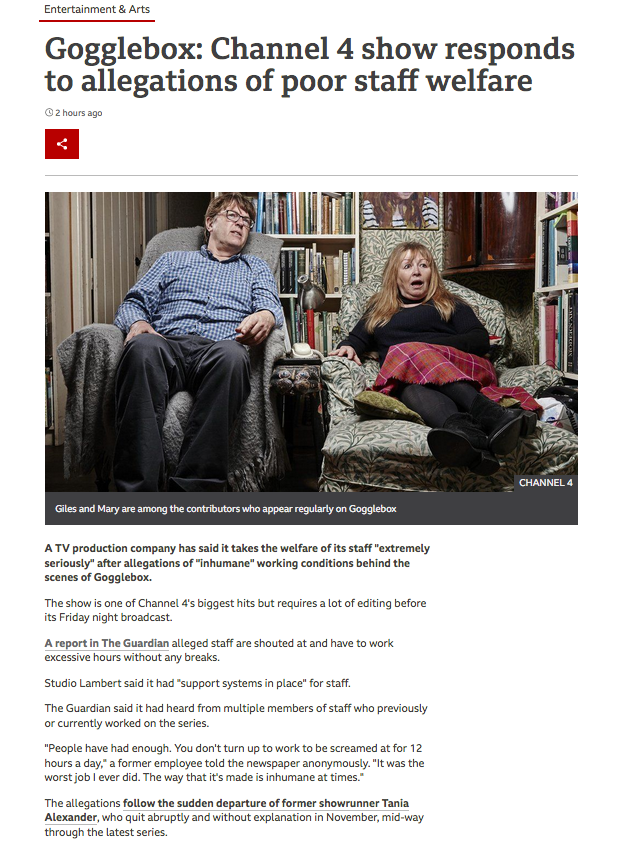
Two articles have come out in the last few days, the first in the Guardian and the second online for the BBC.

https://www.bbc.co.uk/news/entertainment-arts-55847941

https://www.theguardian.com/tv-and-radio/2021/jan/29/gogglebox-staff-claim-toxic-culture-behind-scenes-of-hit-show

The BBC article offers little more to Jim waterson’s article than photographs and a bizarrely ambiguous statement about Tania Alexander who created Gogglebox and left suddenly in the middle of the 16th series of Gogglebox.

What seems clear to me is that bullying and aggressive workplace behaviour is never an isolated issue whoever is accused- it is generally linked to a general abuse of or struggle for power that seems to envelope the business as a whole and the BBC article confirms this when it makes it clear that there have been numerous complaints certainly to BECTU officials: I am disappointed, therefore, that so little has been done to sort this out.

It is often difficult to say where bullying begins though once it starts, isolated instances seem to explode all over the place. I have seen this happen in a number of places and in different countries and cultures- certainly, people have talked to me about the whole subject of bullying in the workplace. The Greeks have a very nice saying- the fish smells from the head. Allegations of bullying, then, suggest that a business badly needs some serious self-examination and a renewed sense of leadership and direction.

I have been concerned about the industry for some time, partly because of the persistent trail of misery that seems to dog this form of TV production. The catalogue of suicides and mental health problems associated with the various shows is harrowing and growing. It affects not only those we see on camera but also those behind the camera. If we want to save this form of entertainment, we need to act fast and go beyond what is in the futile (and now current) OFCOM regulations. I have suggestions- they simply need to be considered. Others may have better suggestions, but sitting on our laurels, or crowing about the publication of the OFCOM regulations will not now be enough. Nor is enough to change personnel or scatter psychiatry at former contestants as if they are the problem. This is an industry that needs root and branch reform globally if it is to continue and I think we have the expertise and the imagination to lead the way if we want to.

As for Studio Lambert, I can only say, at this stage, that I enjoyed the process of filming “The Circle” enormously and felt very cared for and protected while I was in the apartment bock in Salford. Whatever was going on was certainly not evident to me while we were making the show.


I agreed to do “the Circle” partly because I was aware of an article that had appeared in the Guardian following what is called “Crowngate”. It strongly suggests that Stephen Lambert set up his own studio, in part, as a moral crusade to reform the way TV documentaries and reality shows are filmed. This was published in 2007:

https://www.theguardian.com/media/2007/oct/05/bbc.tvfakery3

In 2010, RDF was sold to France. It has since been taken up by Banijay, and is responsible for a host of reality tv shows from Big Brother to Survivor, Masterchef and wifeswap as well as some scripted shows like Wallander and Black Mirror.

In response to the story that also appeared in the Daily Mail, here are a couple of comments. It makes for sad reading:

Time for Resignations and Reform

It has been clear for the last decade at least that Europe is in need of serious reform. Indeed, it is the lack of reform and the lack of democracy in its central systems that gave credibility to Mr Farage’s movement and ultimately to Brexit.

But simply because we have left Euope must not stop our interest in the wellbeing of our neighbour and must not silence us when we see grave wrongdoing.

In this case, Mrs Von der Leyen needs to lead by example and resign. She invoked Article 16 without reference to Ireland or the UK, she published the details of the EU contract with Astra Zenica (and inadvertantly revealed the secret deal struck that was probably itself against EU law, quite apart from the fact that the contract revealed that the prior UK agreement was perfectly sound). What she has done, most clearly is to demonstrate a level of hypocrisy that should not be tolerated. I spoke about this today in a Youtube video made on the back of an interview I did for a TV news show.

This evening, following exactly what I did while I was on “the Circle”, I drew a picture of Mrs von der Leyen. When I drew people in “the Circle”, it was an opportunity to get to know them. Nothing is as intimate and as revealing as the process of drawing a portrait, however cursory that sketch may be. My conclusions, therefore, about Mrs von der Leyen: I do not think she is a bad person. She has kindness and sincerity in her eyes. She wants to be liked. She likes to be led, to take advice. She needs to be persuaded to do the right thing, the bold thing and to set an example to the rest of the EU bureaucrats. I simply think this is a chance for the EU to look at the way it is working and nothing will effect this more dramatically than a clear resignation.

Here is a link to the video I made on Youtube:

What about the people?

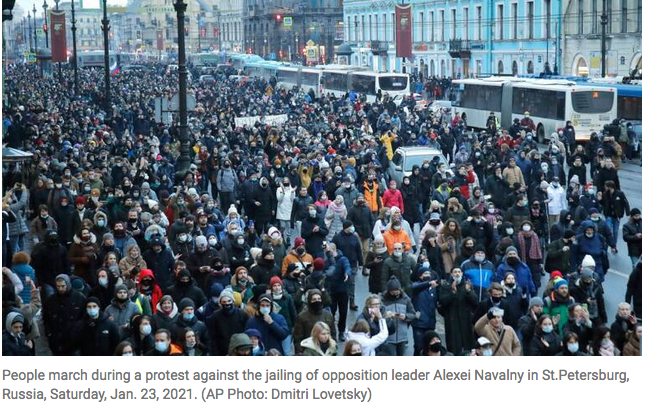
There have been two events in the space of a month where politicians have called the people on to the streets and the resulting scenes of chaos have been broadcast around the world.

The first was Mr Trump’s call to his supporters and the storming of the Capitol. 5 people died. The second has been Navalny’s call to take to the streets on 23rd January. Comparisons may not be wanted but they cannot really be avoided.

Riots have been a feature of history and there have been many different ways of stirring them up and of quelling them. Cleon and Alkibiades stand as images of demagogy. While Libanius argued for clemency and Piso favoured reason in dealing with a rioting mob but for the most part riots in the ancient world, however they were started, were met with the brute force of a military crackdown.

The riot act of 1714/15 was only repealed in 1967 and effectively meant that if people did not disperse when told to do so, they faced death. Hence, the phrase “to read the riot act”.

Last year, the George Floyd protests turned violent and 5000 National guard were deployed across 15 states and Washington DC. Parallels were drawn then with the riots in the UK when protests over the death of Mark Duggan in early August turned into 4 days of looting and riot. In the British instance, copycat riots flared up acros sthe country leading to more than 3000 arrests and 5 deaths, a number of serious injuries and £200 million property damage. These were the early days of social media and a combination of twitter and the more prestigious blackberry system (BBM) was used to direct looting. People posed for photographs, selfies, with their stolen goods and indeed these self-same trpophy pictures were later used by the police to identify them and make arrests.

The Daily Mail and BBC were quick to blame Twitter. The Daily Telegraph particularly talked about twitter as a means to “incite and film the looting and violence”. Some of this could be put down to pique that the traditional media was late in getting the story, and there is also a case for arguing that twitter was simply the “messenger” of choice. But ease of communication must be a factor in the spread and speed of the riots, the flash-mobs that moved from venue to venue and the subsequent looting. Following the riots, the MP for Tottenham David Lammy called for BBM to be suspended.

Various other factors have been advanced to explain how a peaceful protest might turn into a riot. Police over-reaction, and response as well as the presence of agitators in the mass of protestors can be decisding factors. Often, it is a matter of nightfall. What is peaceful during the day turns nasty at night.

In the UK, the right to peaceful protest is well documented and is defined by the mass marches seen regularly from the Jarrow crusade to the countryside alliance against the Blair fox hunting law. Indeed, the right to protest peacefully is enshrined not only in common law but also in the human rights act of 1988. Buttressing these is Article 10 of the European convention on Human rights which explicitly protects freedom of expression free of state interference and Article 11 which guarantees the Right to Peaceful assembly.

There are grey areas, of course, as these laws are interpreted in a variety of different ways that might permit, for instance, police practices like kettling and guiding protestors, filming and monitoring them and placing restrictions on numbers and location of protests, particularly those taking place near Parliament. It might have been interesting to have seen what would have happened in practice had Jeremy Corbyn won a National election and then had to face down a protest led by his brother Piers.

But the rights of freedom of association and of assembly are qualified rights and, certainly in Britain, protests can be prevented in the interest of health and safety. Under the tiered lockdown, a protest might have been legitimate but I wonder if it would be equally legitimate under the current blanket lockdown rules. I know there were plans to tighten up the rules and that the Government has discouraged mass protests.

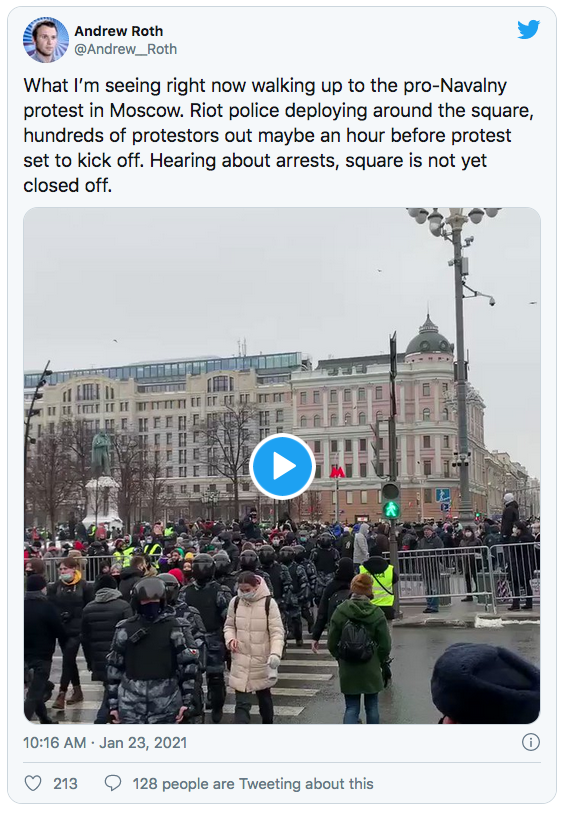
This brings me to the protests across Russia. So far, I understand that about 2000 people have been arrested and detained; film records suggest that many of these arrests were targeted by the police at known supporters and “ring-leaders”, and it is also clear from before the protest began that the police intended to stop it citing a variety of reasons, only one of which was covid regulations and health, another was about “encouraging minors to commit illgal acts that might endanger their safety”. The number of people who turned out, therefore, despite the threats from the authorities, is remarkable. Perhaps more remarkable is the absence of any reports so far of looting. This, to me, marks this protest out as very different to the one that took place on 6th January in Washington. Looting, violence and shooting suggests something terrible which was aggravated by Trump’s failure to call his supporters to heel even if they might have been inclined to disobey him. At its heart, therefore, is the question of “incitment” which has always been tricky in an age of free speech and mass media. My argument would be very simple, that a head of state should not be in a position where this is even under debate. Trump chose foolishly to place himself at the heart of an angry mob. Trump’s role as a sitting President puts the riot of 6th January in a completely different box to anything called today to support the cause of Alexei Navalny.

If Pushkin square was known as a place to assemble, why did the police not close it down?

AS for the Nalavny story itself, there is now a new twist emerging. The Kremlin has clearly decided that its policy of denial is no longer working. It has now started to aportion blame and claims that the Navalny telephone call to Kadryacheb could not possibly have happened without American secret service support.

I am afraid this is a lame claim. I will finish therefore with a small story from my own experience. When I was trying to work out what had happened to my partner in detention in Crete in 2001, and to secure justice for him, I found myself facing not only a stone wall of legal indifference mounted by the judicial system in Hania but also by a form of manipulation from the very charities that should have supported him, whose offices in Athens behaved scurriously. In some desperation, therefore, I called the coastguard office and, by pure chance, spoke to an official who not only knew of the case but was clearly friends with the men who had been responsible for Necati’s assault. Simply because I spoke to him in Greek, this man assumed I was part of the navy defence team and I am afraid I did not make any effort to clarify my role. Accordingly, he sang like a canary and confirmed many of my worst fears, chief of which was that tehre was implicit State support for Dandoulakis and Vardakis. I did not need US sceret service support to make this phone call. I simply relied on the rank stupidity and boredom of the staff who answered the phone. Equally, I did not intend to have the telephone conversation that occured. It was a matter of pure chance. I am sure that Navalny was able to do exactly the same and the story he tells about his exchange with Kadryacheb sounded very familiar indeed to me.

This is now a story that can only have one ending. How that happens, God knows, but Putin’s time has been called and it is up to him to look over to Trump and to negotiate a more dignified exit. If I were now in Navalny’s position, I would ensure that an up to date and detailed manifesto is published as soon as possible. He has secured the youth vote. He now needs to reassure the older generations and business leaders that he has the means to deliver a better future and a stable, functioning government. He might be the face of this movement at the moment but he needs a much bigger team around him, and more dynamic local leaders to lend their voice to his or it will be a matter of replacing one autocrat with another. This should not be about revolution but about Russian reasurance.

No man is an island

We are becoming more insular. It is not only Brexit, but that may not help. It is rather a matter that we are simply not listening to others or observing what they are doing; we are certainly not copying best practice.

I was very shocked, for example, to read an article today that was talking about the various vaccines in development around the world. Apparently, there are 150. We only hear of one and that, I am proud to say, has been produced in Oxford; it is based on a SARS-CoV-2 spike protein—which helps the coronavirus invade cells—into a weakened version of an adenovirus, which typically causes the common cold; indeed, alot of work has been done in a small building within the Chruchill hospital complex next to the Haemophilia department that I visited about 10 days’ ago. There was heavy security around the building, hence I have no photo.

A few weeks’ earlier, the trials were suspended because someone fell ill. We were told it was routine and soon we were told the trials were back on. Only this was not really the whole truth.

This is what I read today:

Preliminary results from this candidate’s first two clinical trial phases revealed the vaccine had triggered a strong immune response—including increased antibodies and responses from T-cells—with only minor side effects such as fatigue and headache. It is in phase three of clinical trials, aiming to recruit up to 50,000 volunteers in Brazil, the United Kingdom, the United States, and South Africa. On September 8, AstraZeneca paused the trials for a safety review due to an adverse reaction in one participant in the U.K. The details remain unclear, though the company has described the pause as a “routine action.” After an investigation by independent regulators, the trials resumed in the U.K., Brazil, South Africa, and India but remained on hold in the U.S. as of September 23.

There might be political reasons for the delay in resuming the trials in the US. The US is trying to trial home-produced vaccines (by Johnson) and to establish vaccine distribution sites by November 1, 2020, just days’ before the Presidential elections. Nevertheless, the failure of the British press to record the US continued delay is alarming. There is no place for Nationalism in a Global health crisis.

I am hoping to write more about the British response to Covid in comparison to what other countries are doing. Much of this is about the way things are presented. (What Americans have started to call “optics”) It simply does not look good. Optics matter.

Dr Who and icons

I wonder why there is no punctuation to the title? Maybe, the reason is that it would be a toss-up between an exclamation mark and a question mark. There would always be debate. Dr Who? Dr Who! Dr Who

In the early 1960s, the exclamation mark was slightly over-used. Think Oliver! Blitz! and Twang! (Maybe, just over-used by Lionel Bart)

The premise of the lengthy Who series is that it is possible to move through time. This may not be scientific reality at the moment, but it is a great plot device and can be traced back certainly to 1895 and to HG Wells’ Time Machine. The book deals with something that was resurrected almost exactly in the 1980’s with “Back to the Future”. There is even a simplification of the idea of 4 dimensions. The 4th dimension is defined in both pieces as “Time” -a bit of a simplification mathematically and scientifically, but it makes for a great device.

This is what HG Wells had to say,
Filby became pensive. “Clearly,” the Time Traveller proceeded, “any real body must have extension in four directions: it must have Length, Breadth, Thickness, and—Duration.”

and this is the same scene in “Back to the Future”, There are two great “aha!” moments. The first is when Marty is told to accelerate to 88 mph in the delorean towards a billboard that will not be in the way in 1885 and the second is when Doc uses a railroad track with an unfinished bridge that will be quite safe in 1985.

I do not think Dr Who or The Time Machine was primarily devised to be about Time Travel. Time Travel was a way to get characters from one environment to another, a contrast of societies. Time Travel was more integral to the plot of “Back to the Future”, though, with all the stuff about two versions of teh same person in the same space at the same time.

In Dr Who, however, the Doctor travels in a machine that specifically recognises the link between time and space, the TARDIS. The TARDIS is an updated Wellsian plot device and an updated time-machine. Its spacial confusion is a nice nod to the hypercube of course.

Physics works on the assumption that there are 10 dimensions (this is necessary for understanding string theory). Maybe more. Certainly more, in theory. In fact, Edwin A Abbot anticipated Wells by about ten years when he wrote “Flatland: A Romance of Many Dimensions,” where he describes the life of a square in a two-dimensional world. Later, the sphere and the square have problems interacting. Einstein talks about the 4th dimension as space-time.

The twighlight zone, or rather Rod Serling talked about a 5th dimension “beyond that which is known to man”. It seems a world of improbability but when we move to a higher dimension, we can look down on the jumbled mass squashed into 2d or 3d and untangle it a bit. It is like moving from the basic grid to a node view, or from moving away from a 2d graph to a 3d mockup.

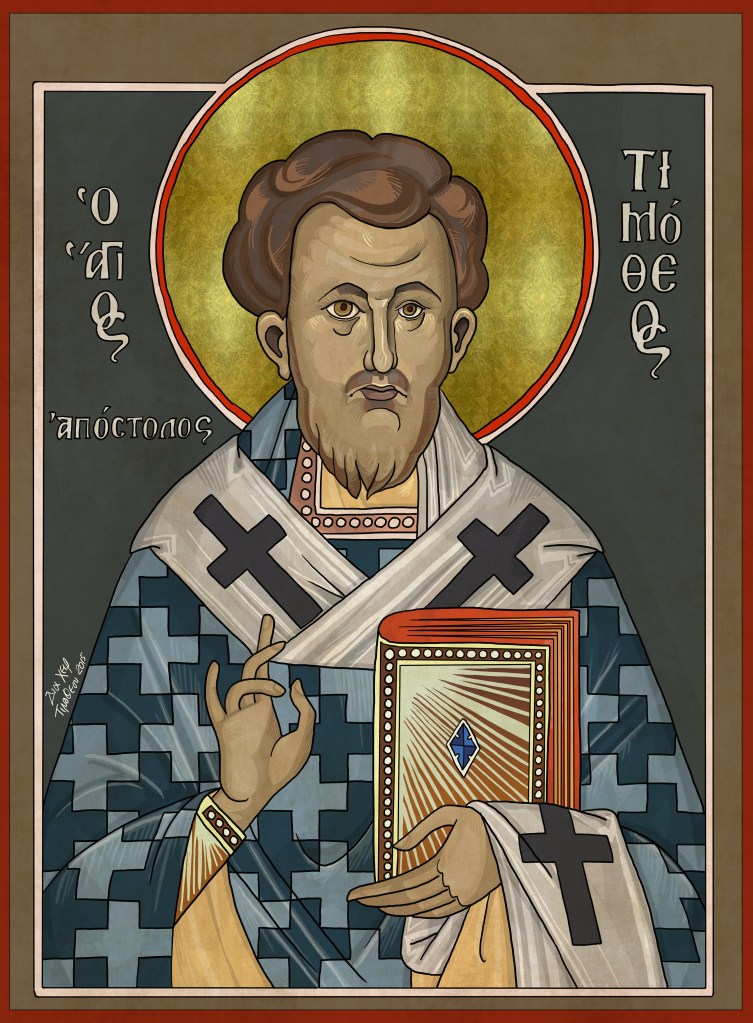
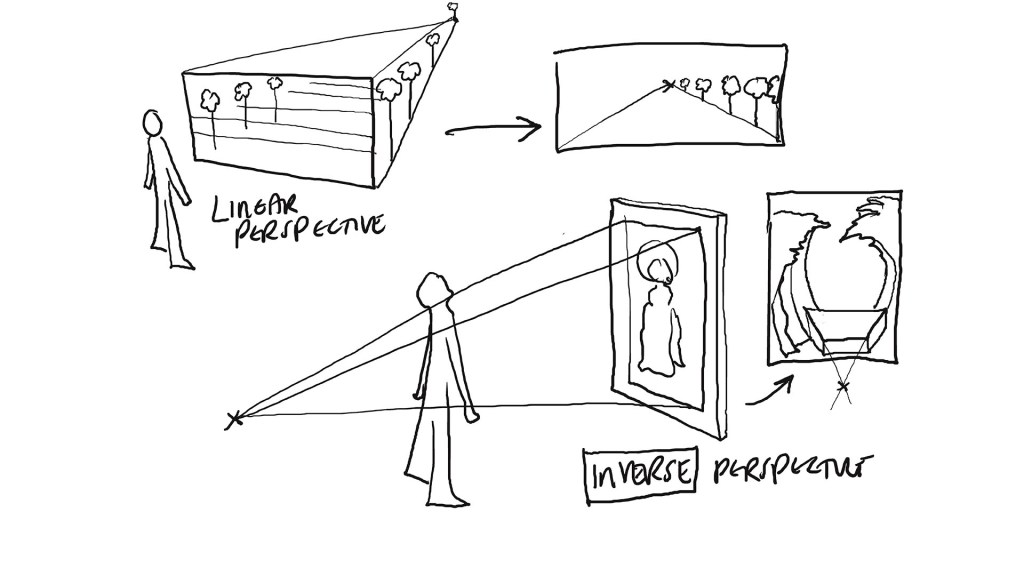
In fact, art has been playing around with this concept for years. We understand the nature of linear perspective popularised in the renaissance but probably going back to, at least, the Roman empire of 70 AD Pompeii. However, the concept of inverted perspective that is central to the theology of the icon is probably much more interesting and can be traced back, I think, to as early as attempts in Pharoahic egypt, that is 20th century BC. We could call it art in bidimensionality, though arguably what happens in the Byzantine art of the 7th/8th century AD onwards is unique. It is a celebration of apparent disproportionality where objects and characters appear in a hierarchy of importance to, rather than of spacial integration in, a given scene.

my icon of St Timothy

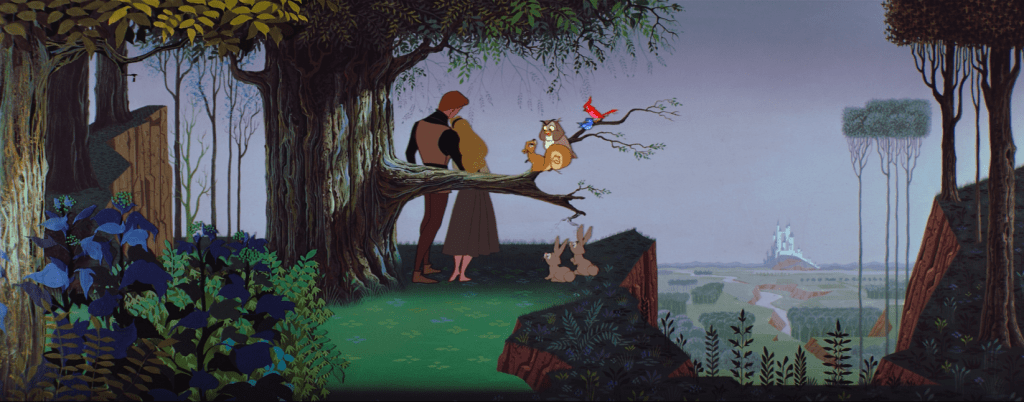
As in Mediaeval art, there is a tendency towards the vertical line, symbolic of ascent to paradise. We see this beautifully also in the work of Ervind Earle who designed Sleeping Beauty for Disney in the late 1950s and who, in turn, said he drew on Albrecht Dürer, Pieter Bruegel, Nicolaas van Eyck, Sandro Botticelli, as well as Persian art and Japanese prints. But he certainly also drew on the Byzantine form. Earle left Disney before Sleeping Beauty premiered but it is his film and his vision on the screen.

Inverse perspective together with the two-dimensional axonometric representations it encourages is sometimes decried and often misunderstood. What it does, though, is to place the viewer within the concept of the picture. If the vanishing point is shifted from some way BEHIND the image (let’s say 3feet), and, instead, is the same distance IN FRONT of the picture, then the viewer must be contained in that image.

We have approached religious art as if we were a mathematician looking back from a 4th or 5th dimension at the limited reality constucted here. That is truly a sense of participating in a God-like view. I think it is probably one of the most brilliant inventions of modern art. It is, of course, a re-thinking of this tool that gives us cubism (that, for another day!). One day, I will demonstrate all this with some well-honed animation though I remember my efforts to do the same for the hypercube when I gave a talk to the physics’ department of my university about the physics of animation. (I was a bit shocked that so many of the students had no idea what I was talking about- whoops)

She Makes us Proud!

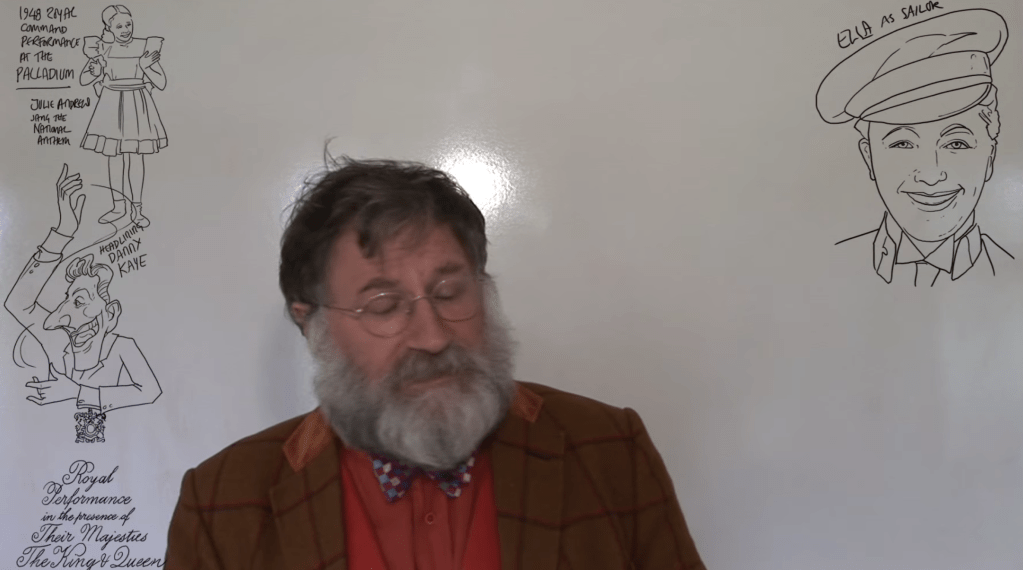
Here is a little film clip that I have waited a while to see!! It’s Julie Andrews singing the National Anthem at the 1948 Royal Command performance with Danny Kaye as I mentioned in my first film about the History of the Music hall. At some point soon, I hope, the sequel to that little documentary I was making will finally be finished and I will post that as well.

here is a link to the first part of my Music Hall history

and a relevant picture from that film of me talking about Dame Julie and Danney Kaye as well as her links with Ella Shields:

Kismet

There was a ridiculous attempt to re-stage “Kismet” a few years’ ago in the ENO. It is a shame that it went wrong because the original show and the Howard Keel film is wonderful in all ways. When the day is most dull, I find a few minutes of the old Vincente Minnelli film from the 1950s restores a healthy heart.

Even the wooden performance of the prince in the film is enchanting. “Take my hand, I’m a stranger in paradise.” There is plenty strange in that setting- a very strange cockerel in a bush, a strange white peacock and alot of strange fake grass. The prince is hardly out of place in the strangeness. Who cares! This is simply a glimpse at a 3d version of a persian minature. I am sure it influenced Richard Williams when he set out to devise “the thief and the cobbler”. After all, Williams also used a score overwhelmed by the crypto-Georgian composer, Alexander Borodin (Бородин).

There was a reworking of the show called Timbuktu! with Eartha Kitt in the late 1970s. It kept many of the big songs, though it lost the song I think is best…

Kismet certainly influenced me in the early 1980s when, in Oxford, there was a production of “Hassan” by James Elroy Flecker. It was the first play I designed for the Oxford Playhouse and the directors (there were two of them) wanted lots of painted backdrops. It was a disaster and the only time I have witnessed the downing of tools by a cast who observed correctly that there were more of them on stage than there were audience in the auditorium.

I remember, though, working day and night in the workshop on a 30 foot painting representing a city slum. In fact, hidden in the slum was a magical golden palace so I sprinked a few peacocks and various fantasy clouds of blue and pink oozing from hookahs. While I was painting, one of my friends came by and I explained this was a picture of a slum. From then on, he assumed that I was so divorced from reality that I believed poverty was a thing of camp glitter. A few terms’ later, in the summer, I think, I designed “the Mikado”. I am still rather pleased with the design actually, and found a few drawings for it the other day. One of the features was a gauze frontdrop that fell half-way through the 1st Act finale separating Katisha from the chorus which was fun to paint and to see.

In the same term, I also designed a garden show of a greek tragedy by Euripides called ION. It was all in Greek with a pastiche of a hatzidakis score by a man called Clive Thomms. He was very talented and I have no idea what happened to him afterwards. I painted the ION sets in the cloisters at my college- it caused a bit of a stir. Later I recreated the look in the dining room of a friend’s house just outside Oxford. It must have been a bit dark- it was a recreation of Red-figure vase painting.

Otherwise, that year in Oxford was dominated by demands from a weary Canadian director for audition after audition of pieces he was proposing to direct in the Oxford Playhouse. I got very good at making cardboard mock-ups of the stage there. I think the list ran something like King Lear, Julius Caesar, Man of La Mancha, Samson Agonistes, Macbeth, the Rivals and Duchess of Malfi. I miss those maquettes a bit. In the end, I had a basic model that I rebuilt again and again as desired. It was not until my second year that I started to get a good run of shows and then I was designing sometimes 3 or 4 plays a term and a good many more posters. By the time I got to designing Peter Pan, I think I had working lights on the model.

My favourite song in KISMET is “Not since Nineveh”. It is sublime. And “the fool sat beneath an olive tree..” is pretty good too. “Why be content with the olive when you could have the tree?” I love the irony of seeing the Caliph’s procession going back in the distance behind the main characters…This is simply Minnelli at his best and it is strange that Kismet is one of those films that is almost impossible to access today. Somehow, time has not favoured this classic.

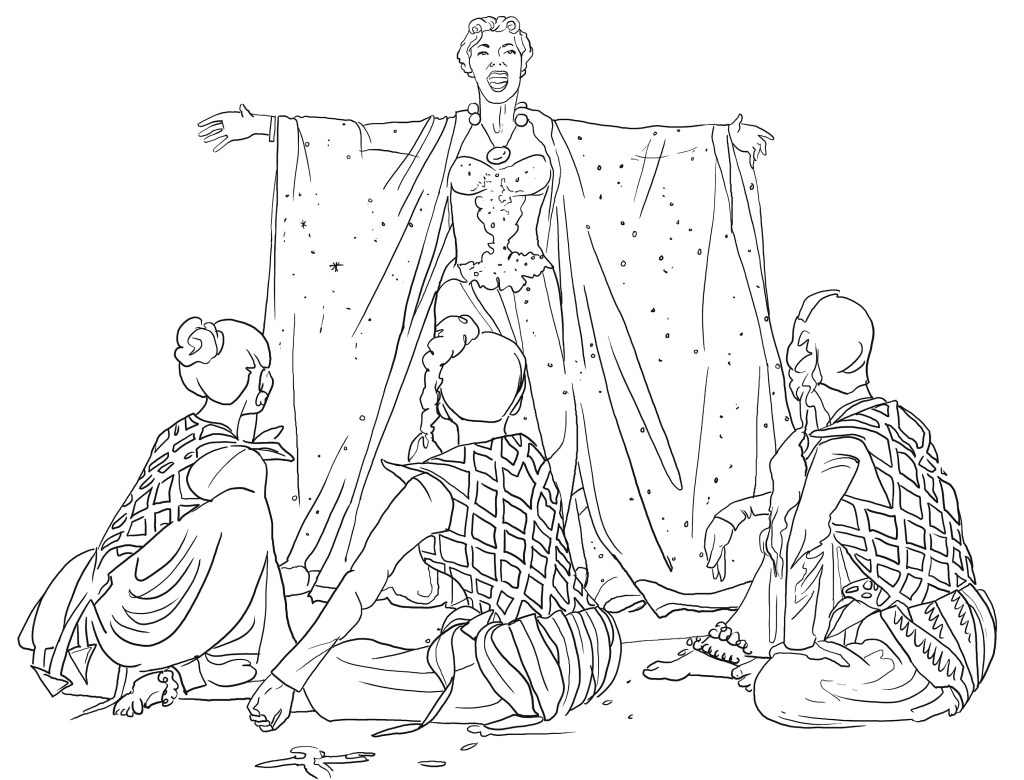
Delores Gray from the film- Not since Nineveh

and another!

I remember seeing Delores Gray in the London production of “Follies”. She had quite a run of British action, appearing in The Good Old days and Dr Who but she also did a stint at RADA and the year she made Kismet, she also made “It’s always fair weather” a great Gene Kelly show. It is odd altogether. She makes “Kismet” sizzle. She is spectacular. In the past, I remember dismissing this film as kitch, but now I realise this is kitch with class. It is high camp as well as kitsch. There’s a good yiddish work (קיטש) by the way, so Shava Tova for today!