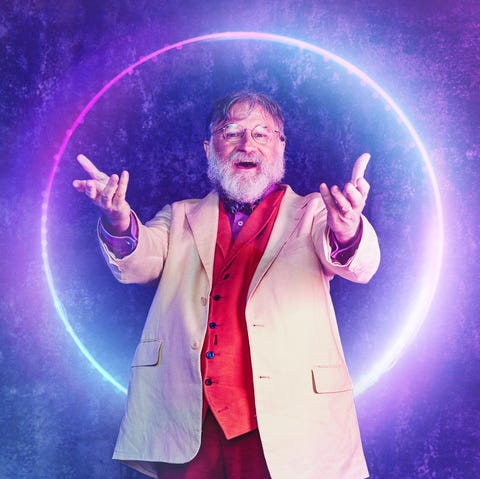
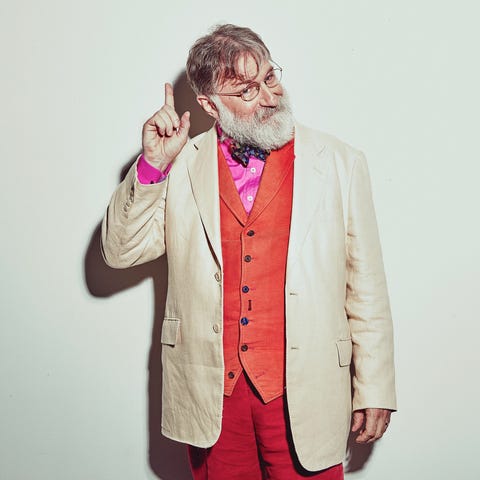
The Guardian on “the Circle”

I was interviewed a short while ago for “the Guardian” and the best thing to do is just to reproduce the story as it was printed today:

You can find it here: https://www.theguardian.com/tv-and-radio/2021/mar/09/the-idea-is-bonkers-the-secrets-behind-the-success-of-the-circle

The piece is written by DOMINIQUE SISLEY

‘The idea is bonkers’: the secrets behind the success of The Circle

The isolating, app-based Channel 4 show feels eerily relevant to the past 12 months. Former and current contestants discuss the experience – and the struggle of readjusting to normal life.

t is September 2019 and Richard Madeley is twerking alone in a high-security flat in Salford. The presenter is taking part in the second season of the Channel 4 reality show The Circle, on which he is catfishing as a 27-year-old PR girl called Judy. Dressed in a motion-capture suit, he is gyrating seductively, his lips pursed in concentration. The other contestants, who are oblivious to Madeley’s true identity, are watching an anonymous rendering of his movements on their screens. “Oh my God, that’s twerking isn’t it?” screams one. “That’s twerking!”

The Circle is not a typical reality TV show. Part popularity contest, part social experiment, part dystopian drama, its premise feels eerily relevant to the past 12 months. Contestants are moved into a refurbished block of flats, where they are confined to their own space and isolated from each other. The only way they can communicate is through a bespoke, text-based social media app called The Circle.Advertisement

Contestants can decide to play as whoever they want: some choose to be themselves, while others decide to catfish (use a fake or partly fictionalised persona online for fraudulent or deceptive purposes; previous players have changed their age, race and gender). The winner is the person who, after three weeks, is rated the most popular by the other contestants.

“It sounds easy,” says Emma Willis, who presents the show. However, lockdown has made people realise “how hard it is when you take someone’s freedom and independence away from them”.

The Circlewas created by Tim Harcourt, the creative director of Studio Lambert, who is also the executive producer behind Gogglebox and Naked Attraction. The idea was ambitious, even by his standards – people sitting alone and texting each other could easily make for flat, monotonous viewing – but it was given the green light by Channel 4 in 2018. “The idea just felt completely bonkers, like taking a WhatsApp group and turning that into entertainment,” remembers Gilly Greenslade, who commissioned it.

Despite the channel’s doubts, the test pilot – filmed over two days in a flat in east London – proved to be riveting viewing. The show was scheduled for a full run a few months later. The first season was broadcast on Channel 4 in September 2018, running for two weeks from a block of flats in London. A second season followed a year later, with production moving to Salford (and adding Madeley as a special guest). A celebrity edition for Stand Up to Cancer begins tonight, with the third regular series kicking off in a week’s time.

“I suppose The Circle is a bit like Neighbours,” says Harcourt, when asked about its appeal. “It’s just minor misunderstandings eked out over time. It’s quite soapy.” In the show, though, these misunderstandings are amplified by the isolation, remote communication and constant threat of catfishing. “When I’m with my wife at home, if I got a WhatsApp from someone, I’d maybe think they were being lairy, but she would just look over my shoulder and go, no, they’re just being brusque. In The Circle, you’re by yourself. You’ve got no voice of reason.”

The success of The Circle has led to spin-off series in France, Brazil and the US, which air on Netflix. The franchise has revealed cultural differences in the way people play: Harcourt says many of the French players were belligerent (“They really went at each other”), while the Brazilians were an “absolute laugh” and wanted “to party every night”. The American contestants were among the nicest; they tended to be more ethical and less inclined to catfish. “At the end of the meal, they wanted to stand up, hold hands and pray,” says Harcourt. “It was like: ‘What?’ You’d never see the Brits do that.”

Part of what makes The Circle so compelling is its casting. Rather than filling the flats with sun-baked, cosmetically enhanced twentysomethings, the producers pull contestants from all walks of life. The winner of the most recent UK season was Paddy Smyth, a 31-year-old account manager with cerebral palsy, while the early favourite, and third-placed finisher, was Tim Wilson, a flamboyant 59-year-old theology professor. Building this diversity is no easy task: although The Circle accepts applications from anyone, it actively headhunts “underrepresented, diverse” people to encourage them to apply. “No show would make a secret of that,” adds Harcourt. “That’s part of the casting process.”

Once you are on the show, though, your endurance is tested. Contestants are kept in ornately decorated rooms (designed in part to reflect their personality), with bright fluorescent lighting and several cameras. Windows must remain closed, for privacy, and TV and internet devices are banned. To pass the long hours, players can read, cook, play Jenga or scrawl out their increasingly paranoid game strategies in notebooks. They can also schedule a sliver of time on the building’s roof terrace, or in the gym or the whirlpool bath, as long as they avoid contact with other players (ear muffs must be worn while moving around the block). It sounds claustrophobic, but former contestants speak glowingly about the experience.

The actor and presenter Nadia Sawalha, who will appear as part of a duo in the celebrity series, says The Circle was like a “magnified holiday” that made her feel like “the president of the United States”. Smyth, the most recent winner, likens it to a “five-star hotel” and says that lockdown has been substantially harder. “If you want five cans of Diet Coke in The Circle, it’s there, hey presto. If you want any type of food, it’s there, hey presto. You’re looked after,” he says. “Plus, you always know that it’s going to come to an end.”

But the paranoia can be overwhelming. Because of the isolation and the lack of physical or verbal contact, bonds are formed quickly – and it can feel shattering when they are broken. The show highlights our instinctual craving for social connection and shows how swiftly we can unravel when we are left without it. “Everything feels so heightened,” says Smyth. “We’re taken aback by how quickly we can be deceived, how quickly we can deceive others, how quickly we can form connections. I think that scares us.”

The broadcaster and journalist Kaye Adams, the other half of Sawalha’s pair, says there were moments when she felt “pathetic” and on the “road to madness”, due to all the paranoia and deception: “It did make me realise that your rational brain can go out the window really easily. You start thinking: ‘What did he mean by that apostrophe? That was a really aggressive apostrophe.’” Shesays she could not have done it on her own. “If it hadn’t been for Nadia calming me down, I would have found it genuinely upsetting.”

For regular contestants, there is also a tumultuous aftermath to deal with. Being thrust into the public eye is a shock to the system, especially if you used catfishing tactics. Busayo Twins, from series two, was targeted by trolls when she catfished as a 24-year-old white man called Josh, to “test the theory of white male privilege”. She has since deleted all her social media accounts. James Doran, who came third in the last season after catfishing as a single mother called Sammie, was also criticised for being “ruthless” and “manipulative”.

Smyth came under fire, too, with trolls claiming that he had played for “pity votes” and used his disability to win. “I’m doing really well now, but it doesn’t mean that I haven’t gone through depression,” he says. “After winning a show like that, you’re on such a high, then you go down to such a low … It was so hard for me to get my head around.”

Harcourt stresses that psychological aftercare is taken “incredibly seriously” by theproduction team. All contestants are given a thorough psychiatric evaluation before appearing on the show, while an on-set psychologist works with them during filming and in the weeks after. They are also offered access to a private healthcare company, which promises round-the-clock counselling and mental health support.

While Smyth acknowledges that the welfare provided by the production team was “amazing”, he says he still needed to seek additional help. “The production company does make you fully aware of what to expect,” he says. “They don’t sugarcoat it; they let you know. But until you go through it, you don’t really know.”

Other contestants, such as Wilson, believe the production does not do enough. Although he praises The Circle’s “artistry” and “spectacular” editors, he feels the private aftercare offered in the months after was not sufficiently responsive or hands-on. “I had the most wonderful edit and I loved the experience, but I hated what happened afterwards,” he says. “I was left feeling wrung out and abandoned. I have never been quite so miserable in my life.”

He says his appearance on The Circle wreaked havoc with his career and that the high-to-low psychological trajectory left him unexpectedly traumatised. “When people come out of these shows, what are they left able to do?” he says. “They can model Asos bikinis … But I can’t go back to the life I had before.”

Reality TV aftercare has been put under serious scrutiny in recent years. Almost 40 people globally have died by suicide after appearing on a reality show, with many former contestants speaking out about the irrevocable harm appearing on such shows has had on their mental health. In 2019, the UK government launched an inquiry into reality TV’s duty of care, but there has been little progress in terms of regulatory policy.

Because of this, Wilson – who acknowledges thatThe Circle has one of the best aftercare processes – is actively campaigning for systemic change in the industry. The “exploitative” nature of reality TV shows could be softened, he says, with improved union powers for contestants and more effective independent watchdogs. In a statement, the producers did not comment on this idea, but said that the duty of care for its contributors is of the “utmost importance” and that the company prides itself on its “robust” aftercare protocols.

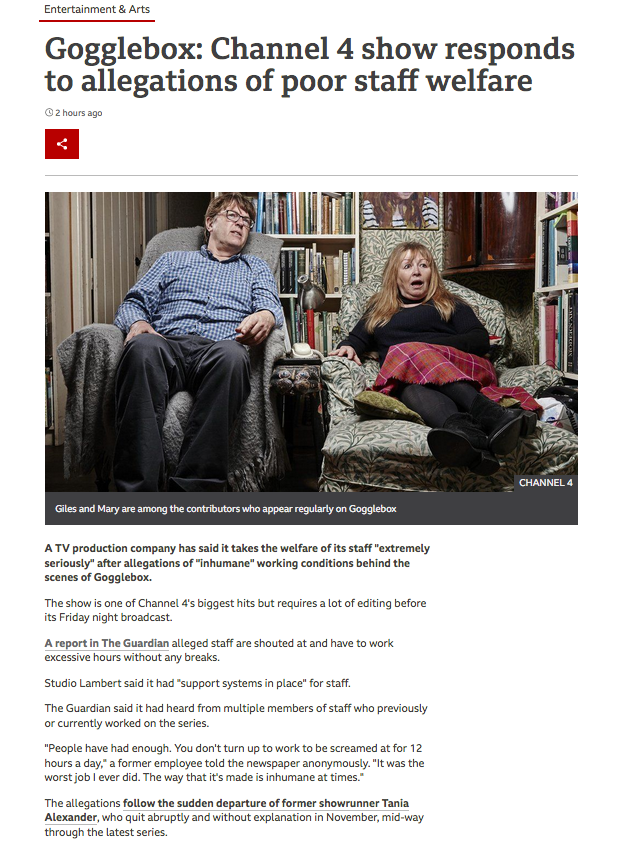
Studio Lambert has been heavily criticised in the past for its work culture. Earlier this year, a former Gogglebox employee alleged that the filming conditions were “inhumane”, aggressive and not Covid-compliant, defined by excessive working hours and a bullying atmosphere. Studio Lambert said that, since March 2020, all its shows had been produced with Covid-safe protocols. It added that it “takes the welfare of its teams extremely seriously across all its productions and has a number of measures in place to encourage people to come forward with any concerns they may have”.

In 2019, Chris Ashby-Steed, a former Gogglebox contestant, spoke out about the aftercare provided by the company, saying that he felt like a “failure” who was “left with scraps” after leaving the show. At the time, a spokesperson for the production company said: “Chris has not contacted us since he made the decision to leave the show. Duty of care is of paramount importance and psychological support is available to all Gogglebox contributors before, during and after appearing on the show, should they wish to take this up.”

Harcourt says: “We constantly communicate with contestants before they go on the show, after they come out of the show and long after they’ve left the show. All of our shows at Studio Lambert involve members of the public playing a game or being on TV, so it’s something you take really seriously.”

He blames the press and social media and says that the production team does what it can to psychologically prepare contestants to deal with both elements. “The social media that is out there at the moment has definitely had an impact on people who are in reality TV shows, and I definitely hold that more responsible for their mental health than reality TV.”

Either way, viewers are still hungry for it. While it is easy to portray reality TV as the problem, Harcourt says there is still plenty to celebrate in the industry. After all, as well as being entertaining, these shows can be interesting and uplifting. “I think shows can be nice,” he says. “I think The Voice is a nice show, I think The Circle is a nice show, I think Bake Off is a nice show.”

They are also – despite years of oversaturation, more popular than ever, particularly among younger viewers. “I feel like there’s a new cycle of reality TV that has learned a lot from the past and then sort of renewed itself for that young audience. I don’t think these shows are going away.”

Bay puns

someone sent me this link this evening.

I did not realise anyone had noticed all the puns. There was certainly a different pun every day. I don’t know if I remember them all.

https://www.digitalspy.com/tv/reality-tv/a29382843/the-circle-2019-contestants-tim-cat-bey/

The Circle fans spot something you might not have noticed about Tim

Could he BEY any more adorable? By Filiz Mustafa 07/10/2019 The Circle Channel 4

The Circle viewers have spotted something pretty great that you might not have noticed about contestant Tim up until now.

Robin Williams lookalike Tim is a 58-year-old professor of theology, a former monk and a cat owner. And in fact, he entered the Channel 4 competition with his pet cat.

In a previous episode of the reality series, Tim revealed to fellow contestant Woody that he has a cat named Bey with him on The Circle.

The Circle

Channel 4 Advertisement – Continue Reading Below

While someone else added: “This guy has more charisma than all the rest.”

And although Tim has already become a fan-favourite on the show, viewers have found something else that makes him even more adorable in their eyes.

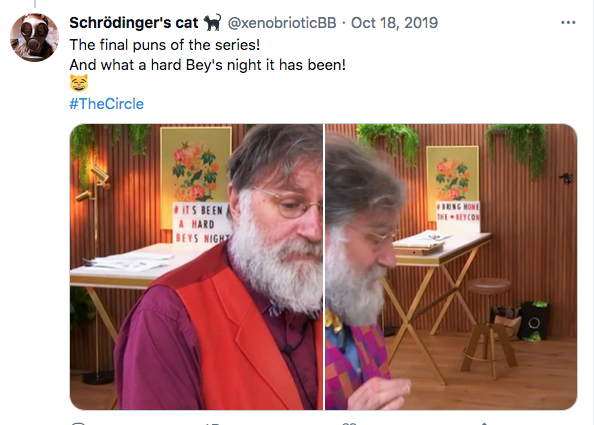
One Twitter user pointed out that Tim’s been making some amusing puns about his cat, writing a series of phrases on a white panel.

“#Beywatch, I miss Sy,” Tim wrote on one of them. “#50 Shades of Bey,” read another one.

“#Circle Beykoff,” read another one. Congratulating fellow contestant Georgina, who recently celebrated her 22nd birthday on the show, Tim wrote: “#Happy Birthbey @Georgina.”

Take a look at the Bey puns down below:

Schrodinger’s cat has been very clever and found evidence of a few more of the puns:

Circle advertising

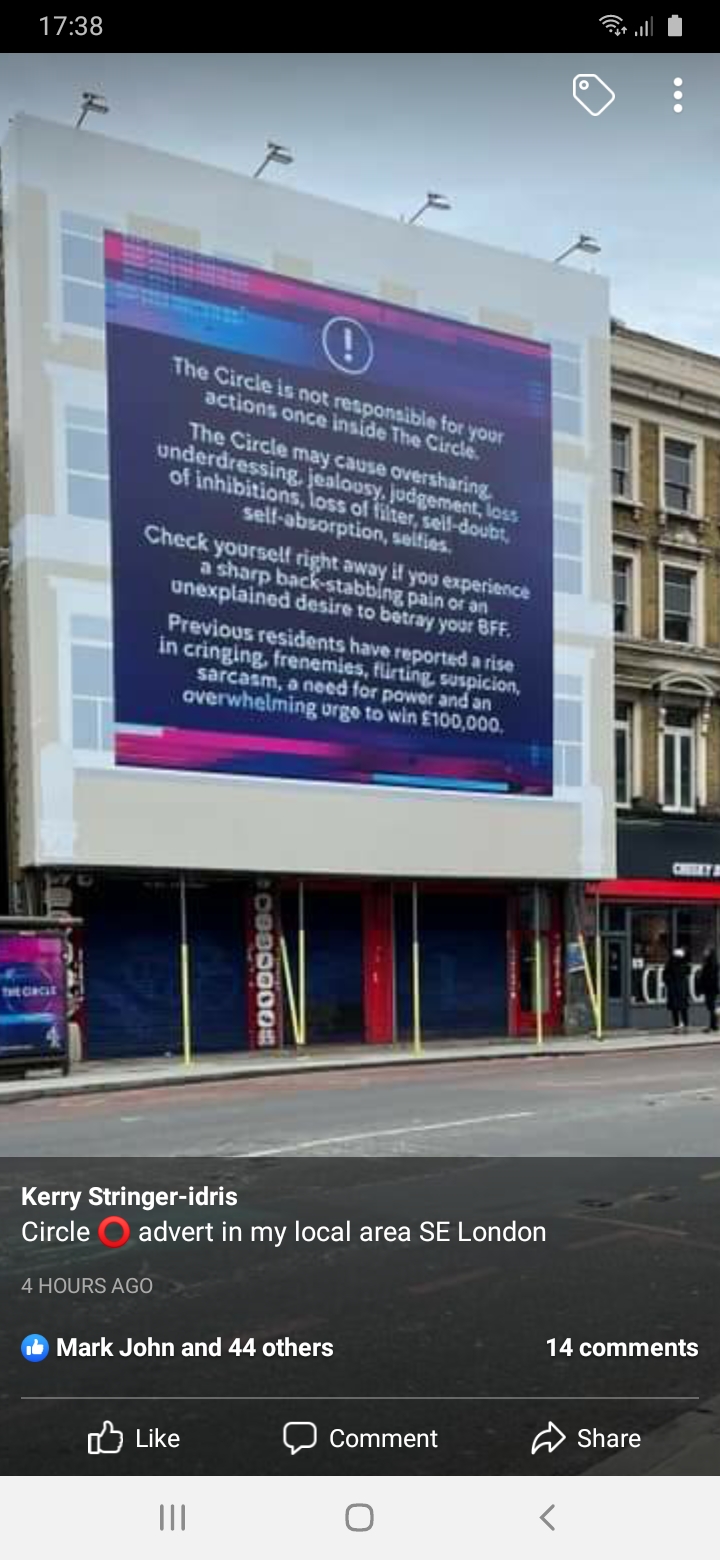
Here is an advert for the forthcoming series 3 of “the Circle”. I believe it is due to be transmitted in March. I have now been asked a couple of times to be part of the programme.

I am very cautious and the advert makes me more so.

Having been on the show, I find the printed advert very uncomfortable reading and the TV trailer below is much the same content. Some “Previous residents” may have indeed “experienced an overwhelming urge to win £100,000”. I am pleased I was not one of them, however much I was asked what I would do with this prize or what I would do to get this prize. I was grateful and remain grateful to have won the viewers’ vote and I still do not fully understand how the prize money for the viewer’s vote was deducted from the prize money that was offered to the overall winner, but clearly the “circle of trust”, in the final reckoning, was played by the circle producers, rather suggesting that “the Circle” remains fully responsible for what goes on in its care whatever its advert may allege.

Friendship

When I was approached about doing the show, I was told “the Circle” was a game about popularity and friendship. That is the game I played. I thought it was about trust and bonding that went beyond the deceit of catfishing. It was that sense of trust, I believed, that should continue beyond the show and that should be the message of the show.

To be fair, the tv advert is more careful about what it says than the printed advert. If the printed version of the advert, particularly, describes the new season of “The Circle”, it is no longer a show I would recognise or that I was on (it is different); that is perfectly reasonable, of course, things change, but I feel uncomfortable that its advert implies I am included in the “previous residents” and that their reports are also my reports. I should add that the last paragraph of this advert, which is partly reproduced at the end of the tv trailer, therefore, is deeply misleading. It would be wrong to think that all previous residents “have reported a rise in cringing, frenemies, flirting, suspicion, sarcasm, a need for power and an overwhelming urge to win £100,000.” None of that describes me on “The Circle” at any point during filming. Indeed, I would be genuinely horrified and genuinely worried if someone believed that described me or my behaviour on the show.

I have seen the American show “survivor”. Every week, now, like clockwork, I watch a new episode, starting with the first show in 2000 and discuss it with the players who were in that series. I assume the new episodes of “the Circle” are now modelled on “survivor”. The format is there. The back-stabbing and the deceit are built into the ethic of “survivor” in a way that they were not built into “the Circle”. Maybe after the success of The Circle of trust, it was inevitable that the show would change, and that is perfectly okay with me. I just do not want the production publicity to imply that I was part of that.

On the anniversary of the death of Caroline Flack, I am worried that there is now a show that promotes itself as a vehicle for deceit and backstabbing, self-doubt, self absorbtion, suspicion and greed- all this in the name of entertainment. I am worried that this is a show to which my name is linked without any qualification. I take heart, however and I trust that, along with these changes in tone, the new series may come with the enhanced and effective aftercare regime and the fully independent professional support throughout that I have repeatedly called for. It is very difficult being a Catfish and doing it successfully. Catfish need proper support.

If this is the entertainment of the future, we need to make sure we look after the entertainers. The new “Circle” can lead the way in this. That would be a development I would wholeheartedly endorse.

Postscript:

25th February

It is with the greatest regret that I now add that I have received a message today from the circle Production company promoting the work of the same lacklustre aftercare service that failed a number of participants so spectacularly last year. I have been asked a couple of times if I will take part in some form in the circle 3 and celebrity shows, but I am afraid I cannot in all honesty now do so. I am so sorry.

I will, however, take part in podcasts already arranged with other companies and I wish the contestants in each Circle show and the production team all the very best. I trust these shows will be as joyous and as much fun as were the shows I watched last year and as was the season 2 in which I participated so enthusiastically.

I hope that, on reflection, The Production company will put in place proper and robust care in line with or better than the recommendations I have made and I trust this will lead to well-considered and effective legislation from the Government. We can lead the way in making this popular, huge and growing industry safe.

Reality TV update

Two articles have come out in the last few days, the first in the Guardian and the second online for the BBC.

https://www.bbc.co.uk/news/entertainment-arts-55847941

https://www.theguardian.com/tv-and-radio/2021/jan/29/gogglebox-staff-claim-toxic-culture-behind-scenes-of-hit-show

The BBC article offers little more to Jim waterson’s article than photographs and a bizarrely ambiguous statement about Tania Alexander who created Gogglebox and left suddenly in the middle of the 16th series of Gogglebox.

What seems clear to me is that bullying and aggressive workplace behaviour is never an isolated issue whoever is accused- it is generally linked to a general abuse of or struggle for power that seems to envelope the business as a whole and the BBC article confirms this when it makes it clear that there have been numerous complaints certainly to BECTU officials: I am disappointed, therefore, that so little has been done to sort this out.

It is often difficult to say where bullying begins though once it starts, isolated instances seem to explode all over the place. I have seen this happen in a number of places and in different countries and cultures- certainly, people have talked to me about the whole subject of bullying in the workplace. The Greeks have a very nice saying- the fish smells from the head. Allegations of bullying, then, suggest that a business badly needs some serious self-examination and a renewed sense of leadership and direction.

I have been concerned about the industry for some time, partly because of the persistent trail of misery that seems to dog this form of TV production. The catalogue of suicides and mental health problems associated with the various shows is harrowing and growing. It affects not only those we see on camera but also those behind the camera. If we want to save this form of entertainment, we need to act fast and go beyond what is in the futile (and now current) OFCOM regulations. I have suggestions- they simply need to be considered. Others may have better suggestions, but sitting on our laurels, or crowing about the publication of the OFCOM regulations will not now be enough. Nor is enough to change personnel or scatter psychiatry at former contestants as if they are the problem. This is an industry that needs root and branch reform globally if it is to continue and I think we have the expertise and the imagination to lead the way if we want to.

As for Studio Lambert, I can only say, at this stage, that I enjoyed the process of filming “The Circle” enormously and felt very cared for and protected while I was in the apartment bock in Salford. Whatever was going on was certainly not evident to me while we were making the show.


I agreed to do “the Circle” partly because I was aware of an article that had appeared in the Guardian following what is called “Crowngate”. It strongly suggests that Stephen Lambert set up his own studio, in part, as a moral crusade to reform the way TV documentaries and reality shows are filmed. This was published in 2007:

https://www.theguardian.com/media/2007/oct/05/bbc.tvfakery3

In 2010, RDF was sold to France. It has since been taken up by Banijay, and is responsible for a host of reality tv shows from Big Brother to Survivor, Masterchef and wifeswap as well as some scripted shows like Wallander and Black Mirror.

In response to the story that also appeared in the Daily Mail, here are a couple of comments. It makes for sad reading:

Time for Resignations and Reform

It has been clear for the last decade at least that Europe is in need of serious reform. Indeed, it is the lack of reform and the lack of democracy in its central systems that gave credibility to Mr Farage’s movement and ultimately to Brexit.

But simply because we have left Euope must not stop our interest in the wellbeing of our neighbour and must not silence us when we see grave wrongdoing.

In this case, Mrs Von der Leyen needs to lead by example and resign. She invoked Article 16 without reference to Ireland or the UK, she published the details of the EU contract with Astra Zenica (and inadvertantly revealed the secret deal struck that was probably itself against EU law, quite apart from the fact that the contract revealed that the prior UK agreement was perfectly sound). What she has done, most clearly is to demonstrate a level of hypocrisy that should not be tolerated. I spoke about this today in a Youtube video made on the back of an interview I did for a TV news show.

This evening, following exactly what I did while I was on “the Circle”, I drew a picture of Mrs von der Leyen. When I drew people in “the Circle”, it was an opportunity to get to know them. Nothing is as intimate and as revealing as the process of drawing a portrait, however cursory that sketch may be. My conclusions, therefore, about Mrs von der Leyen: I do not think she is a bad person. She has kindness and sincerity in her eyes. She wants to be liked. She likes to be led, to take advice. She needs to be persuaded to do the right thing, the bold thing and to set an example to the rest of the EU bureaucrats. I simply think this is a chance for the EU to look at the way it is working and nothing will effect this more dramatically than a clear resignation.

Here is a link to the video I made on Youtube:

It’s a bit rich

When the evidence is on film and circulating around social media, it is a bit rich to blame the protestors for violence when the only violence seen was done by the police. Mr Putin stressed to students that violence was not positive, but he also called the protests a form of “terrorism”, something I think that stretches credulity.

Meanwhile, our own Foreign secretetary has said quite clearly that the “use of violence against peaceful protesters and journalists” is wrong and the Russian government should “release citizens detained during peaceful demonstrations”. If past experience is anything to go on, however, there will be severe penalties imposed on anyone who happened to be caught on the streets on saturday, particularly if they have a recognised name. The Russian police want scalps rather than justice, it seems. They want names.

Of course, this can backfire, as in the arrest of Mr Ustinov in 2012 who was simply visiting a friend. He managed to get the Orthodox church to intercede for him and to get his 3 year prison sentence squashed. I suppose he was lucky. But a nasty experience.

Today, masked men raided Navalny’s flat and surpised his brother Oleg. It is worrying. Clearly, these are not the police- these are thugs or thieves but they may still be government-sponsored- there is no evidence that they are an independent group of masked men. This is not the way to proceed.

Nor is bluster. I think “Putin’s biggest secret” on the Black sea needs to be sorted out. If it does not belong to him, then the proud owner might now step forward. But that will not happen. There is no other owner. Putin is quite right, I am sure, that neither he, nor any member of his immediate family have put their names to any contract for the “palace”, but it does not make it any the less his.

The time has come for Mr Putin to bow out of public life and arrange a smooth transfer of power. A frank conversation with Mr Navalny might even guarantee him the immunity he has been trying to effect in law through the Duma, though the price Mr Putin may have to pay will be to surrender his new thuggish friends to the demands of transparency, and public order. Magnanimity at this stage, however, (and Putin is still in a position to be magnanimous) will cost Putin less than the utter destruction of his reputation and a bunker mentality. He knows the game is up: he might have attracted thugs and villains to his inner circle, but he is a canny politician at heart and one of the longest serving heads of state- there is something to respect in a man who knows when to exit.

The Ancient Roman term for an exit was vomitarium whoich gives us the englsih word”vomit”.Exit seems a much politer way to describe the end of an era.

For the Irada Zeynalova story, see the BBC report here and follow my links: https://monitoring.bbc.co.uk/product/c200wjny

Is the kremlin defence credible?

In the book “the Greeks and the Irrational”, the idea of a shame-based society is applied to ancient Greece. I was fascinated by this concept because it suggests that the village or community has a collective identity and a collective understanding of impropriety- hence the idea that, in Classical law, a person is considered guilty until they demonstrate their innocence or appeal for the Jury’s understanding. A “Guilt based” society is more urban and individualistic. I am a 21st Century urban animal – if I have done nothing wrong, I have no need to explain my actions: I do not live in the ancient world. As a rule, if I have done something wrong and I am overeager to defend myself, I look fairly guilty. Often, therefore, in today’s world, a dignified silence is the best approach.

This evening, Moscow has begun a fairly impressive fightback against the Navalny uprising. On Turkish TV, a very impressive journalist, Sevil Nuriyeva, presented what amounts to the Kremlin defence. It had five major points. Firstly, and most importantly, that the Navalny show was staged by unnamed powers in the West intent on destabilising the Kremlin regime, and that Navalny is financed by western powers. Some of this has been suggested before. Secondly, a flat denial that the Black sea palace is Putin’s- it is a government building. Thirdly, a clarification of the reason for Navalny’s current 30 day detention- specifically, that he has failed to appear at a police station in line with the parole agreement reached after the 2013 suspended sentence. Fourthly, that the Kremlin has a tradition of permitting protests to take place because it is a proven way to flush out the organisers and put them under arrest. The threat is clear- they can expect to be arrested in the coming days and weeks. Fifthly and finally, a piece of polemic, partly put forward by Mr Putin himself on 17th December when he answered the BBC journalist, Steve Rosenberg. If Russia intended to kill its enemies, he teased, it would do so efficiently and effectively. The whole aura of nerve gas, the argument goes, is a Western image that conjures up teh worst excesses of the cold war and cannot be proven to have been sourced in Russia if indeed such nerve agents actually exist. Again, there are demands for Germany to provide the evidence or to give Russian agents access to the material being investigated.

There is one final statement that has emerged- that at least two people are being groomed to succeed Mr Putin and neither of these are called Navalny.

Ms Nuriyeva knows Russia well and understands the way things work. What she has said today is paralleled by other reports coming out of Moscow. This is, in other words, a targeted response. It is also a thoughtful approach and a good analysis of the material available. I think it is wrong.

Moscow has moved from outright denial to a very specific and cogent presentation that makes the Kremlin the victim of the story. It is accompanied by new reports that reduce the numbers of arrests and of the crowds that apparently assembled across Russia on Saturday. I will not question these revisions Instead, I will stick to the five points that Ms Nuriyeva has put forward.

I hesitate to answer each point in turn but here goes- I think there is no doubt that Mr Navalny is financed by powers in the West, but these are almost certainly Russian exiles. I have referred to at least one and I have strong suspicions about others. For what Navalny has sourced so far, it is certainly not necessary to have CIA access of spycraft. It can be explained away very simply by arrogance and stupidity on the part of the russian agents themselves. These same agents have already demonstrated a marked degree of stupidity in claiming to have visited Salisbury to chjeck the height of the spire. The only reason to visit Salisbury is frankly in celebration of the 3 paintings done by Constable, and of these there was no mention at all.

There is enough anecdotal evidence to suggest that Putin stays in the Black sea palace complex. Artists have performed for him there and been paid with lavish gifts. Some of them have not kept their mouths shut. It is certainly possible that Putin’s friends in the government are also welcomed to the Palace but the fact that his toy car collection is on display suggests something more personal than a Government bolt hole.

While the parole offence is a reasonable excuse for detention, the 24 hour deadline, the lack of notice and most significantly the bundling of extra charges suggest that this is not a routine follow-up investigation. The last two points are rehetorical and fairly well rehearsed, the first, that protests are allowed as a way to identify the ring-leaders is clearly a threat and the second is a scary statement that sends shivers down my back- “if we wanted to kill someone, we would”. There is a list of people who have died in unexplained ways, all of whom have fallen foul of the Russian regime. There is also fairly good evidence of the use of poisons, whether radioactive or chemical. If the conversation Mr Navalny had with Kardryacheb is ignored, and I think this would be to overlook a central piece of evidence, then Mrs May’s statement after the Salisbury incident is still decisive here- either the Kremlin is responsible for the poisoning or it has let these weapons get into the hands of unidentifed terrorists. There is, of course, the argument that all the evidence is fabricated and that there has never been any radioactive poisoning, or any chemical attacks at all.

I would like to think the best of the Russian government. I like Russia and I enjoy my trips to Moscow. I am also of the opinion, as the great man John Maynard Keynes said, that “when the facts change, I change my mind.” I make no claims at all to infallibility and I am eager to bow to better knowledge than my own; however, the facts, as presented, do not seem to me to be scuppered by the defence that is now being paraded.

As for the novel idea, the first we have ever heard of this, that successors are being readied to follow Mr Putin- that seems to me to confirm my fears that Mr Putin realises how badly he has been damaged. I think it is only a matter of time.

Teatime with Tim- who knows what subjects will come up in discussion!

What about the people?

There have been two events in the space of a month where politicians have called the people on to the streets and the resulting scenes of chaos have been broadcast around the world.

The first was Mr Trump’s call to his supporters and the storming of the Capitol. 5 people died. The second has been Navalny’s call to take to the streets on 23rd January. Comparisons may not be wanted but they cannot really be avoided.

Riots have been a feature of history and there have been many different ways of stirring them up and of quelling them. Cleon and Alkibiades stand as images of demagogy. While Libanius argued for clemency and Piso favoured reason in dealing with a rioting mob but for the most part riots in the ancient world, however they were started, were met with the brute force of a military crackdown.

The riot act of 1714/15 was only repealed in 1967 and effectively meant that if people did not disperse when told to do so, they faced death. Hence, the phrase “to read the riot act”.

Last year, the George Floyd protests turned violent and 5000 National guard were deployed across 15 states and Washington DC. Parallels were drawn then with the riots in the UK when protests over the death of Mark Duggan in early August turned into 4 days of looting and riot. In the British instance, copycat riots flared up acros sthe country leading to more than 3000 arrests and 5 deaths, a number of serious injuries and £200 million property damage. These were the early days of social media and a combination of twitter and the more prestigious blackberry system (BBM) was used to direct looting. People posed for photographs, selfies, with their stolen goods and indeed these self-same trpophy pictures were later used by the police to identify them and make arrests.

The Daily Mail and BBC were quick to blame Twitter. The Daily Telegraph particularly talked about twitter as a means to “incite and film the looting and violence”. Some of this could be put down to pique that the traditional media was late in getting the story, and there is also a case for arguing that twitter was simply the “messenger” of choice. But ease of communication must be a factor in the spread and speed of the riots, the flash-mobs that moved from venue to venue and the subsequent looting. Following the riots, the MP for Tottenham David Lammy called for BBM to be suspended.

Various other factors have been advanced to explain how a peaceful protest might turn into a riot. Police over-reaction, and response as well as the presence of agitators in the mass of protestors can be decisding factors. Often, it is a matter of nightfall. What is peaceful during the day turns nasty at night.

In the UK, the right to peaceful protest is well documented and is defined by the mass marches seen regularly from the Jarrow crusade to the countryside alliance against the Blair fox hunting law. Indeed, the right to protest peacefully is enshrined not only in common law but also in the human rights act of 1988. Buttressing these is Article 10 of the European convention on Human rights which explicitly protects freedom of expression free of state interference and Article 11 which guarantees the Right to Peaceful assembly.

There are grey areas, of course, as these laws are interpreted in a variety of different ways that might permit, for instance, police practices like kettling and guiding protestors, filming and monitoring them and placing restrictions on numbers and location of protests, particularly those taking place near Parliament. It might have been interesting to have seen what would have happened in practice had Jeremy Corbyn won a National election and then had to face down a protest led by his brother Piers.

But the rights of freedom of association and of assembly are qualified rights and, certainly in Britain, protests can be prevented in the interest of health and safety. Under the tiered lockdown, a protest might have been legitimate but I wonder if it would be equally legitimate under the current blanket lockdown rules. I know there were plans to tighten up the rules and that the Government has discouraged mass protests.

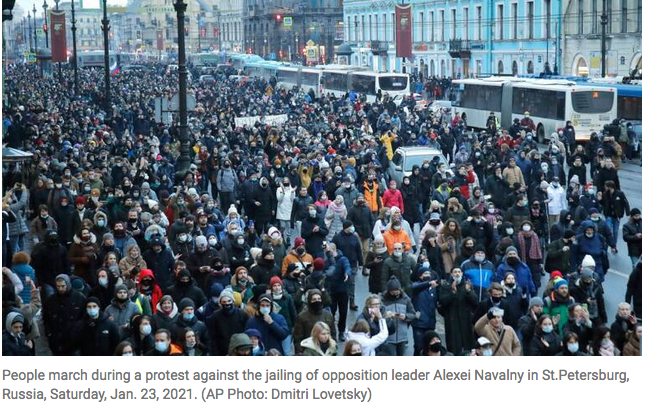
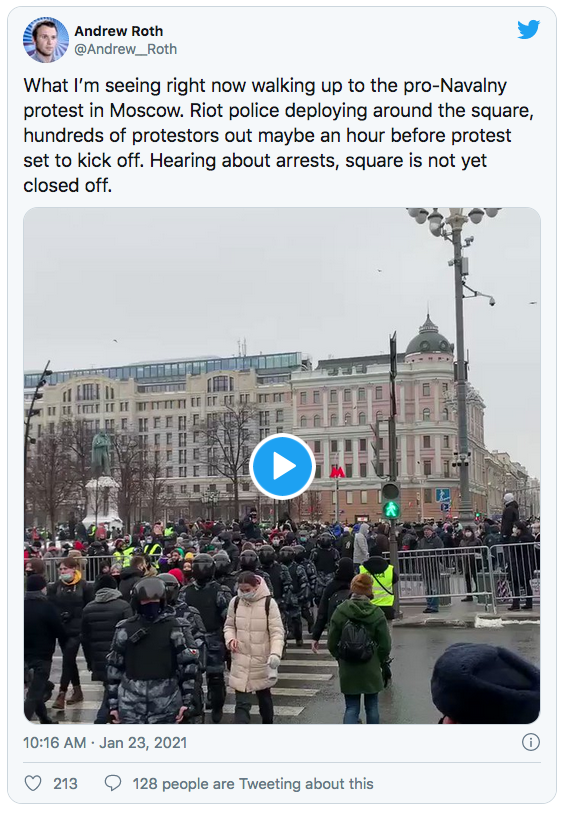
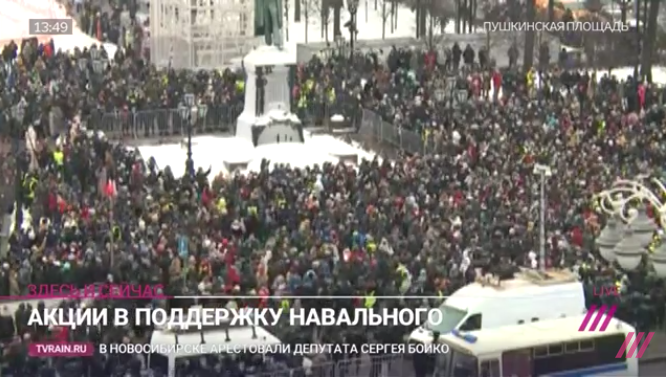
This brings me to the protests across Russia. So far, I understand that about 2000 people have been arrested and detained; film records suggest that many of these arrests were targeted by the police at known supporters and “ring-leaders”, and it is also clear from before the protest began that the police intended to stop it citing a variety of reasons, only one of which was covid regulations and health, another was about “encouraging minors to commit illgal acts that might endanger their safety”. The number of people who turned out, therefore, despite the threats from the authorities, is remarkable. Perhaps more remarkable is the absence of any reports so far of looting. This, to me, marks this protest out as very different to the one that took place on 6th January in Washington. Looting, violence and shooting suggests something terrible which was aggravated by Trump’s failure to call his supporters to heel even if they might have been inclined to disobey him. At its heart, therefore, is the question of “incitment” which has always been tricky in an age of free speech and mass media. My argument would be very simple, that a head of state should not be in a position where this is even under debate. Trump chose foolishly to place himself at the heart of an angry mob. Trump’s role as a sitting President puts the riot of 6th January in a completely different box to anything called today to support the cause of Alexei Navalny.

If Pushkin square was known as a place to assemble, why did the police not close it down?

AS for the Nalavny story itself, there is now a new twist emerging. The Kremlin has clearly decided that its policy of denial is no longer working. It has now started to aportion blame and claims that the Navalny telephone call to Kadryacheb could not possibly have happened without American secret service support.

I am afraid this is a lame claim. I will finish therefore with a small story from my own experience. When I was trying to work out what had happened to my partner in detention in Crete in 2001, and to secure justice for him, I found myself facing not only a stone wall of legal indifference mounted by the judicial system in Hania but also by a form of manipulation from the very charities that should have supported him, whose offices in Athens behaved scurriously. In some desperation, therefore, I called the coastguard office and, by pure chance, spoke to an official who not only knew of the case but was clearly friends with the men who had been responsible for Necati’s assault. Simply because I spoke to him in Greek, this man assumed I was part of the navy defence team and I am afraid I did not make any effort to clarify my role. Accordingly, he sang like a canary and confirmed many of my worst fears, chief of which was that tehre was implicit State support for Dandoulakis and Vardakis. I did not need US sceret service support to make this phone call. I simply relied on the rank stupidity and boredom of the staff who answered the phone. Equally, I did not intend to have the telephone conversation that occured. It was a matter of pure chance. I am sure that Navalny was able to do exactly the same and the story he tells about his exchange with Kadryacheb sounded very familiar indeed to me.

This is now a story that can only have one ending. How that happens, God knows, but Putin’s time has been called and it is up to him to look over to Trump and to negotiate a more dignified exit. If I were now in Navalny’s position, I would ensure that an up to date and detailed manifesto is published as soon as possible. He has secured the youth vote. He now needs to reassure the older generations and business leaders that he has the means to deliver a better future and a stable, functioning government. He might be the face of this movement at the moment but he needs a much bigger team around him, and more dynamic local leaders to lend their voice to his or it will be a matter of replacing one autocrat with another. This should not be about revolution but about Russian reasurance.

Alexei Navalny protests

Novichok is familiar to me because it is the word used to describe a first-year student, what Americans call “a freshman”. For the last five years, I have been a professor in one of Russia’s leading universities and have met many fresh-faced Novichki. For most of us in the West, however, Novichock has another more sinister identity- it was the name of a military nerve agent used in the 2018 Salisbury attack on Sergey and Yulia Skripal.  It was used again, according to German investigators, in a failed attempt on the life of Alexey Navalny. In the words of Mrs May, “Either this was a direct act by the Russian State against our country. Or the Russian government lost control of this potentially catastrophically damaging nerve agent and allowed it to get into the hands of others.” In other words, the use of Novichok in any instance represents either Kremlin malice or incompetence. The more often it is used and identified, the more Mr Putin has to explain.

The problem with Russia’s denials is that Moscow already has “form”. In 2006, the exiled critic Alexander Litvinenko was poisoned with radioactive polonium and died in University hospital, London. The Russian secret service, the FSO was implicated in the case.

There are three main aspects to the Alexei Navalny story.

The first is that the Kremlin’s cack-handed and consistent response to Mr Navalny has turned the former 2007 blogger and critic into an international star and real political contender, the second is the embarrassment he has already caused the Kremlin and the third is the effort made to silence Navalny’s supporters and more specifically the attempt to invoke Covid regulations to stop the protest planned for Saturday 23rd January that, as I am writing has already attracting sizeable numbers in Moscow’s Pushkin square and in St Petersburg.

This is, in other words, a story that makes the current Russian administration look foolish, and in the last few days, Navalny’s allegations of corruption have become personal with the publication of a 2-hour video showing what is alleged to be a 1 billion dollar palace in its own complex the size of a small state on the black sea built apparently with money given secretly in return for political favours, a form of backshesh on a staggering scale.

The question really is whether even Navalny could have anticipated his own success. Much of it has been delivered to Navalny by an increasingly anxious Kremlin, initially to stop his bid to become Moscow mayor and later to stop him running against Putin as a Presidential candidate. Indeed, the more the Kremlin responds, the more powerful it makes Navalny. It is Putin’s response that makes Navalny so credible- the attempts to intimidate, silence and even kill Navalny suggest that what he is saying is true. Even in 2015, the Wall street journal described Navalny as the man Putin fears the most. So much so that, like Lord Voldemort, Putin will not even mention his name. He calls him “a certain force,” or “a character you mentioned”, but Putin’s friends, like former bodyguard Viktor Zolotov in 2018 have been more vocal. Zolotov challenged Navalny to a duel, accused him of libel and in a youtube video says : “I’ll make a nice juicy steak out of you” and “give you the spanking you deserve”.  

On returning to Russia last week, Navalny knew he faced arrest on charges of fraud, of libelling an army veteran and of breaking a parole agreement put in place in 2013 following arrest and imprisonment for an offence dismissed by the EU and timed to make his bid for political office impossible. So, besides being outspoken, Navalny is unquestionably brave. It was the parole issue that was cited on his arrest and imprisonment, a matter the regular Kremlin spokesman called an “internal affair”.

There is some irony in the charges against Navalny: Navalny alleges staggering and specific corruption within the Kremlin and yet, he himself is now charged with embezzling money donated to his own campaign. At the end of December, coinciding with news that Navalny had recovered from poisoning, his suspended sentence, imposed in 2014 was due to end. But at this point, the Russian authorities demanded that he appear in Moscow or face further detention. And it is his failure to meet the 24 hour deadline that seems to be the charge holding him currently in Matrosskaya Tishina prison.

The support Navalny has received, however, is already staggering. The video he posted about Putin’s alleged corruption garnered 60 million views in 4 days, tiktok postings in his support over the same period have been viewed over 300 million times and the threatened marches, despite intense cold, an aggressive police crackdown, the arrest and detention of his spokesperson and lawyer, are already building up around the country.

Perhaps most damning of all was Navalny’s cheeky telephone call to konstantin Barishovich Kadryachob, a FSB agent who was tricked into confirming that he was responsible for cleaning up the scene after Navalny’s poisoning and that the Novichok had been put in Navalny’s underwear. Had Navalny’s plane not made an emergency landing and had he not been given immediate medical help, Kadruyachob was sure the poison would have been efficacious. This call came only a couple of days after Putin himself on 17th December had a testy exchange with a BBC reporter, Steve Rosenberg referring in his response to “the famous blogger” and “this patient in the Berlin clinic”. Putin said, “who needs him anyway? If [they] wanted to, they would’ve probably finished it. But in this case, his wife asked me, and I immediately gave the order to let him out of the country to be treated in Germany… This is a trick to attack the leaders [in Russia].”

Putin’s aggressive denial is matched by a wide campaign to discredit Navalny. The allegations of fraud are probably not credible as similarly Putin’s sweeping dismissals of the opposition leader as someone with “delusions of grandeur” and a persecution complex. The internet makes it harder, though, to censor news in any traditional way, so, while Navalny is rarely mentioned on mainstream tv broadcasts or in the official press, his story dominates social media and even if the police and Russian authorities manage to disperse the crowds this afternoon, the damage to the Kremlin’s authority has been done.

Navalny, for his part shows no signs at all of going away any time soon. And he has made efforts to protect himself. Any attempt, for example, that the prison authorities might make to stage his suicide in prison are already anticipated by a positing Navlny has made saying he is not suicidal and, in addition, that he has already strenuously denied the allegations against him. Moreover, while the Kremlin might say this is an internal matter, it is difficult to dismiss Western support, and it will become harder and harder for Moscow to ignore the European judgement that his 2013 conviction was an “arbitrary application of the law.” It is this case which was commuted into a suspended prison sentence and this case that forms the basis of Navalny’s current detention. More significantly, as time goes on, it will become harder for Moscow to ignore the both the German and British evidence of Novichok poisoning. At some point Mr Putin will have to answer Mrs May’s clear question about the poison itself- is its use as a weapon evidence of incompetence or of malice.

Here is a short video that I made last night

It is worth adding that Navalny has actually published a proposal of what he would do in office. This was in 2017