

I posted this picture a while ago and here is the latest line-test with some corrections to the Right arm and the addition of the pigtail.
I posted this picture a while ago and here is the latest line-test with some corrections to the Right arm and the addition of the pigtail.
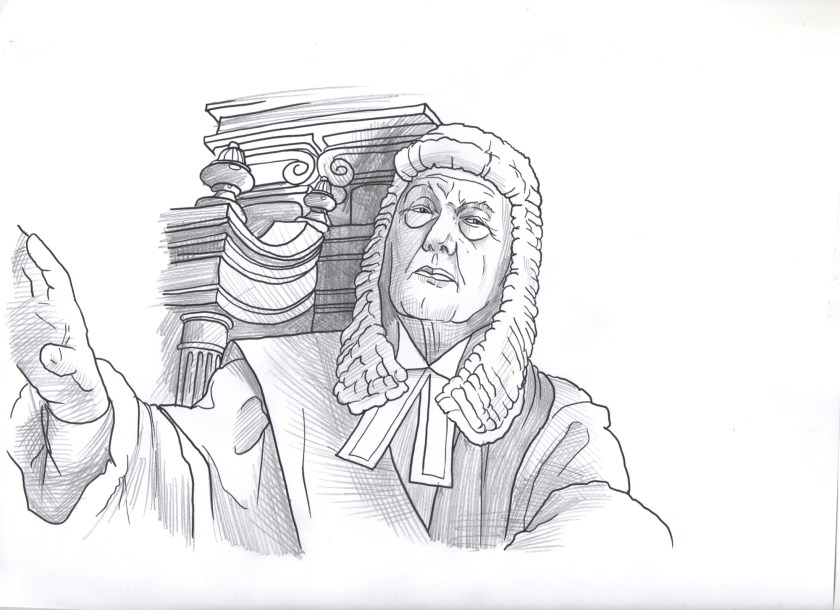
Here is a post on progress on the Judge’s song from “Trial by Jury”.
This is a line test of the first verse. The Right arm and some of the body is still missing as well as the earlier frames of the pigtail and the pupils.
The animation was completed on the Harmony/toon boom system though I note the production of the brilliant and recently-screened “Ethel and Ernest” on BBC was done with TV Paint which seems to offer so much more opportunity in terms of textures and usability. Harmony was a wonderful tool when it was run by the Vogelesang family, particularly Lilly and Joan, but they were taken over by Corus entertainment in 2014 or so and it does not seem to have been the same ever since. I have been teaching in a school in Moscow that apparently promotes the software and it was a devil of a job to get it actually to work at all on the school machines. So much for Industry standard! I note the company also acquired Animo, Pegs’n’co and the Cambridge animation system, rival 2d animating software and has not made any effort to update any of these since, effectively smashing the opposition and leaving precious little choice.
Here is an earlier version:

This is the finished “look”-

First combined image of background and character…

For the last year I have been grabbing time between lectures to make some progress on part 2 of the documentary talk about music hall. I have also been finishing some storyboarding for a couple of proposed films and some preparation for a BBC project, so it has been a full year! (That is by way of a preamble and an excuse for tardiness!)
Here is the full documentation on a piece I have just finished animating which is based on a song by Harry Champion:
First sketches:


with jacket sleeves:
With coloured and shaded hat:
body sketched in:

the tomato plant:
and adding the jacket design incrementally

The finished product:
The Context:
The first part of the Music Hall documentary:
The Coburn scene developing:
Marie Lloyd scene:
The original song:
My animation:
The beginning of the film (Music Hall part 2)
Turn on the television anytime and the chances are you are going hear music that is produced using digital orchestration and sample libraries. So, the orchestra you are hearing is not, in the conventional sense, an orchestra at all – it just sounds like one. If the music production is done well, it should be almost impossible to distinguish between what you are hearing and what a “real” orchestra would sound like. That is the art / science of digital orchestration. The music for CSI, The Mentalist, Dexter and many more, is all produced “inside the box”. It is now almost impossible to find an advert where the music is not produced in this way. Tight production schedules and limited budgets usually don’t allow for recordings of real orchestras, so the sample based recording isn’t just a demo or a mock-up, it is the final cue.
Click on the link below. Here, there are two examples of an orchestral piece by Vaughan Williams and two examples of a Beethoven string quartet. One of each piece is produced using digital orchestration – which is which?
More and more, and for the same reasons, this also applies to films. Low and mid-range budget films will never be able to finance studio recording sessions with a large orchestra, music director, producer, recording and mixing engineers etc. Even in some blockbuster films where large Hollywood style orchestras are used, the soundtrack will often be enhanced with extra sampled percussion and brass etc.
What is sampling and how does it work?
Not Robots and Nothing to do with Synthesizers!
When you hear sampled music, you are hearing real musicians playing real instruments, – a solo violinist may well be playing a Stradivarius! – but, every single note and articulation has been sampled – recorded – separately and often many times over. Every note an instrument can play and in every way – ppp, pp, p, mp, mf, f, ff, fff, sfz, staccato, detache, legato, flautando, harmonic, con sordini, pizz, and so on, is sampled in meticulous detail. Often, but not always, these samples will be recorded “dry”. That is, with absolutely no ambient sound, echo, reverb. If you listen to dry samples, they are very uninspiring – if you have ever been in an anechoic chamber you will get the idea. Reverb to taste is added later. More about reverb anon. The world leading Vienna Symphonic Library (VSL) have built their “Silent Stage” so that all their sampled recordings are completely dry.
A full orchestral sample library will go through this process for every instrument. In addition, where sections of players are required e.g. First Violins, Second Violins etc. there may well be 14 or more players playing together. Full professional sample libraries are massive containing millions of samples.
The Legato Revolution
An important milestone in orchestral sampling occurred in 2002 with the development by Vienna Symphonic Library of the “interval legato concept”. Anyone who has learned to play an instrument to a reasonable standard will be aware that it is not enough just to play the correct notes in the correct order in the correct time. Good phrasing, and especially legato phrasing, will utterly transform a piece. Hitherto all sample libraries faced the same problem – how to join notes together so the phrase or passage sounded completely authentic. In 2002 VSL developed complex algorithms which overcame this problem, the results were astounding and this process has been taken up by all sample developers ever since.
Click on the link below to listen to a 1st Violin section from VSL.
No More Machine Guns!
Around the same time VSL also developed the method of using different samples for repeated notes. Most music contains many parts where the same note is repeated many times. If the same sample is repeated many times the result is not at all convincing and is known as the “machine gun effect”. The developers created a system where each repeated note triggered a different sample of the same note giving a much more realistic sound – this is now universally referred to as “round robins” and all serious sound libraries use this system.
Software
What do you do with 10 million samples?
Fortunately the companies producing such vast libraries also produce highly sophisticated software to control and manipulate the samples. The screenshots below show part of the user interfaces for VSL’s Vienna Instruments and East West Quantum Leap’s PLAY software. It is here that the user controls and manipulates the samples. There are many other companies with similar products but these are the two with which I am most familiar and use on a daily basis.
Usually there is a matrix where the user loads the samples required. In some pieces only a few articulations will be required e.g. sustain and legato, for other more complex pieces a wide range of individual articulations will be needed. This can be very demanding on computing power and often slave computers with powerful processors. a lot of RAM and several solid state hard drives, will be needed to take the strain.

A set-up like this can be used as stand-alone connected to a keyboard where the player can play, for example, an incredibly realistic string or brass section. This is commonly used in “live” situations. This of course has been and continues to be controversial as many musicians see it as a threat to their jobs and there is no doubt that this does and will continue to happen. On Broadway in 2003 there was a Musicians Strike which began as a strike over pit minimums and rapidly escalated. In London’s West End Cameron Mackintosh moved Les Miserables from the Palace Theatre to the Queen’s Theatre leading to a reduced orchestral size – a smaller pit – and increased use of samples triggered from keyboards. So, from the audience’s perspective there was no reduction in sound produced by the orchestra.
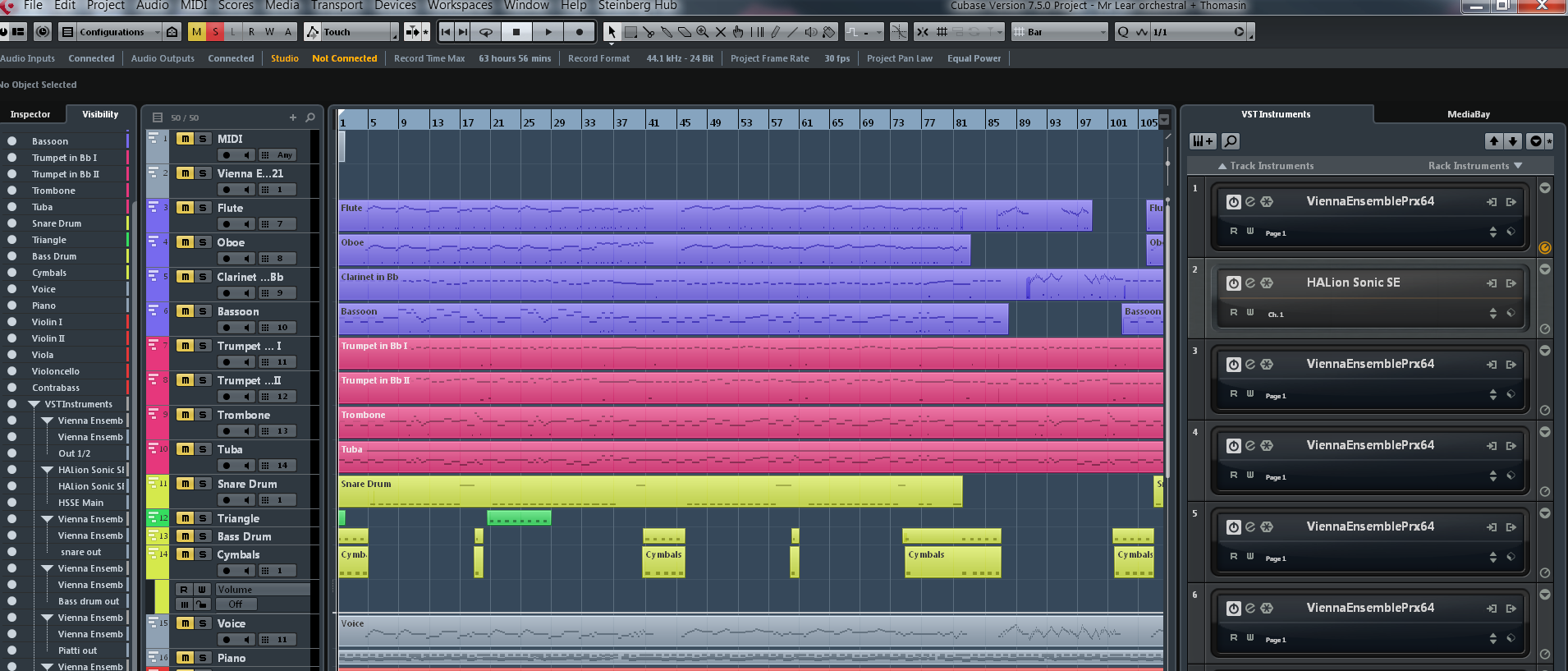
In music production for TV, Films and CD type work these interfaces will normally connect to a DAW (Digital Audio Workstation) such as Cubase, Protools, Studio One etc. Here the user controls the whole audio project with as many instrument tracks as required – it could be over a hundred.
Below are examples of editing widows from Cubase.


The coloured track lanes are individual instruments which are processed as required and eventually mixed down to stereo, or surround sound. It is in these widows that all the minutiae of editing takes place. The process here is similar to standard multi-track recording which of course is the staple of many recording studios. In some cases this is still done using multi-track tape recorders – analogue – but more and more, using computers – digital. Each method has its own champions and many a heated discussion takes place over their relative merits.
How Pleasant To Know Mr Lear
Screenshot 3 is from “Following Lear” Zontul Films Ltd currently in production. The music was composed and produced by David Watson (Kanon Digital Orchestration) using the digital orchestration techniques described above. A mixed stereo file was sent through the ether to Shonk Studios Oxford where soprano Thomasin Trezise recorded the vocals which were then sent back to Kanon for mixing and mastering. This track is not finalised but you can listen to the work-in-progress by clicking on the link below. You can also see Tim Wilson preparing some of the storyboards and animations for the piece.
A Note on Reverb
I mentioned above that many sample libraries are recorded completely dry i.e. with no ambient sound on the recording. This has the benefit of giving the producer much greater control of the final audio track. Reverb techniques have come on a long way since the days of the old “spring” reverb. This was literally a spring inside a plastic pipe which could be inserted into the audio path. It gave pretty impressive results for its time but if you want to see one now you will have to go to a museum!
There is a vast array of very high quality hardware and software reverb systems available. Where pure acoustic realism is sought, rather than a reverb or echo “effect”, the most commonly used system is that of Convolution Reverb or Impulse Response. Without going into the physics of the process, convolution reverb involves audio engineers going to a particular venue – a concert hall, scoring studio, a church or even a famous cathedral and actually recording the directional sound impulses of that space. Using these programs and impulses you can then place your “dry” instrumentalists or singers “virtually” in that space. The realism of the results can be quite amazing.
VSL’s Multi Impulse Response convolution (MIR)
VSL’s MIR, which I use a lot, goes even further taking up to 5000 impulse responses per room. They will also consider the placement of any instrument on a stage and the directional and sonic characteristics of the instrument. Microphone placement is very important and it is possible to listen as the conductor, someone sitting near the front of the auditorium or at the back or in the balcony and so on.
Mozart wet and dry.
Click on the link below to listen to excerpts from the Overture to The Marriage of Figaro.
This first one I have kept mercifully short. It sounds raucous, out of balance and truly awful. Yet, apart from the addition of the MIR impulses and instrument placement, it is identical to the second example which I hope is more pleasing to the ear. This second example is placed in the Mozartsaal in Vienna.
Where to now?
The speed of technological advance is unlikely to slow down. Computers are getting more powerful, processors ever faster, solid state hard drives will become the norm – this can reduce the need for huge amounts of RAM. The professional sample library market is very competitive with new top-end products advertised in specialist magazines every month. The digital / virtual orchestration area of the music business is almost unrecognisable from that of just a decade ago.
Where does that leave our living breathing musicians? The business will continue to change and musicians will have to adapt, there is no doubt about that. However, music conservatories across the world continue to produce incredibly talented musicians. Perhaps the British – but not the Scottish – Government has come up with a solution – stop producing musicians! The introduction of the Ebac. The Ebac will essentially be compulsory for all maintained schools. The Ebac does not include music and the arts! Any school which does not conform cannot be graded as outstanding. I feel sorry for the head teachers – especially those with a creative arts background – who will have to make very difficult decisions. I suppose we get the governments we deserve. After all we elect them. Or at least at the last election the 66% of us who voted did.
Perhaps there is something to be said for a benign dictatorship – especially if musicians are in charge!
David Watson
August 2015
Kanon Digital Orchestration
Auchermuchty Scotland
Here is a link to the first part of my talk on the history of the Music hall.

and here is a link to Julie Andrews singing the National Anthem for the King at the Palladium:
Here incidentally is a recording of Dame Julie at 12 singing, at the height of her “Educating Archie” days – simply spectacular
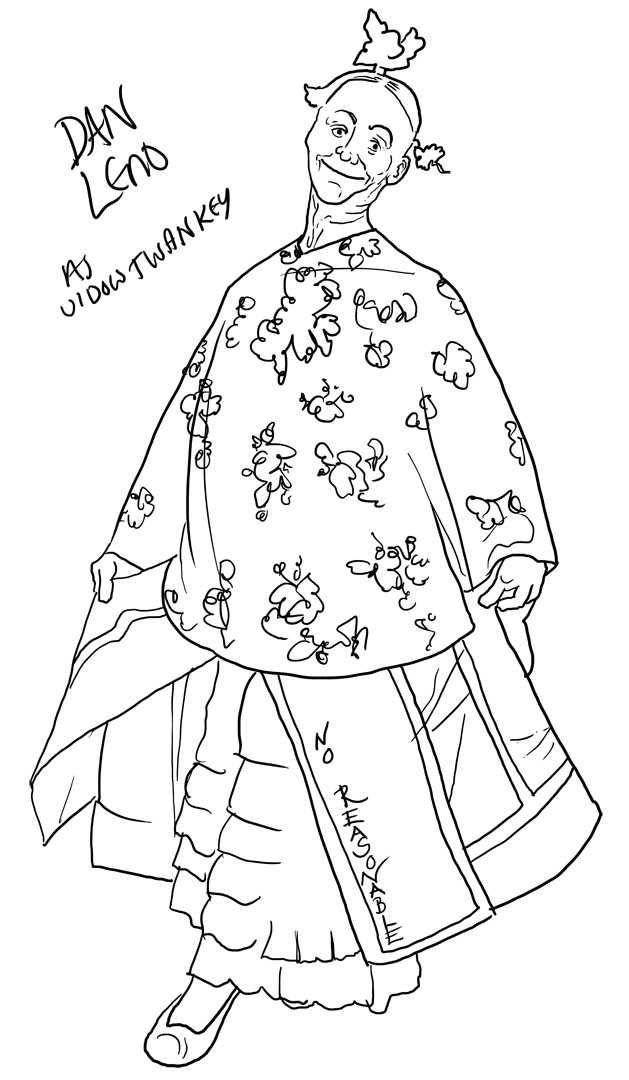
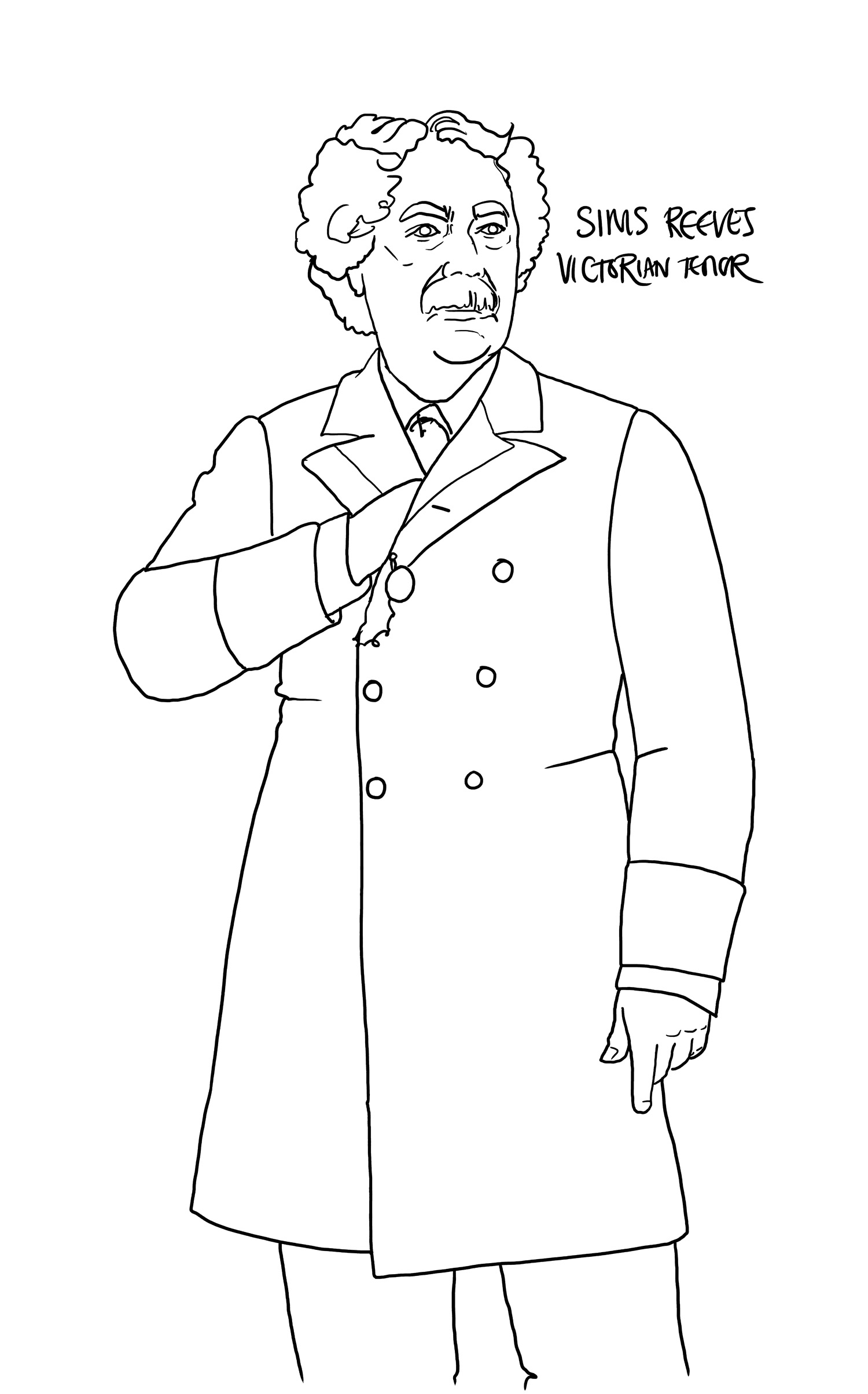
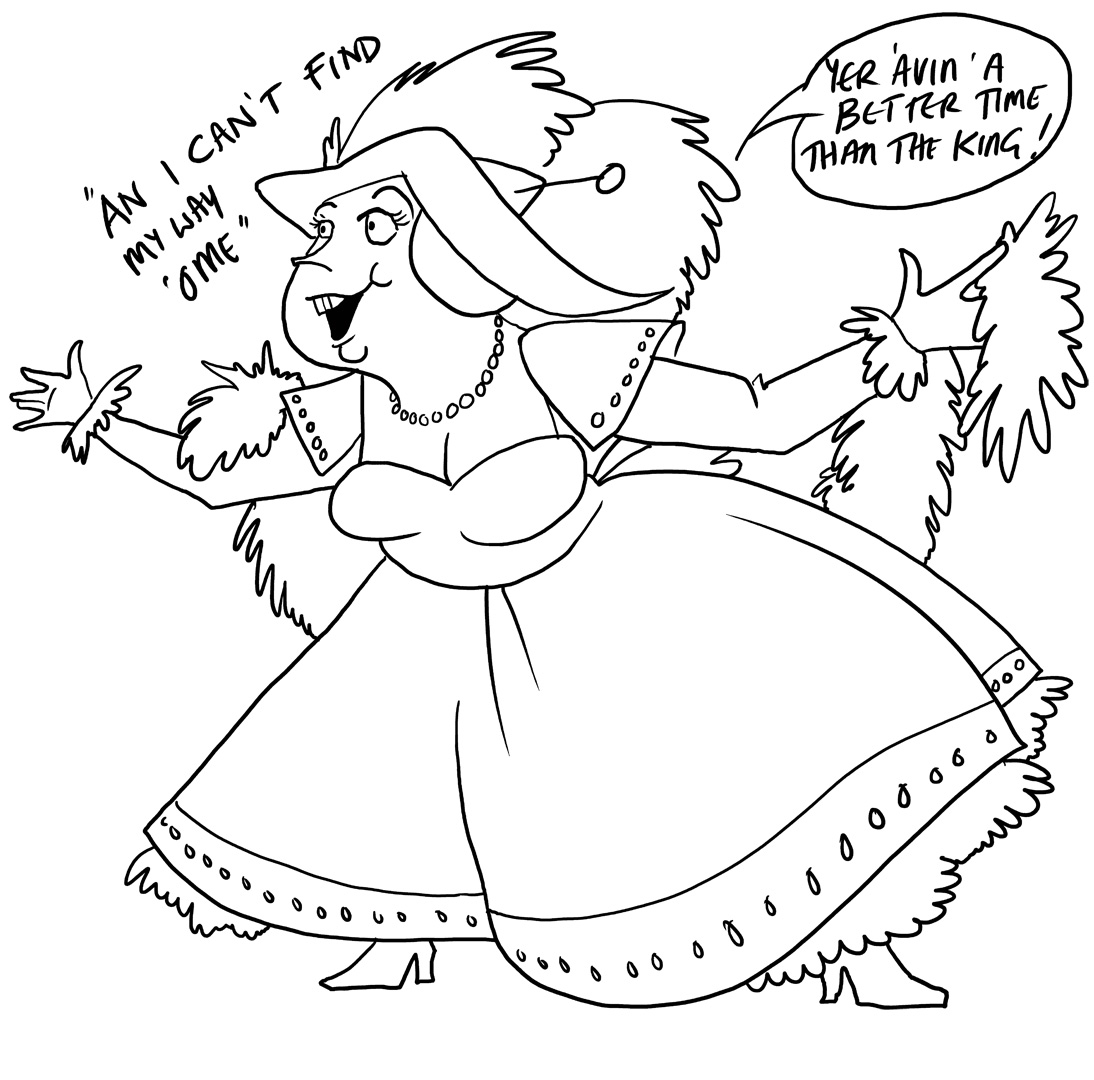
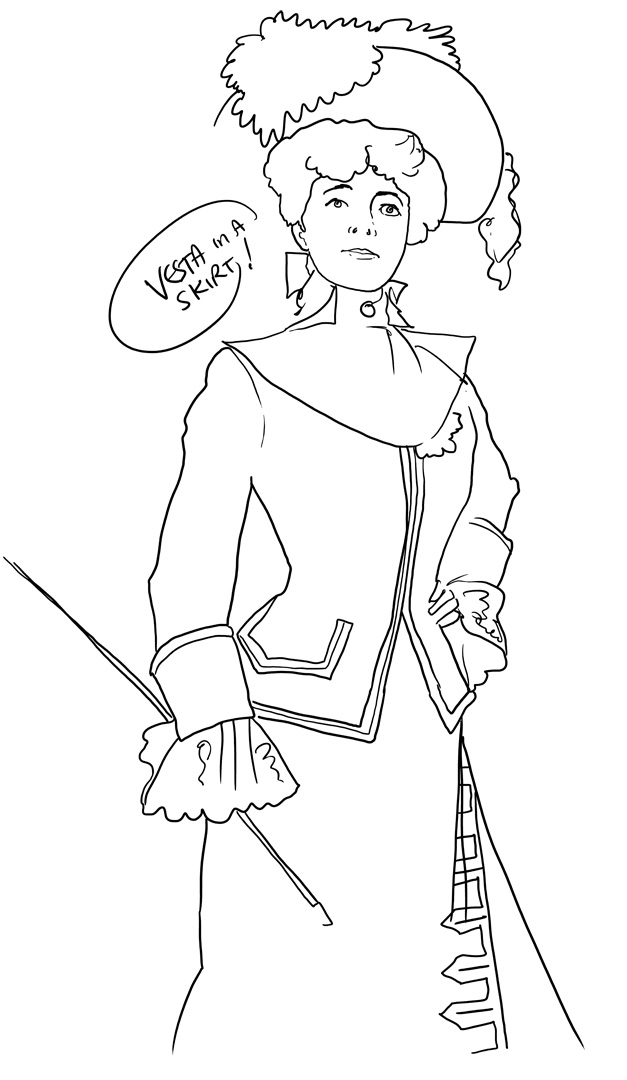
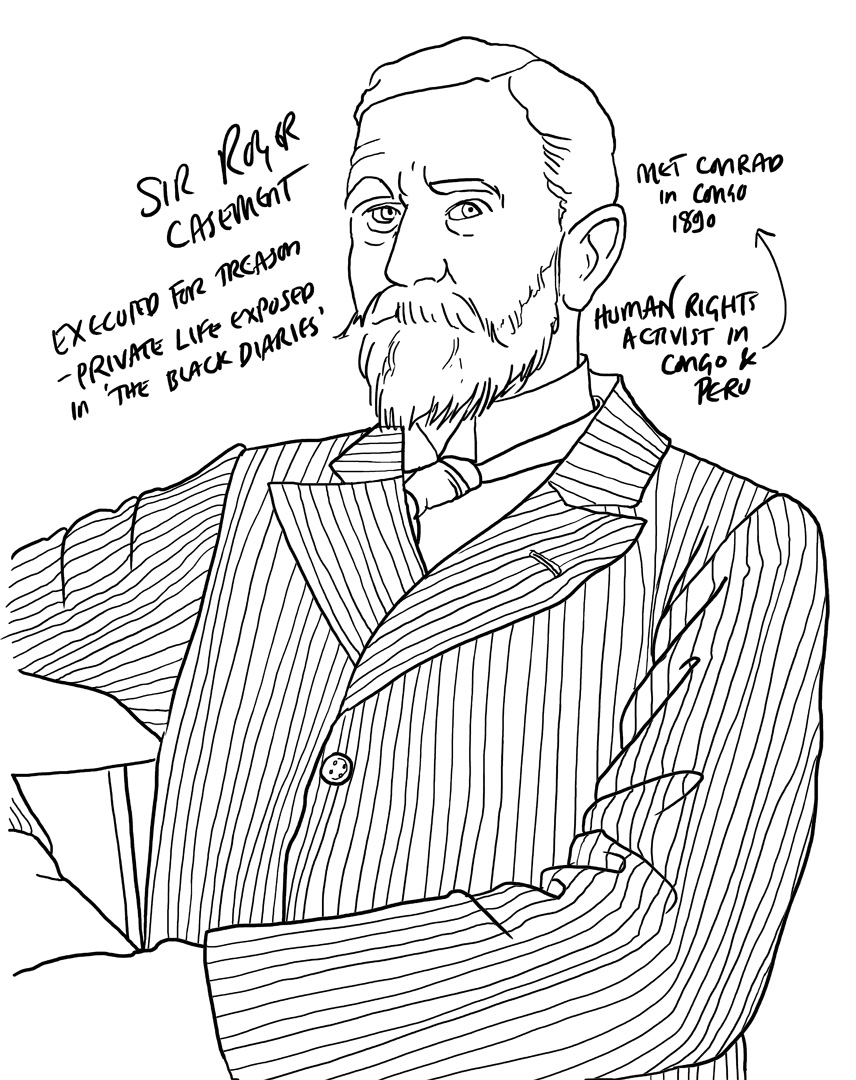
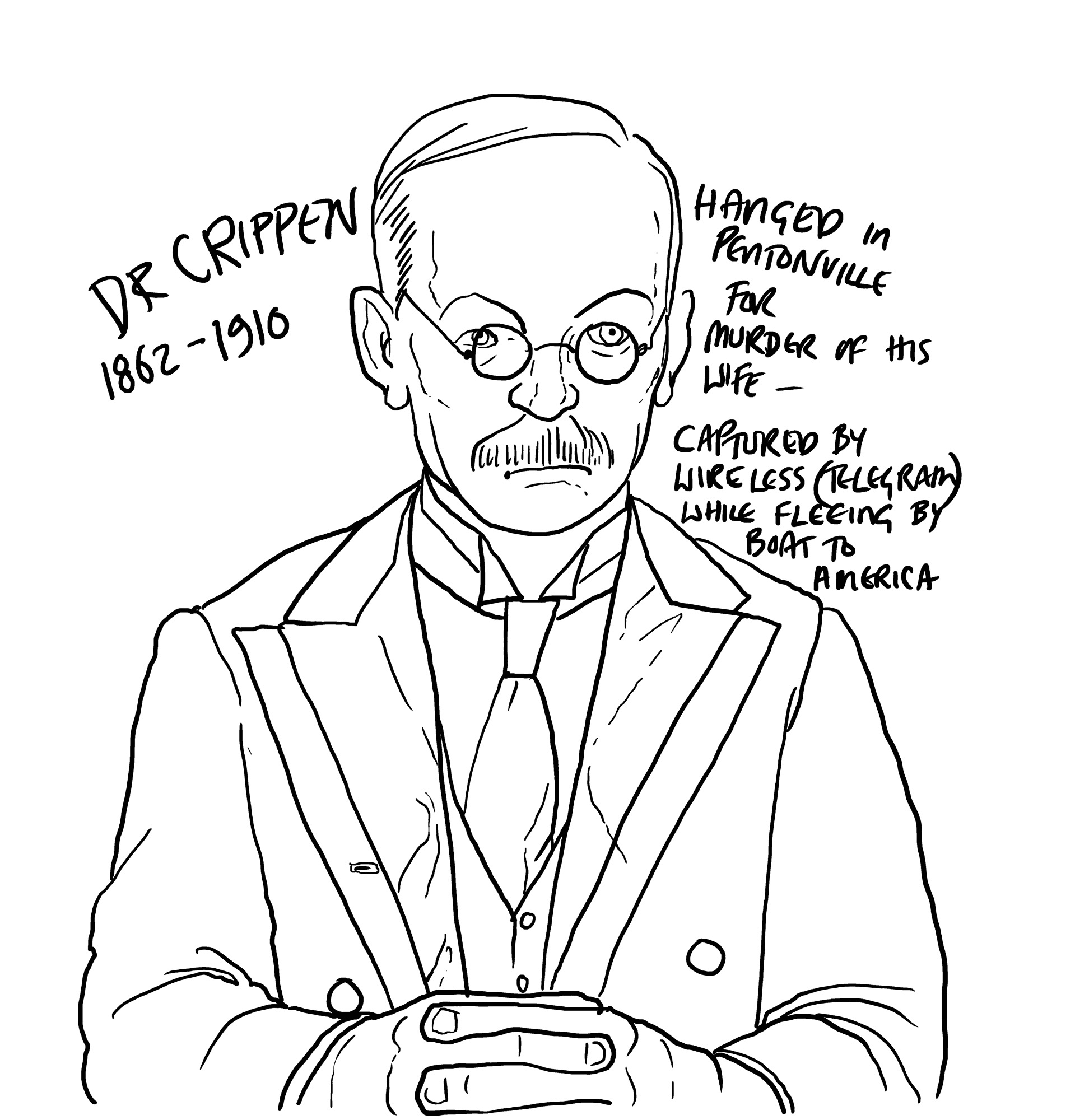
and here are some of the illustrations from the film:









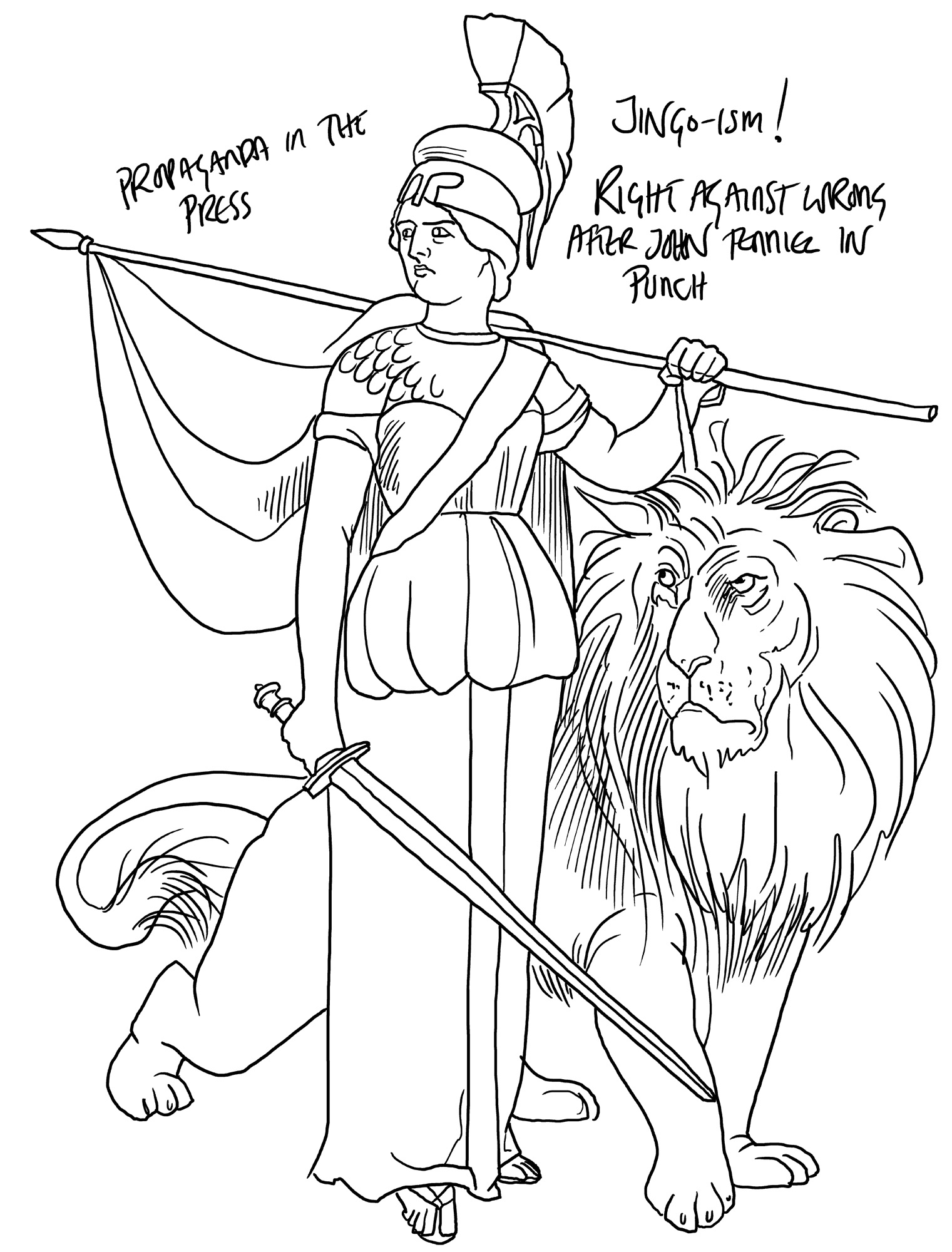


Here’s a scene from the Drury Lane production of “Oliver!” which sums up everything about the Music Hall, I suppose.
Here is the finished version of the title sequence:
early poppy sequences:
music by David Watson, used with kind permission
©David Watson, Kanon editions 2015
©Tim Wilson, Zontul Films 2015

here is the same scene with the correct background- in need of shadows but otherwise finished!
Here is an 8 second bit of animation. He still needs the tail coat and details, but the basic movement is now beginning to take shape. I have abandoned the 4th finger like Disney… It really does take up time to animate a 4th!!
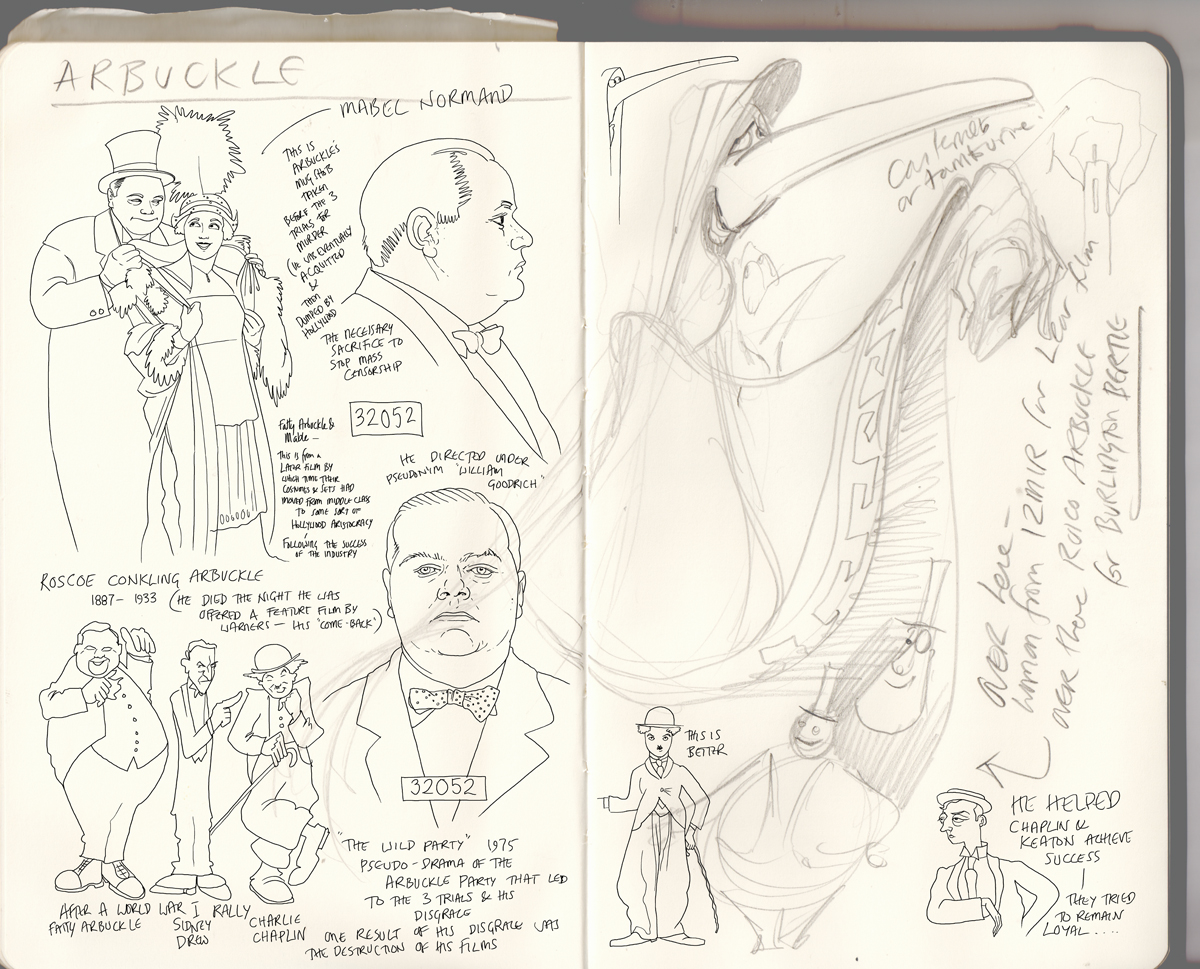
There is no real link between these two in reality but I love Arbuckle’s work – one of the great masters of silent cinema and treated appallingly by the early studios and by history. I think the shape of our Bertie and “Fatty” Arbuckle is similar. I need to make Bertie as agile frankly. Here is a drawing of a dance done by Arbuckle
and below is the progress reel for Bertie…
Regarding Arbuckle- there were plenty of other scandals that frankly were worse than anything he was involved in, and he was made the scapegoat for the industry at a time when moral crusaders, hot with the success of prohibition, had the “flickers” in its sights and probably planned to close hollywood. Arbuckle spent three weeks in gaol awaiting trial on a case that had been concocted by a woman known for racketeering, fraud, and extortion. Though acquitted of Murder after three trials, Arbuckle had admitted to possessing drink in a city that had a reputation for being fairly lax in applying the principles of Prohibition anyway. Under the Volstead Act, Arbuckle paid a small fine for the alcohol but I think that was sufficient in the end to damn him, and he was brought almost to bankruptcy by the legal expenses. Nominally innocent of the charge of murder, his films were, nevertheless, banned when he was credited by the Hollywood moguls as a man with “bad morals”, and less than a week after he was completely acquitted of murder in 1922, he was forbidden by Will H Hayes from working in cinema again. While he got round this and made a comeback of sorts in the 1930s, he died before he was able to fully realise his potential. This was a truly great performer and his treatment by the cinema industry was despicable.
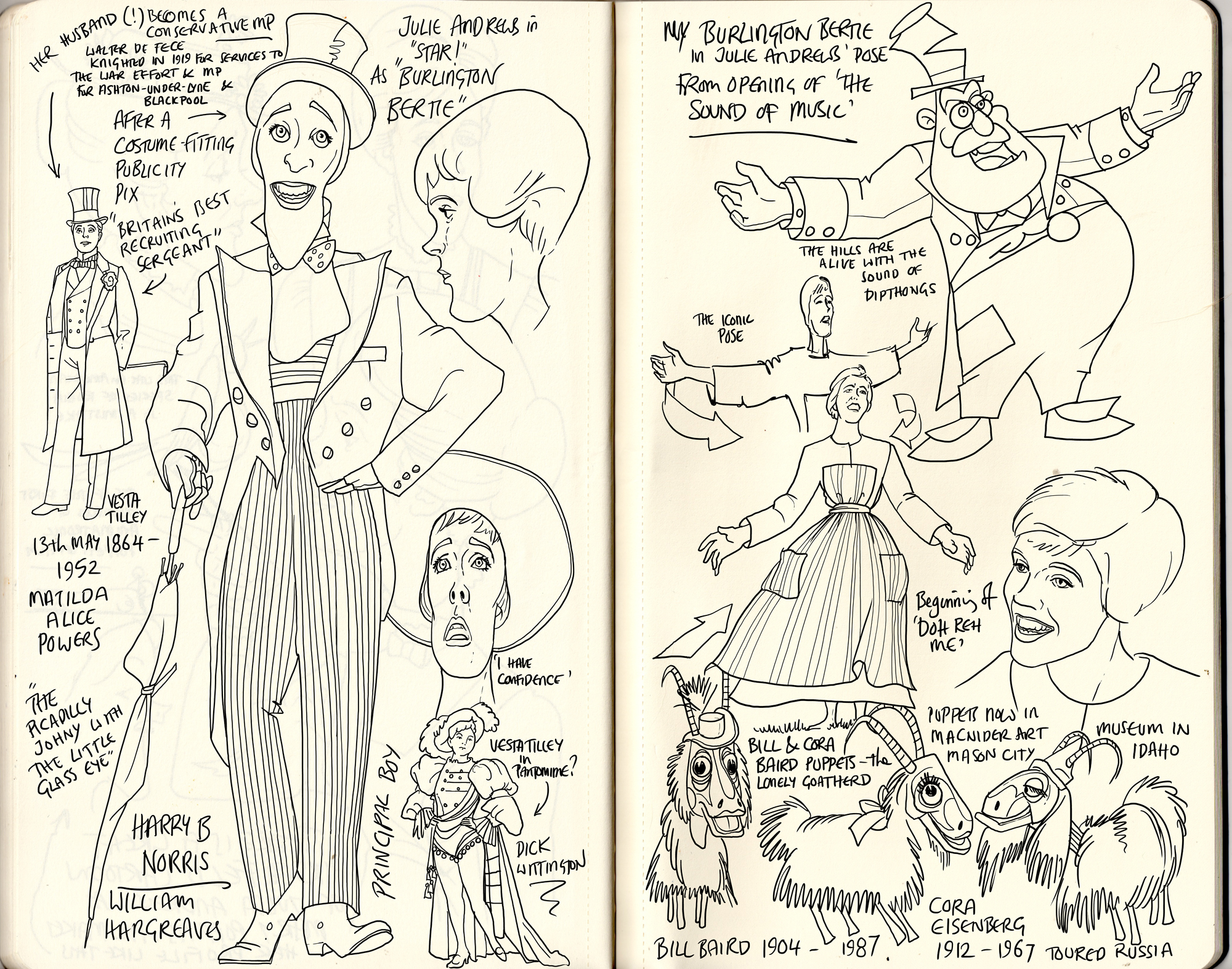
We are slowly getting on with the animation of our short film based on “the Music hall”. “Burlington Bertie” is one of two films, both of which feature a song by the first world war composer William Hargreaves in arrangements by David Watson of Kanon. Bertie is odd though because all the references in the song are to Queen Victoria and the “Prince of Wales,” Edward VII who had died by the time the song was even first performed by Hargreaves’ wife, Ella Shields in 1915. It was then later done by Julie Andrews in the film “Star”. When she comes off stage after singing the song for the first time as a pregnant understudy, one of the other actresses standing in the wings asks “how was that?” she says, “It was marvellous!” and that rather seals her fate- sacrificing a private life to the demands of her theatre-public (1968) The film, sadly- some of which was shot in the Hackney Empire where we are setting our own film- was not a great success but it has some great scenes in it! Well worth watching. The final number “Jenny” has an irritatingly repetitive lyric but Dame Julie is as game and joyous as ever. According to her memoirs (the very readable “Home”), she had been offered the part of “Lady in the Dark” early on in her own Broadway career but turned it down. I think she was worried about comparison to Gerty Lawrence, so it is ironic that she went on to do a bio-pic of her life.
Here is a colour snippet from our version of “Bertie”:
Now, this is the reason for the out-dated references: The “Bertie” song by Hargreaves is actually a pastiche of a much older song by Harry B Norris which was famously sung from 1900 onwards by Vesta Tilley, the darling of the lesbian set. The original song is fairly patriotic too with a great chorus that is well-worth repeating. Here is the end of the last verse and the end of the final chorus. Suddenly, reading this, you can see how the bunting would go flying and why Vesta Tilly earned such a reputation during the First World War!
Altho’ absent minded, he does not forget
That Englishmen always must pay off a debt.
He drops all his pleasures, the polo, the hunt
And just like the rest, he is off to the front;
Altho’ he’s a johnny, he’ll fight in the ruck,
He’s wealthy and foolish, but if you want pluck –
…
What price Burlington Bertie,
the boy with the Hyde Park drawl,
What price Burlington Bertie,
the boy with the Bond Street crawl?
He’ll fight and he’ll die like an Englishman.
Forgive all his folly we can;
Says old John Bull ‘I plainly see
These Burlington boys are the boys for me!’
There are a few dodgy lyrics though here- I hate the laziness, for example, of “always must” * but the rest is priceless! (*The inversion is clumsy- It’s almost as lazy as the lyric: “I just called to say I loved you”- the word “just” has no purpose there at all. It is included for the scansion alone.) The Bertie here is a Gent down on his “uppers”. He’s not from Bow, he’s from South Ken!
The Hargreaves’ version plays around with patriotism, too, and we will certainly make use of this in our animation- but it focuses much more on the idea that his Bertie, in contrast, is a “down and out” pretending to be a toff. There is alot of pride in this “tramp” too: The same stock character/characters, in effect, turn up in “Easter Parade” with a song by Irving Berlin. Check out Judy Garland’s “Little Titch” shoes here…a tremendous tribute to the music hall/vaudeville!
And for the potency of the tramp character in music hall, look no further than Chaplin!

and frankly, it is the same idea that we find in “Hello Dolly” when Cornelius Hackl, Barnaby Tucker and co elect to walk to Harmonia Gardens “because it is more elegant”. There’s a charming version of this song here:
The Lady Diana at the end of the Hargreaves’ song would be Lady Diana Cooper, not of course Diana Spencer.
Bertie comes from Bow which makes him a genuine Cockney. He is idle, drunk and smokes too much- he enjoys hobnobbing with the idle rich in the West End. This is a slightly different character to the one in the Norris song. In the original song “He rents a swell flat somewhere Kensington way” and has frittered away his inheritance on “Brandy and Soda”. But his biggest failing seems to be that he is always ready to help. When a girl wants a present she wonders “who can I touch” and along comes the rousing chorus,
What price Burlington Bertie,
the boy with the Hyde Park drawl,
What price Burlington Bertie,
the boy with the Bond Street crawl?
A nice little supper at the Savoy,
Oh! What a duck of a boy,
‘So free’ says she, ‘with L.s.d.,
Burlington Bertie’s the boy for me.’
The LSD line gets a new meaning I suppose after the 60s.
Below is a recording of the Hargreaves song with some very elementary movements and then follows a line test of the coloured version at the top of this post. I am afraid there is a long way to go…. I will add some updates soon and some images of the backdrops which are also coming along nicely!
(I am not sure how Bertie’s pose is actually “ironical”- I suppose because he is picking up fag ends from the strand and strutting around wearing a monocle. Maybe there is more to it than that? I welcome any observations!)
 animate-tim.com