The end of last year, Henry Astor asked me to do a title sequence for his film “Aubade”. He is an old friend and I was very happy to get involved. The film was beautifully put together telling the story of the making of a guitar, a song that is written specifically for that instrument and the performer playing it.
Here is the Youtube link and a screen capture:
The following frames are from an earlier version with a more elaborate font
There was an initial screening in the theatre at Chipping Norton where once we did Figaro- more on that very soon.
A truly great man and a charming person. I met him briefly while he was filming “In Love and War”, but I think my over-riding memory of him is as the Circus master in Dr Dolittle. This is a masterpiece of “putting over a song”. It is simply a joy from beginning to end. The 12 films he directed are solid pieces of work. Gandhi, a Bridge too far and Young Winston stick out as remarkable examples of good-old-fashioned crowd control. Chaplin gets a great performance from Robert Downey junior and Chorus Line is surprisingly effective though the subplot is distracting.
The picture above comes from a film I made about Interview technique. It can be found here:
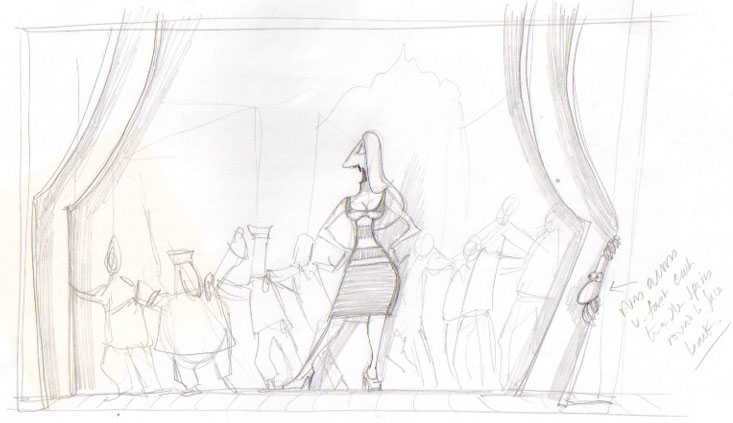
Much of the walk is hidden behind stage scenery, but the process of getting that movement right is still necessary. Two things emerged in the week- firstly trying to get a walk working makes some very odd shapes in a 2d drawing that perhaps would look very wrong in 3d, and secondly, drawing up background scenery, I realise how important it is to draw a building to fully understand it. So I have now spent 3 days struggling with Big Ben and the house of Parliament. One thing I should add is that animation is genuinely easier with Toonboom/ Harmony, but these big tracking shots remain tough.
Pugin
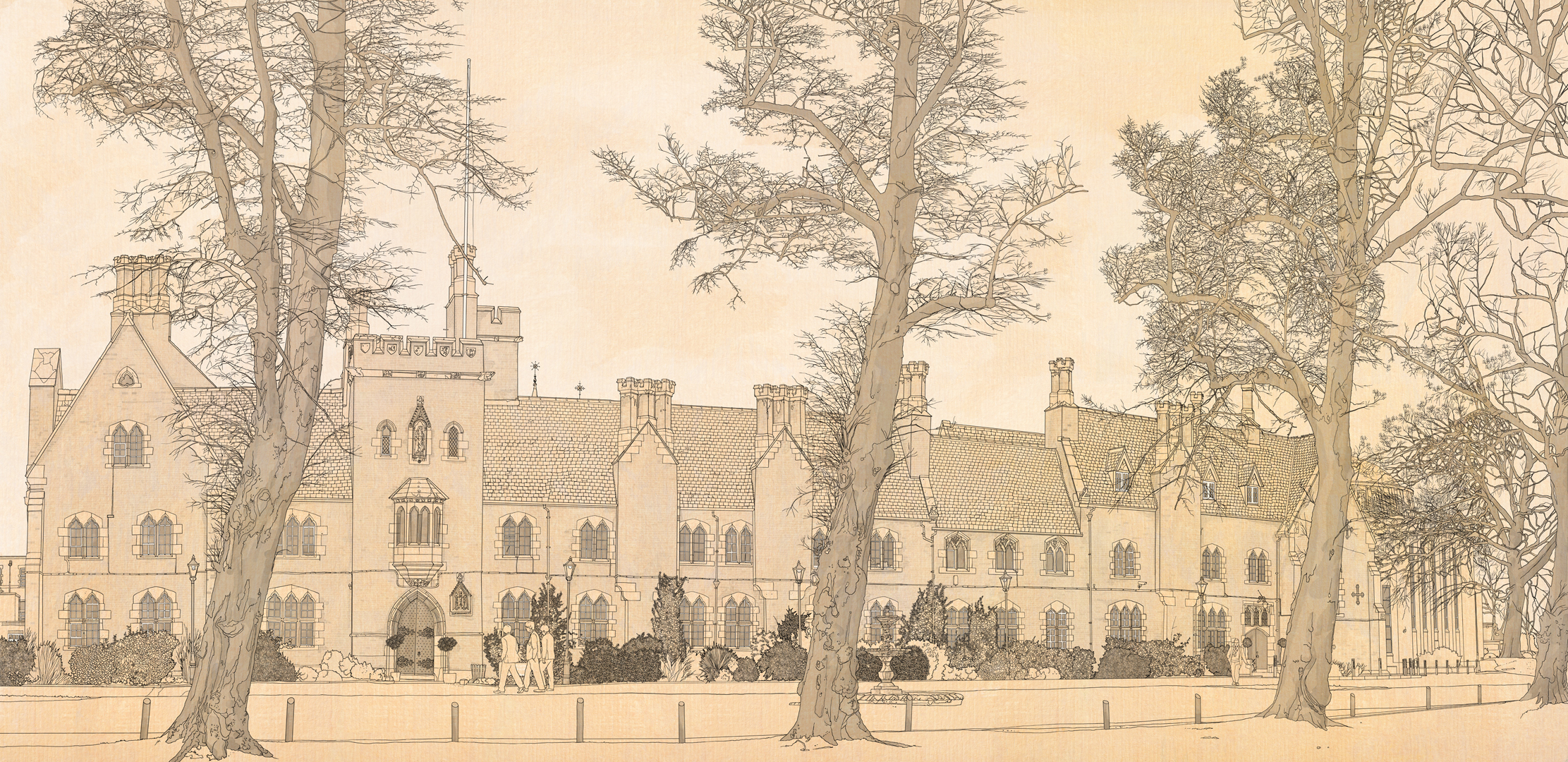
Pugin provides such complexity. Next week we are off to Ratcliffe to sketch the new prep school that is being built there. Oddly, the architect is a distant relative of the original Pugin. It is some sort of poetic justice. Here is an image of the cloisters at Ratcliffe and of the Pugin facade. I will post images of the new Prep school shortly of course.
Here is an icon of Photios, sometimes called Photius in the West and Saint Photios the Great in Orthodoxy
.
3 files about Homosexuality in the Bible: links below
We have just finished a new educational film about the 6 texts used in the Bible to condemn homosexuality.Because it is only 40 minutes long (it is divided into 3 parts on youtube) Below are parts 1 and 2:
Part 1:
Part 2:
I am afraid there are a number of glosses that i have made and which I will try to correct here over a number of blogs. I am aware that I have not really done justice (slight pun) to the text by Photios that is the lynch-pin of the main argument in the film. The issue I am discussing here occurs in the third part on youtube and the link to that part is here.
Part 3:
What Photios says
I have provided the Greek text of what Photios writes on the film, though it is on-screen fleetingly-
so here it is again:
Photios was very interested in the way Greek changes over the years from the various forms of Ancient /Attic Greek used by Homer to the Greek of the Septuagint and then the koine used in the New Testament. Photios was familiar on a day-by-day basis with the Byzantine Greek of the Imperial court and the Church but there was probably yet another more colloquial version of that in the streets of “the city”, H Polis.
Colwell’s rule
So his greatest work is probably his lexicon, which has helped scholars today to work out how words have changed their meanings and how Greek grammar has evolved. This is particularly important if you want to avoid the nonsense of the Jehovah’s Witnesses who wrongly ascribe at best an Attic grammar to the New Testament and at worst some inexperienced mumbo-jumbo. I met a man today who was sitting by the canal reading a bible. I asked which version and he said “the New World Translation”. I could not get away fast enough! There are endless errors in this Jehovah’s witness text, some simply bizarre- like the use of “torture stake” for “cross” because the Jehovah’s witnesses do not accept that Jesus died on a cross and the refusal to translate any words for hell because they do not believe in hell either. Anyway, the crucial passage is John 1:1 (in every manuscript except Codex L which has ὁ Θεός ἦν ὁ Λόγος)-
The Greek:
here is the correct version:
Ἐν ἀρχῇ ἦν ὁ Λόγος, καὶ ὁ Λόγος ἦν πρὸς τὸν Θεόν, καὶ Θεός ἦν ὁ Λόγος the last phrase of which is in Greek a form of Yoda-speak:
“And God the word he was” or some such “Star wars” jabber.
But it should be translated: “the word was God” but is translated by the Jehovah’s witnesses as “the word wasa god”. Origin thinks that John omits the article because he refers to Jesus as God and not to the Father and Origin argues, “the true God is Ho Theos” (Commentary on John Book 2, chapter 2) which comes close to the Jehovah’s witness position of denying the Trinity, but not quite. Later scholars absolutely reject this: Bultmann, for example, is incandescent at the thought that the omitted definite article means only or merely “divine”: Denn man kann doch nicht verstehen: er war ein Gott, ein Gottwesen, als ob θεός ein Gattungsbegriff wäre- (he thinks, instead, that the word THEOS has some special grammatical rules of its own) but there is another solution.
Here it is:
In koine greek, though not in Attic greek, there was an increasing temptation to omit the article when a definite noun (a name) precedes the verb or when a noun should be identified as the predicate.
This is often called “Colwell’s rule” and other instances can be found in Mark 15:39 and Matthew 27:42-
βασιλεὺς Ἰσραήλ ἐστιν.
The rule can be adjusted slightly because the “anthrous” noun, that is a noun without a definite article, can sometimes (as maybe here) simply be a way of establishing importance or prominence. The purpose of this paragraph is not so much to rebutt the Jehovah’s witness but to demonstrate that Greek was at the time when the New Testament was written in a state of flux and that Photios understood this.
In his commentary, therefore, on Romans 2, Photios considers Paul’s use of words very carefully and concludes that Paul was being specific about a particular part of the law/ the Torah.
Tracking down the fragment
Only a fragment of this commentary exists today and is found in a collection of patristic fragments so it is itself a bit obscure. I managed to track down the text but struggled with the translation and called on an old friend in Athens who sent me off to see a man he called Bill who turned out to be the same man who had first “discovered” the text and published a small article on it in the early part of this century. When looking at obscure texts, the chances are that you are dealing with just a handful of people who know about them, translate them and use them. So, I had a fruitful and entertaining correspondence with Professor Bill Berg, the very man responsible for digging up this brilliant little gem. For my part, I was struggling with elements of the paragraph which seemed to me to be deeply anti-semitic and he agreed. So that was that. They are not important to the argument but they suggest that the man who was writing was doing so quickly and with alot of passion. It is not really surprising that this was the man who single-handedly fractured the Church. Many Catholics today dismiss the “filioque” dispute as a linguistic quibble and I remember having a long debate about this over a few weeks in the letters page of the Athens News, but the Greeks and Russians still regard the issues in the filioque as central to their decision to perpetuate the schism. For Photios and the modern Orthodox one of the central issues of the filioque is its origin in the writings of Augustine and this itself taints the theology of Augustine for the Orthodox.certainly. I think this is why there is a slightly different understanding of “original sin” in the East. In the film, I make reference to a number of “Church fathers” among them St John Chrysostom and St Athanasius.
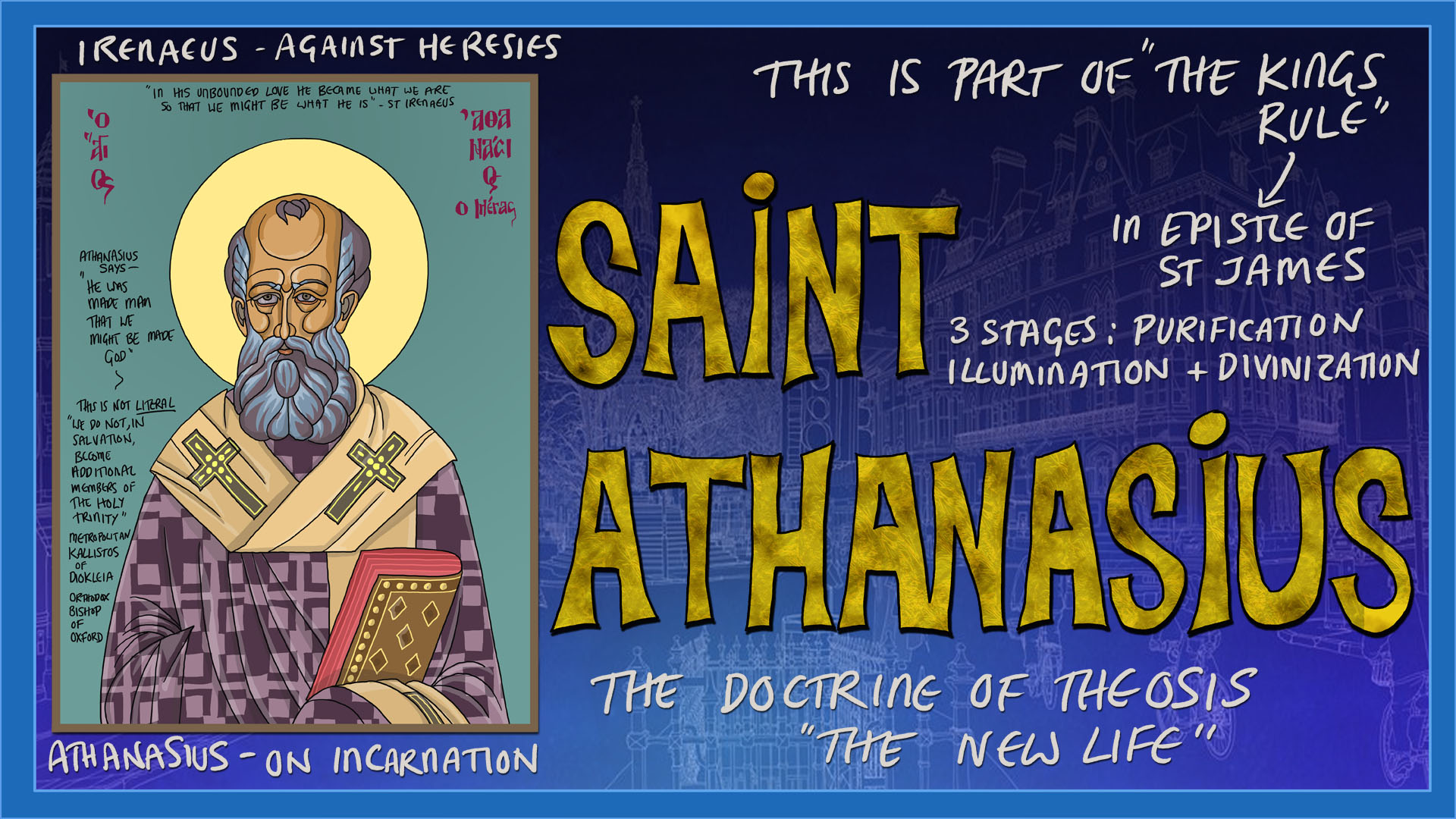
Here is St Athanasius:
St John Chrysostom who wrote the text used for the Liturgy every sunday in Orthodoxy has also got a reputation for intollerance. This needs more examination, and again may need to be put in context.
Romans 2: 26-27:
Back to Romans. The verse Photios is considering is Chapter 2. 26-27.
So, if a man who is uncircumcised keeps the precepts of the law, will not his uncircumcision be regarded as circumcision? Then those who are physically uncircumcised but keep the law will condemn you who have the written code and circumcision but break the law.
Photios says about this:
(Photios’ words in brackets here)
“for the Jews, (them) Paul (he) talks about the Torah (the law); for the uncircumcised, he talks about the ‘justices of the law’ not the whole law but only a specific part.”
Photios has not quite gone all the way but it can be demonstrated by statements in, for instance, the beginning of Luke when Luke describes Zacharia and his wife keeping “all the jobs and justices of the law” that there are two different parts to the Torah and that these two parts were acknowledged as such at the time of Christ. Things change when the Temple falls in AD 70- and Judaism redefines itself as rabbinic or Pharisaic Judaism so this may explain why such a distinction gets lost.
The Golden Rule is the King’s Law
“The Golden Rule” (to love one another), broadly speaking, is that part of the Torah which is endorsed by Paul as central to the Christian life and is also flagged up by Jesus. Let me explain!! The measure of our relationship with God is to be found in our relationship with one another. This is defined by Christ in the Golden Rule, (Mtt 7:12: Πάντα οὖν ὅσα [a]ἐὰν θέλητε ἵνα ποιῶσιν ὑμῖν οἱ ἄνθρωποι, οὕτως καὶ ὑμεῖς ποιεῖτε αὐτοῖς· οὗτος γάρ ἐστιν ὁ νόμος καὶ οἱ προφῆται.) but it is also found in Hillel (Shabbat 31a: What is hateful to you, do not do to your fellow: this is the whole Torah; the rest is the explanation; go and learn) and is embedded in Lev xix 18.
In the epistle of James, this is called “the Kingly law”:
Now, a “kingly law” was regarded in the ancient world as something that took precedence over any other existing laws. An example of this can be found in Pergamum (Deissmann) but the idea is fairly straightforward. If Christ had issued the Golden rule as a “kingly law” then that takes precedence over anything else in the Torah. The Golden rule is to deal well with others. It is not about cultic practice. In other words, the Gentile might well be able to keep the “kingly law” (which sums up the whole Torah anyway) in the knowledge that he can not keep the Torah itself. This happens at a time when elements of Pharasaic Judaism were perhaps getting out of control. People were indulging in the cultic observances as a way to make up for their failing with one another. David Wood suggests that this is the kernel of Paul’s message- that no amount of cultic obedience can erase offences to the Golden rule. That is paramount and trumps the cultic laws, because the “kingly law” is absolute.
In terms of the two types of law, and here I think the film does an adequate enough job in part 3:
Homosexuality falls into those laws defined as “cultic”: rather than into those laws that support the “Golden Rule”, what Wood calls “the Justices”. Paul might not like Homosexuality (personally) but he does not think it is something that will damn someone to eternal death, particularly if they are mindful of the Golden Rule. What is damning instead is nastiness, and spite and I suppose writing hateful things in a blog. We must be nice to Jehovah’s witnesses when they knock on the door. Be nice but do not necessarily agree with what they say. Islam!! When I began this study, I fully intended to broaden the film with an episode about Islam, partly because I had heard of a (mostly underground) gay mosque in Paris. There is a big debate in Islam about toleration. I think it comes down to three verses from the Koran which I shall print here: The first is from Sura 5.51 which says that Muslims should not be friends with people of other faiths, specifically Jews and Christians.
In other words, if you are confident enough about your own identity, it makes sense to befriend others who either reject that identity or who do not share it. The more we talk with our “enemies”, the more we both learn.
Conclusion
Nothing comes from prejudice and hatred.
A Political postscript:
drawing from earlier this year: debate on Question time about the impact of Gay Marriage:
Humanitarian Mosque
It is worth checking out the following link which is about a “humanitarian Mosque” in South Africa catering to gay muslims. My own instinct is that such division should be unnecessary but the fact that this debate is opening in Islam tells us just how progressive the religion has become. At the same time, of course, there is also all the nonsense promoted by ISIS. It is salutary to think that at the same time that the Crusades were being waged in the name of Christ, there was also St Francis of Assisi. Maybe the fact that the latest Pope has taken the name Francis is a reason to hope for more tolerance in a world that has gone a little crazy.
Gilbert and Sullivan is about as cartoony you can get- though Offenbach comes very close. I think animation probably lends itself to music that has distinctive rhythms and an interesting orchestration. The words seem to me to be less important than what is happening musically. Though of course the words tell the story. When the Disney people were animating “Fantasia”, the better animators trawled the score to identify the incidental tunes that lay under the main melody. There is a sequence in the Chinese dance in the Nutcracker where Art Babbitt has talked about “those nasty little notes underneath”. But Babbitt uses those “nasty little notes”! It is precisely this fact that makes the sequence stick out as something remarkable. Culhane references this in his book on Fantasia. It is worth looking at the dance in detail because the perspective goes all over the place and it still seems logical. In the same way, the instruments used to orchestrate a particular sequence will dictate a particular image.
Eric Goldberg animates on the beat and repeats a rhythm with the Carnival of the animals in FANTASIA 200o and Andreas Deja does it too in the same film with the barrel organ in Rhapsody in Blue. But I think Babbitt’s mushrooms still have the edge precisely because they take note of the intricacies of the orchestration and the repeated visuals (a visual ostinato) are not necessarily based on something obvious…
You can find a link to it here: (the interesting points are at.46 and the bow at the end)
and here is the flamingo scene by Goldberg:
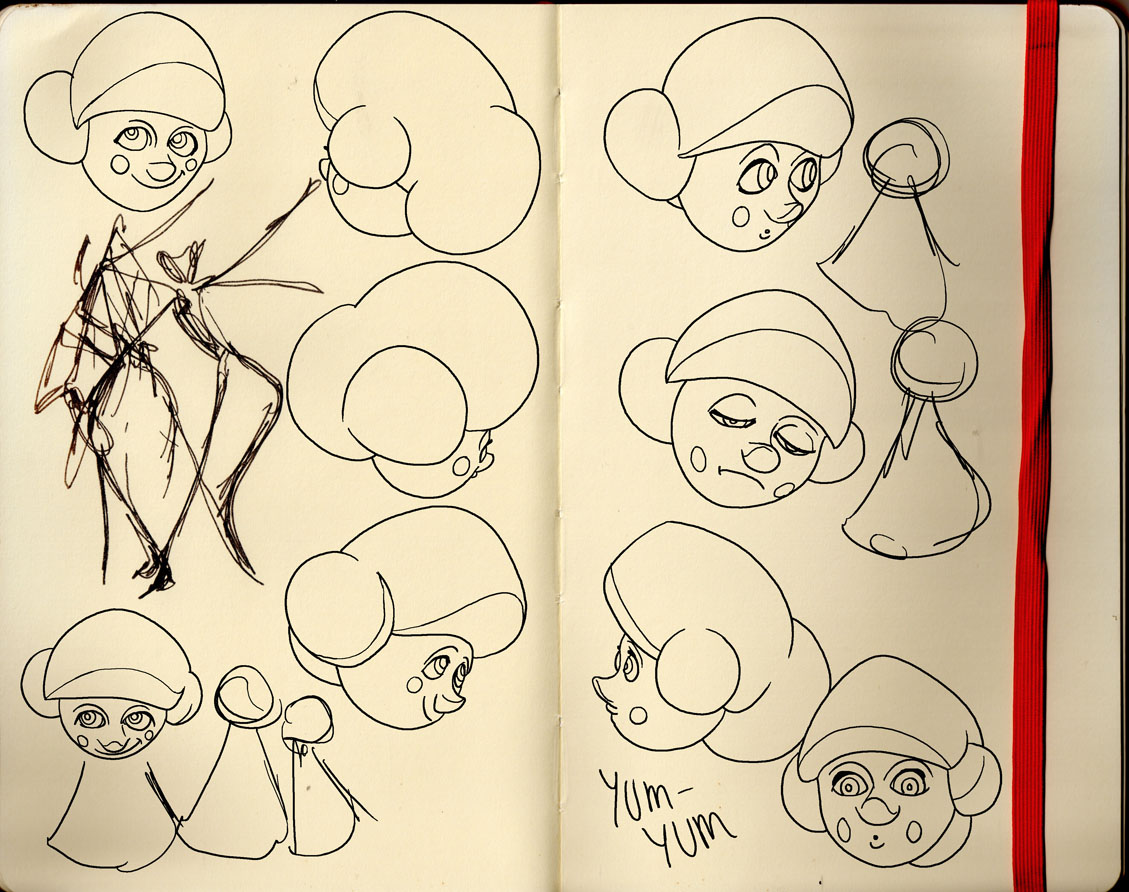
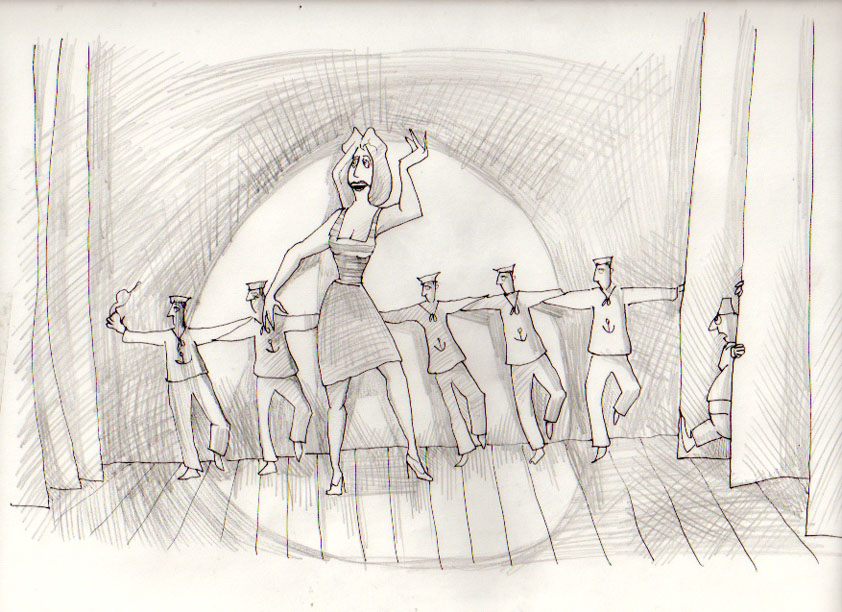
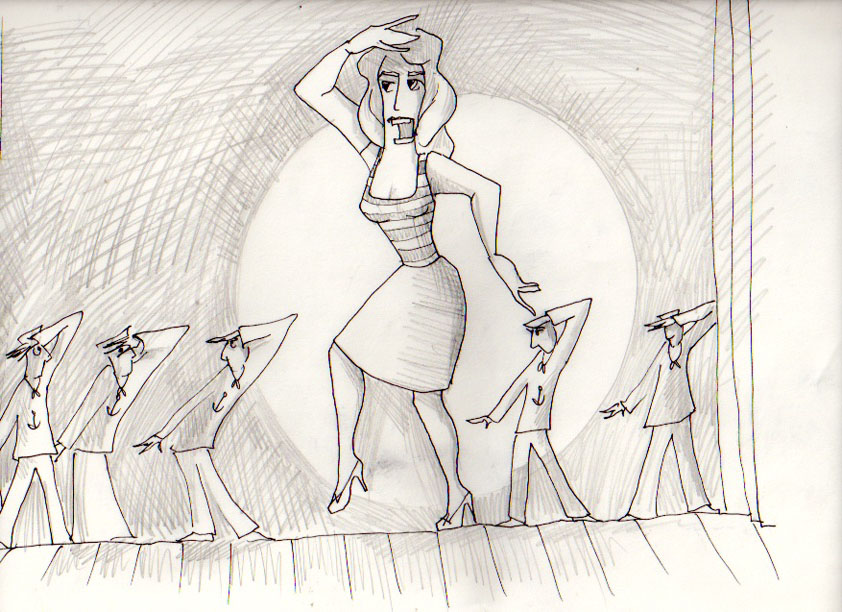
I was playing around with the Three Little Maids from School piece at the beginning of the MIKADO.
This is the text: “Three little maids from school are we,Pert as a schoolgirl well can be,Filled to the brim with girlish glee–Three little maids from school.” David Watson has done a very clever arrangement.
I will post more on this shortly because it is an excellent example of a tune that does a great deal. The three voices (Yum yum, Pitti Sing and Peep Bo) are quite distinctive and the whole thing gallops along at quite a pace. Here are some sketches mostly of Japanese hair-styles…
Below is a page from the notebook on Trial by Jury the storyboards for which move slowly forwards…
Μελίνα Μερκούρη (amaelia) made her name in the west with “Never on a Sunday” and “Topkapi” but she was also a staunch campaigner against the Greek military Junta in 67-74 ending up as an MP in the Greek Parliament and the PASOK minister for culture. Her statue, or rather her bust, is at the entrance to Plaka, opposite the temple of Zeus in Athens. It is an odd piece of work and I drew it a while ago. I am afraid the notebook is now overwritten with things about Victorian poetry but the statue comes out fairly well.
The “Elgin” Marbles
During her campaign for the return of the Elgin Marbles, all captured on the evening TV news, unfortunately, she began weeping in the wrong part of the British museum and needed to be guided to the Duveen gallery where she wept again with passion to protest at the theft of these great pieces of Greek Art. Elgin acquired the marbles between 1799 and 1805 from the Ottomans who were, at the time, in overall control. It can be argued that the Ottomans, though legally in possession of Greece, could therefore sell the sculptures to whoever wanted to buy them. However, the moral case is less clear: the Ottomans twice used the Acropolis as a weapons depot and twice saw bits of the monument blown sky-high, once in 1687 and then again during the war of independence when, to stop the Ottomans’ further destruction of the site, and their attempt to take the iron from the columns to melt into bullets, the Greek armies offered to give them ammunition. The whole Acropolis, frankly, was in danger of destruction as the war inched towards the capital and Elgin can be seen as the saviour, rescuing great art from the jaws of bellicose chaos.
Elgin’s plans:
Thomas Bruce, the 7th Lord Elgin planned for the marbles to undergo extensive restoration but the Italian sculptor Antonio Canova refused to do the work. Elgin’s return journey was disastrous. He found himself repeatedly arrested by Napoleon as he tried to get back home. Some of the marbles sank near the Greek island of Cythera on the voyage back to Scotland. The rest were later bought by the British parliament from Elgin in 1816 and presented to the British Museum under the particular Parliamentary directive of the Local and Personal Acts 56 George III c.99 of 1816.. Other museums with bits of the Acropolis include: The Louvre, Copenhagen National Museum, Wurzburg museum, the Vatican, The Kunsthistorisches Museum in Vienna and the Glyptothek in Munich. The marbles in the British Museum are held under an act of Parliament from 1963 (the British Museum Act) which prevents the museum from permanently loaning any objects that are unique or that are not considered “unfit to be retained and can be disposed of without detriment to the interests of students”. The debate about the sculptures is ongoing and fairly heated, but I think the fact that there are other pieces elsewhere weakens the British claim to be housing the marbles in a way that guarantees access and comparison with other works. While other museums retain pieces, though, the argument by Athens for repatriation is also weakened. A loan would be reasonable, but I think the intensity of feeling about repatriation means that it would never be a temporary loan and so would be illegal under the terms of the 1963 act. The Elgin collection is more than just the Parthenon marbles- there is a large scarab beetle from Istanbul and some Egyptian stuff as well as some bronze tableware and jewellery. Duveen was an antique dealer involved in a dispute about “La Bella Ferronniere” and a number of fakes in his collection. The Duveen Gallery was designed by the american architect John Russell Pope. Much of Duveen’s work was about selling fine art to America and his trade forms the core of the great American Museums’ various art collections.
It is very unclear why Elgin was granted the firman that allowed him to take the marbles in the first place. The general understanding is that this was a personal mark of gratitude by the Ottoman representative in Athens for Elgin’s help in the Ottoman war against the French that had been going on in Egypt. In fact, two such permissions were granted. The first in 1800 and the second to Sir Robert Adair in 1810. As a rule, the focus tends to be on the first firman which survives only in an italian copy and which has been argued particularly by a professor in Crete not to be a firman at all. It was this firman, after all that formed the basis of Parliamentary approval to buy the marbles, though they not only did not have the original Turkish Firman; they did not even have the italian copy. They simply had an english translation that the Rev. Philip Hunt insisted was genuine. It is not at all clear which of the three documents was signet by Seged Abdullah Kaimacan. Much of the debate in parliament, anyway, was about whether the marbles were genuine or simply Roman copies of the originals. An english writer claimed at the time that an Ottoman official tried in vain to stop Elgin from taking the marbles.
Byron
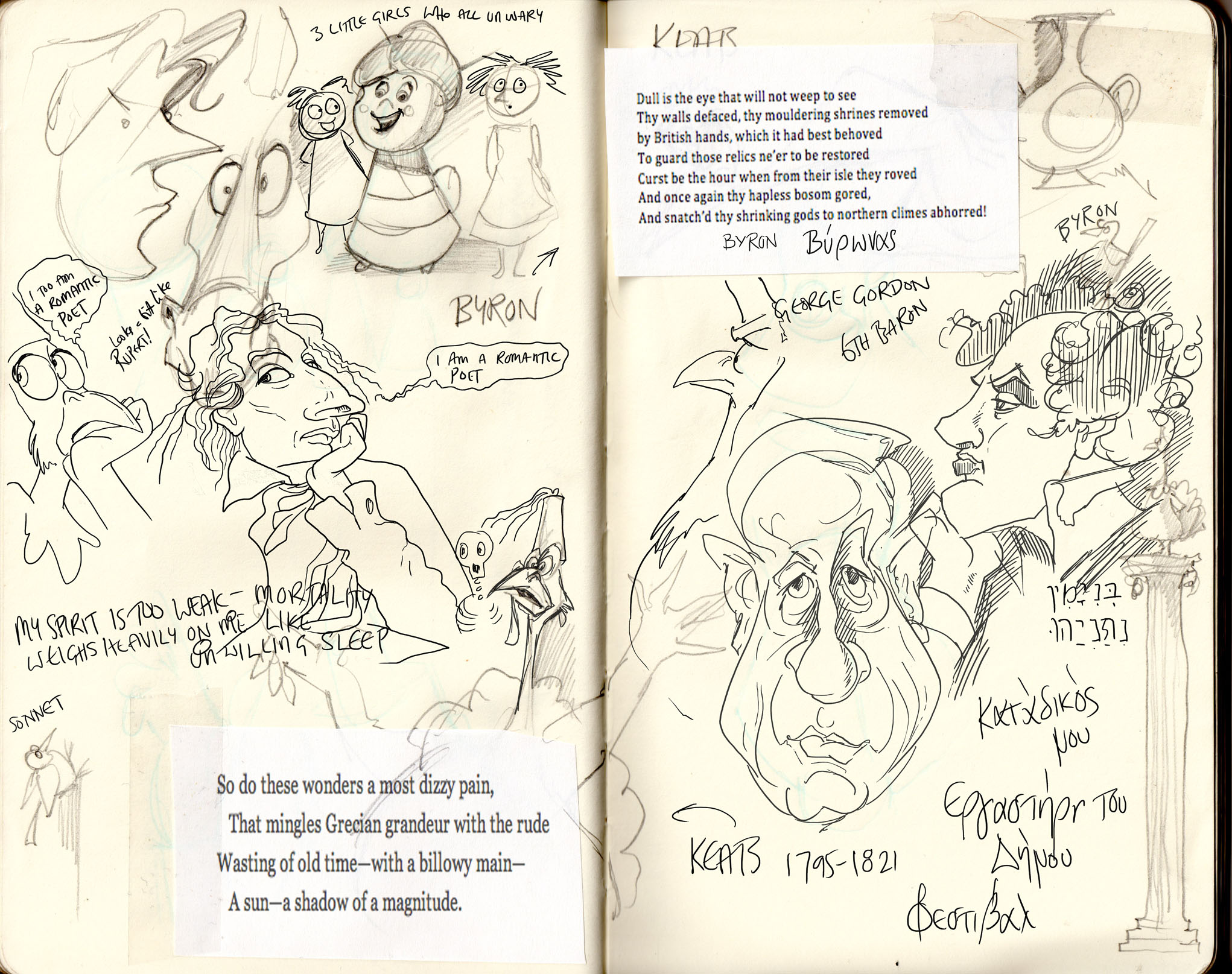
There were protests about the sale of the marbles from the very beginning. Here is an extract from ‘Childe Harold’s Pilgrimage’. There was also “the Curse of Minerva” which was never intended for publication in the UK. Keats, however, also writes about the marbles but only after seeing them in London and while he writes two poems specifically about the marbles, their inspiration leads to the Ode on a Grecian Urn and his idea about “truth and beauty”. I think he must have approved of the sale as did Goethe. When Goethe saw the marbles in London he claimed ‘the beginning of a new age for Great Art’. Certainly the marbles were deeply inspiring.
Cleaning the Marbles
There was the original method of severing the frieze from the walls of the Acropolis itself. The architect hired by Elgin for this task, an Italian man called Lusieri, confessed, “I was obliged to be a little barbarous”. But the most worrying bit of the Elgin/Parthenon marbles story is the cleaning of the frieze in 1938 in preparation for the move in London from the Elgin gallery to the newly-built Duveen. Over a period of 15 months, copper chisels and carborundum were applied to the sculptures to clean them. The man in charge, F.N. Pryce and his assistant, Roger Hinks, both of whom promptly resigned, seemed to think that the appropriate colour for the marbles was white and, therefore, they made an effort to get rid of the yellow/brown patina. The story did not come to light until 1950 when an Italian, Cesare Brandi, published a critical report about cleaning Classical pieces in general. Later, in 1984, the diaries of Roger Hinks were published detailing the cleaning process and, in the same year, the Greek government renewed a demand first made by Hugh Hammersley in 1816 for the repatriation of the marbles through UNESCO. The request was formally rejected by the British Government in 1984, and further demands were made in 1985 and 1997. It remains the position of the British Government (as stated by Tony Blair in To Vima in March 2001) that the marbles should remain in London and should be accessed by the public free of charge. There is a detailed account in Christopher Hitchens’ book TheElginMarbles – should they be returned toGreece? (1987). A later book, Lord Elgin & the Marbles (1998) by William St Clair makes use of restricted papers about the Hinks/Pryce cleanup which led to a conference in November 1999.
Now, all of this sounds fairly catastrophic until placed in context because the Greeks used a similar cleaning process on the Hephaisteion in 1953. In addition, the Athens pollution has seriously damaged the existing sculptures: Olga Palagia writes in The Pediments of the Parthenon (Brill Leiden, 1993) that, when sculptures from the west pediment were removed in 1977, “the industrial pollution of modern Athens had wreaked havoc upon their delicate surface”. A paper by I Jenkins (Cleaning and Controversy) deals with the whole sorry subject.
There have been two modern Greek positions on the marbles and that is unfortunate. The first was a suggestion of a joint and permanent exhibition in Athens. This would have recognised the moral authority of the original sale to Elgin while allowing that the marbles might be better viewed in the context of their original setting in Athens. The second was a demand for the return of the looted property of the State. Anything else would, said Antonis Samaras for the Greek government in 2009, “condone the snatching of the marbles and the monument’s carving-up 207 years ago.” This was an uncompromising and rather silly posture that effectively makes the repatriation of the marbles impossible in the near future, because any arrangement would imply that the British government in the early 19th Century was covering up a crime. The issue of the legality of the sale was in fact debated in the House of commons before the marbles were ever bought from Elgin. I think if there had only ever been a single Firman (permission) granted by the Ottomans, then the sale would not have been recognised as wholly legitimate. But there were two. Even so, Elgin demanded just over £70,000 and received only £35,000 from parliament. This was not a profitable venture and the acquisition of the marbles effectively bankrupted Elgin.
Many years later, on June 21st 2009, the new museum in Athens, designed by Bernard Tschumi, opened. The empty spaces along corridors housing the Parthenon frieze provide a reason and an urgency for reuniting all the various parthenon marbles, as indeed the museum’s initial director, Dimitrios Pandermalis, fully intended. the spaces in the exhibition amount to cultural blackmail, and it is effective.
The Future:
I think now, however, as the various personalities dig in (the British Museum’s director Neil MacGregor, would not countenance any return when the Athens’ museum finally opened), there remains only one course of action available. In the next few years, Britain should lend the Athens museum a piece of the Parthenon frieze and only when it is duly returned to the UK, will there be a general sense of reassurance about the legal ownership of the marbles. At that point, and it might take an act of parliament to arrange this with the present trustees of the Museum, a much bigger portion of the collection might then be packed off to be displayed in a semi-permanent format in Athens.
Our Film, Following Lear:
Anyway, Melina Mercouri’s character, Ilya, in “Never on a Sunday/ Ποτέ Την Κυριακή” is the basis of one of the animated characters we have devised for the Edward Lear Film – though in the song, she is married and has “lost” her husband. David Watson has written a sensational bit of music to the Lear Limerick about “an old man of Corfu” and Vassilisso Vasilinho wrote the very funny words in Greek. Katerina Tiropoli did the voice and Duncan Skinner did the english voice- he will be a “Bud Flannigan type”. Here are some initial drawings of the Melina Mercouri character..
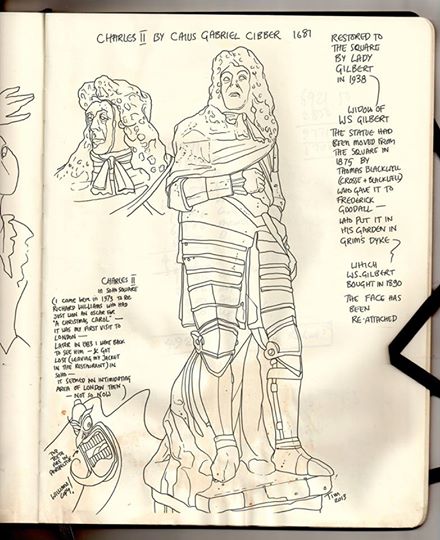
In 1972 I wrote to Richard Williams and was invited to visit his studio. I think I also sent him some artwork. It would have been about this time that a kind lady was also trying to arrange an exhibition for me I learnt recently, so I imagine I was doing fairly well as a little 11 year old draughtsman and impressing more people than I realised. Certainly, it took years to get back to the dynamism and accuracy of those early days partly because I was consistently bullied by the art teacher at school. I was called names by this man, had my work ripped up by him, and was consistently slapped down with words like “slick” and “easy” which I understood then to be criticisms but which today I would accept as some sort of defiant badge of honour. Anyway, this is not meant to be a whine, but more an excuse to think about what I got out of this process. The most important thing is some sort of resilience and determination to keep going whatever happens – that is useful for any animator as Williams testifies. Also, I think this is the source of my interest in teaching- the subject matters not a bit as long as I think I can master it before the lessons begin incidentally, but the desire to ensure that no child is treated as I was is fundamental. Many children are talented. We,as adults, need to harvest or harness those talents.Talent is not really like a plant. It may survive but it certainly does not thrive or grow if you throw alot of shit at it!
I had seen Williams on a childrens’ tv programme called “Clapperboard” and he was shown drawing one of the brigands laughing. I loved the way that the character moved as he laughed. It was subtle and in close-up, but there was clear movement and character. The laugh was something he had recorded himself and I believe, now, that the animation was loosely based on one of the imps in Sleeping beauty. But there is no disguising the mastery. The hand movement on this sequence as the brigand laughs is exquisite and I have looked at it in some detail- Williams draws hands like no one else. This character is now one of many brigands in the second half of the “Thief”.
The sequence is marked by a change from pen and ink outlines to wax pencil outlines that were used also on “Christmas Carol”. At the studio, I was given one of these pencils and some cel and told to draw something which I did, but I was very nervous and I found it difficult. The waxy pencil is easily smudged and is only truly bonded with the cel when it is exposed to hot light under the camera. I should imagine though that the cameraman was forever cleaning the glass panel that holds the animation in place. I think I may have tried using some paint. I am not sure, but I got to use paint later on working for “Wicked Witch” in the late 1980s as they wound up work on “Roger Rabbit” and took on project after project that aped the animation/live action combo style, or simply tried to look computer-generated ( some of the Waterboard adverts that accompanied one of the waves of Thatcher privatisation, for instance which were all actually drawn in coloured pencils on cels that had been sprayed with a formula that made them sufficiently textured to accept the crayons. The same method was used in the Snowman, Father Christmas and the Beatrix Potter films at TVC)
My trip to 13 Soho Square was a day that must have changed my life or at least given it proper direction: in the evening, so excited was I that I vomited with gusto on the train and over my mother’s handbag. I knew then, maybe from some kind of Rorschach test, that I had a vocation to draw animated films. I remember meeting the great man on the stairway in front of what must have been one of his own oil paintings. I draw no parallel at all between my vomit and his painting though I have no real memory of the visual content of either. His picture all looked very dark and grand to me. Animators upstairs flipped scenes that I think I knew even then were from the projected film of “Nasruddin”- I am pretty sure that I saw the thief bouncing from one canopy to another. that was also in the finished print we saw on Sunday. I had seen pirate versions of this on youtube and the australian DVD where it seemed a bit repetitive. In the NFI theatre, with a crowded audience, it looked wonderful. This is broad slapstick and it always needs an audience to get the most out of it!
Later, I went back to the studio a few times and had a delightful dinner with Richard Williams in which he compared computer people to madmen trying to sell crutches to people who have no difficulty walking. “But my crutch is gold plated” he said they would say. “Why walk when you can hobble with a crutch?” This was the infancy of Computer animation and within less than 10 years I myself would be involved for a brief period in the production of computer games animation. But he is right: there can be no short-cuts and nothing replaces the raw knowledge of being able to draw exactly what you can imagine in your head.
I was particularly keen for Necati to see “the Thief” in the best possible way. I have some publicity material the studio gave me by which time the name had changed from “The thief who never gave up” to “Once”.
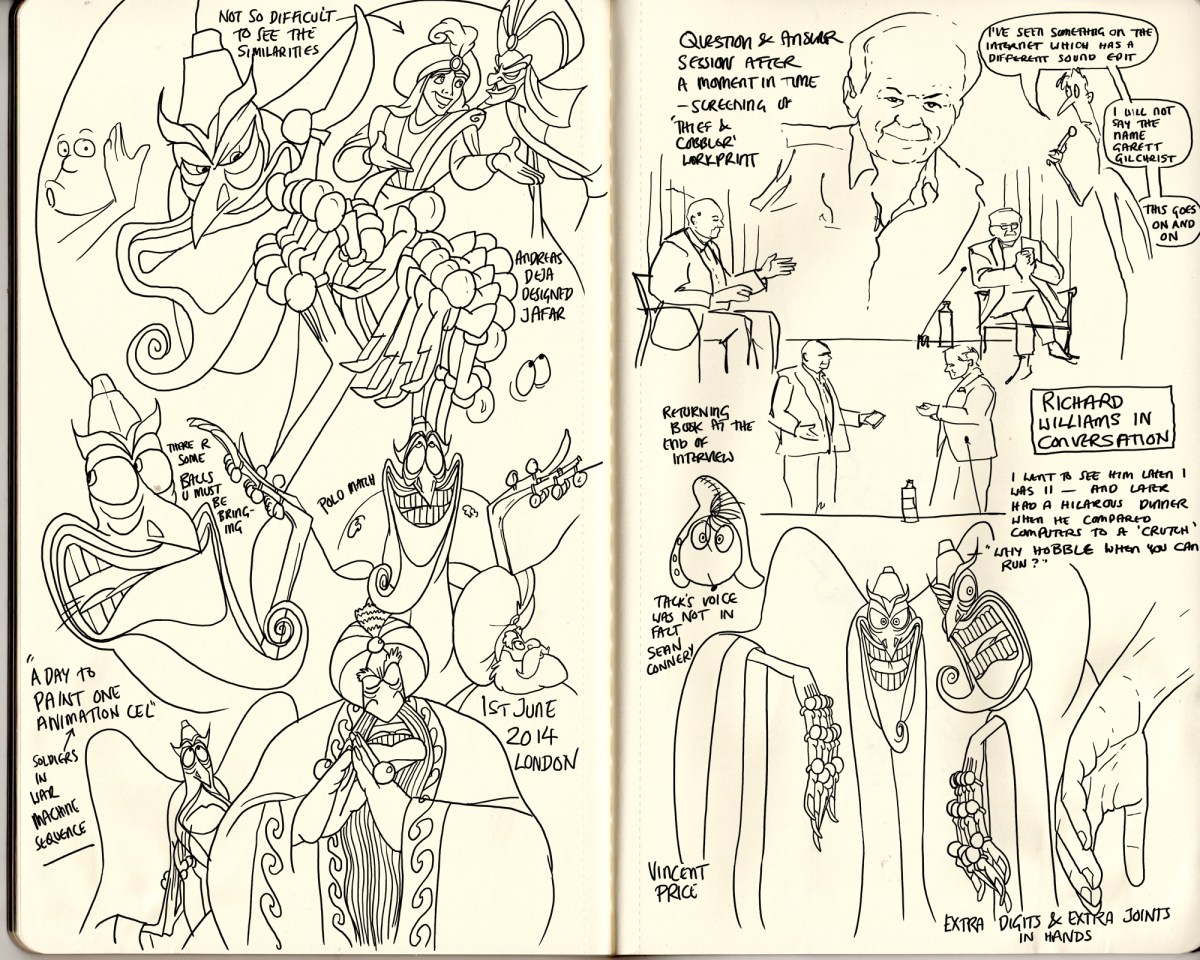
During the talk after the screening, when a few odd people, one of whom I am afraid I have drawn above, hogged the microphone and went on and on (and on!) about pirate versions of the thief that they had seen on the internet (no one mentioned Gilchrist by name- why not? though Dick Williams urged him to get on with his own work instead of obsessing about “the thief”), Williams talked a bit about his current project,apparently based on “Lysistrata” and called “If I live”. When we met for Dinner in ’82 or ’83, he had been talking about an adaptation of the Epic of “Gilgamesh”- a story about a babylonian Noah figure, and there is a creation account in “Gilgamesh” which lies behind the first creation story in the bible. It is more vivid and much more fun, certainly worthy of animation as indeed is Aristophanes’ “Lysistrata”. I will dig out my own animated versions of Aubrey Beardsley and maybe the (unpublished and scurrilous) comics based on Greek texts and post them on this new blog in time but I suspect Williams is doing his own thing with the Greek comedy and has moved some distance away from Beardsley. I moved from Beardsley too: it simply took up so much time! I would love to know what happened to Gilgamesh and what Williams’ “Gilgamesh” would have looked like and also I would like to know what role the laughing camel must have had in “Nasruddin”. There was alot of publicity about the camel but he makes a very brief appearance in “The thief”. Had the hogs stopped talking evasively about Gilchrist, then maybe I could have asked about Gilgamesh or the Camel. Now, we may never know!! I will write more on this subject another time. In the meantime, here are some sketches made on Sunday afternoon during and after the screening.























 animate-tim.com