Lucy Worsley’s first episode of “British History’s Biggest Fibs” aired last night and some very positive reviews in the Press today. My graphics looked very good and, indeed, I noticed that my Shakespeare drawing got used rather more than I expected! All worthwhile. Do, meanwhile, check it out on BBCiplayer!
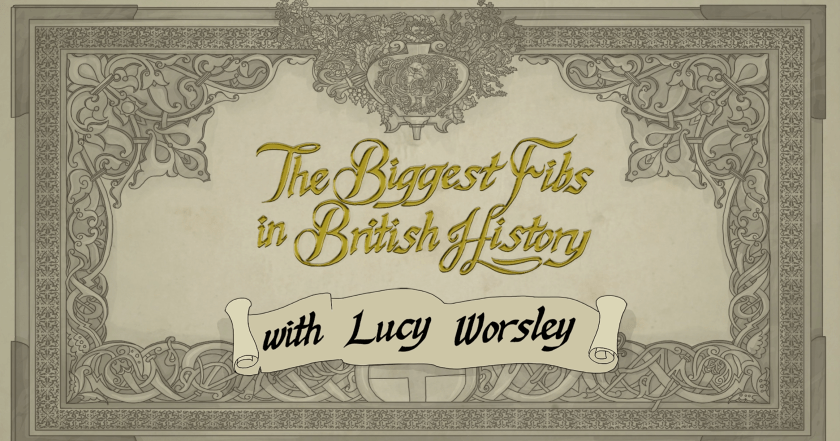
The title changed a few times during production, so here is a different version of the title sequence:
Next week is the Glorious Revolution (a contrast to the french Revolution, of course) and the final week will be the British Raj.
The Producer wrote to me today to say that the first programme had got an audience of 1.3 million, very good indeed for BBC4 which usually gets audiences of about 500,000.
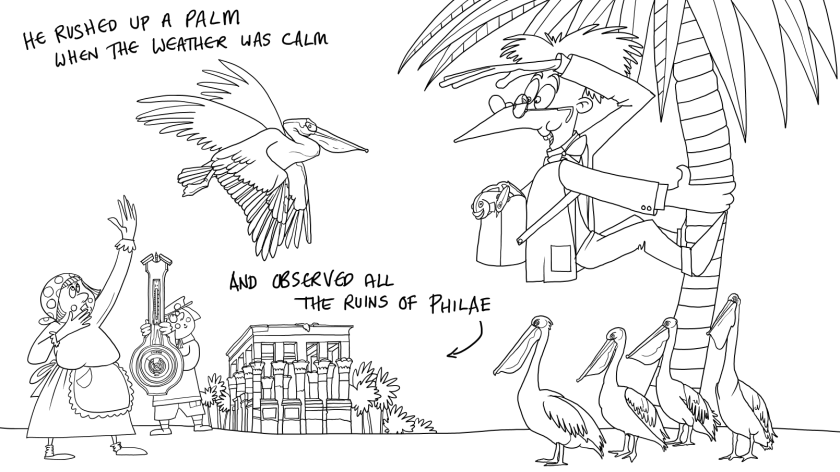
Meanwhile, here is my version of a painting Lear did in 1863 of the island of Philae which will accompany “the Lear Suite” by David Watson:
David Watson has put together many of the Edward Lear compositions to form a Suite. We shall post a version of this shortly. In the meantime, in celebration, here are some Edward Lear illustrations.
On Thursday, a BBC 4 programme airs about three distortions of history- Richard III’s death, the Glorious Revolution and the formation of the British Raj. I was asked to provide titles and animated sequences throughout the series. the sequences show some of the contemporary images, initially on manuscript paper, and finally on what appears to be the pages of the Illustrated London News. Lucy Worsley presents and I am confident that it will be a good show!
Here, meanwhile (though it is NOT in the show!) is a quick drawing that I did of Lucy as Richard III.
There was an article in The Telegraph a few days’ ago about Ian Knowles who runs the two-year old icon-teaching centre in the West Bank. His work is on the israeli wall that divides the land and also in cathedrals and churches around the globe. The West bank centre began in a Coptic Church, is now housed in the Bethlehem university near the Church of the Nativity and is funded almost completely by private donations.
As I understand it, the Bethlehem school was an outreach programme from the British Association of Iconographers, for the most part a Catholic-inspired organisation centred around the benedictine Abbey of Our Lady of Peace in Bedfordshire.
Some years ago, I was taught how to gild and my gilder’s cushion is to hand even as I am typing in my office this evening! Gold is an essential part of the iconographer’s trade, but I am afraid that I have taken the Icon form cautiously into the digital realm: I explained many years ago to Metropolitan Kallistos that I had a plan to animate icons in some way and he was rightly suspicious. He did not completely dismiss my plans but -“I do not think I could pray to a cartoon”, he memorably said. I have not given up this idea, however, though I am aware of the time it takes to realise the detail of an Icon in a new medium, quite apart from the technical issues of trying to move in an inverted perspective. For now, I see my work as an academic exercise and I am currently writing a short course which I believe I will deliver at the Moscow State University sometime later this year. I will use animation simply to define the differences in posture and the significance of the arrangement of characters in traditional iconography. I will also, I hope be able to demonstrate on screen exactly what inverse perspective means and what it does to objects like tables and chairs. While Icons are religious artifacts, they are also an art form telling very specific stories with layered meanings. I see the Icon as the perfect combination of art and religion, so perfect indeed that even with the advances of the Renaissance, and the influence of Western art on both Greek and Russian culture in the 19th Century, the revival of the traditional icon by Photios Kontoglou in the 1950s continues to be a powerful force across the Orthodox world and beyond. It is now not uncommon today, for example, to see Icons in both Catholic and Anglican churches.
On 22nd January according to the Greek Calendar, and on 26th January (transferred from 24th) in the Catholic Church, is the feast of St Timothy, my patron saint.
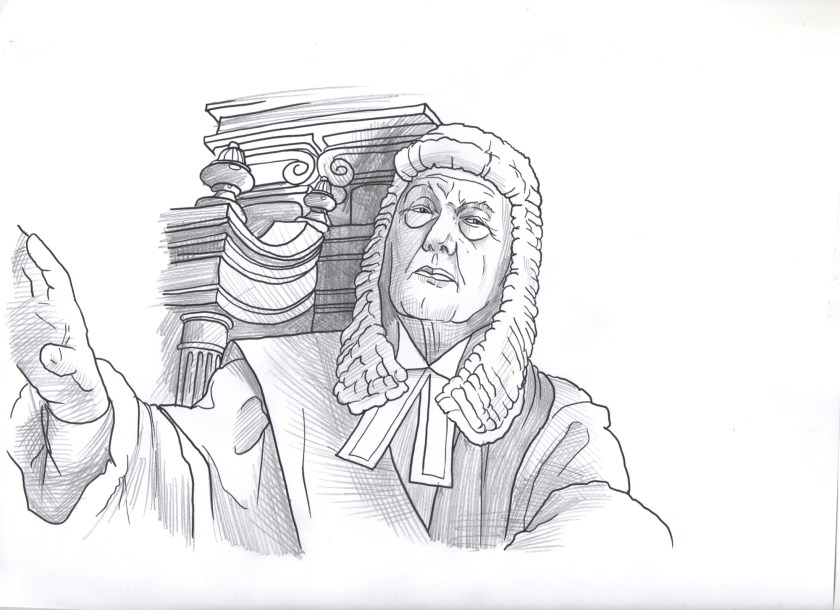
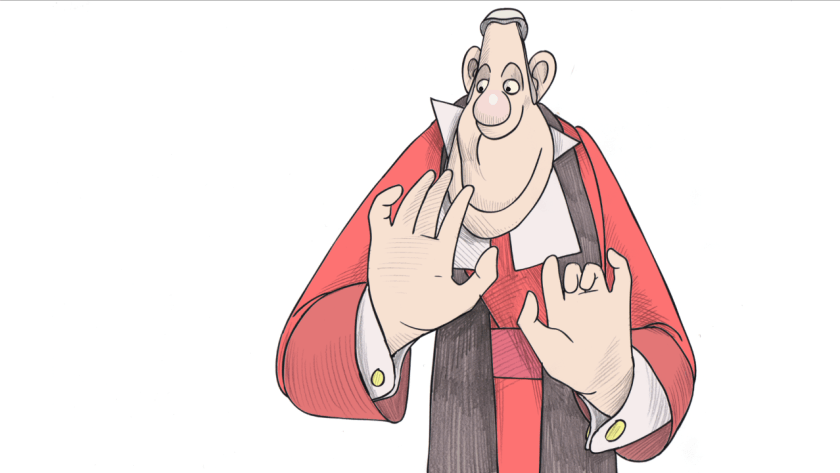
meanwhile, here is the first proof of the judge in colour-
There are shadows to add.
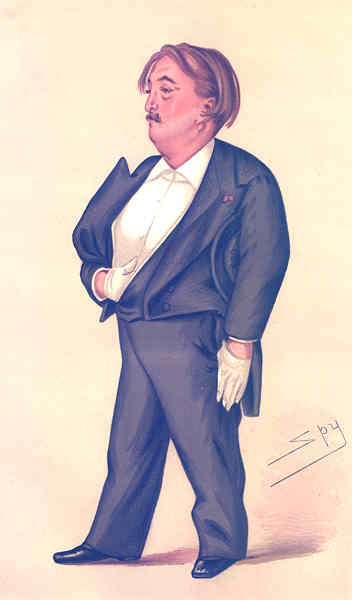
Meanwhile, I was rebuked yesterday for writing a piece about woodprints and not drawing a picture of Gustav Doré, (32-83) the French master.
Doré is best known for his wood engravings, but he is also well-represented in his hometown of Strasbourg by huge biblical oil paintings. He was already in print by the age of 15for the periodical “Le Journal pour rire”.
Rather disturbingly, he was involved in the illustrations for a fairly abhorrent anti-semitic “Juif Errant”.
His printed work stretches from a 1854 edition of russian images to an 1884 edition of Edgar Allen Poe’s the Raven confirm him as one of the truly great European artists. I am particularly fond of the Paradise lost in 1866, Idylls of the King in 1875 and the Dante which he was working on from 1857 to 1867. In 1876, he did a book on London which has informed most of the films set in Victorian slums and was almost literally reproduced by John Box and Terence Marsh for Caron Reed’s version of “Oliver!”
Terence Marsh, who won an academy award for the Oliver designs, indeed, was also nominated for the designs of “Scrooge” a few years’ later so he had his fill of Victoriana. John Box was the art director on the Asquith production of The Importance of Being Earnest with Joan Greenwood and Edith Evans, but he was also production designer on Lawrence of Arabia and A passage to India (in 1984)
Just getting to the point where the judge can be coloured.
The 19th Century woodcut illustration industry was very peculiar. So while Leech, Tenniel, Phiz (Halbot Knight brown), Dore and co produced very fine and very quick drawings, these were then copied by craftsmen called “woodpeckers” and turned into prints. In the case of the Punch cartoons, this process must have been accomplished in a matter of days and some of it is astoundingly complex. The best “peckers” in the business seem to have been the Dalziel brothers who worked on the Tenniel Alice illustrations of 1865 and 1871 as well as Moxon’s Tennyson poems of 1857.
The wood engraving process was different to that used in the late middle ages. The woodcut used the plank wood or side grain, and tend to be larger using bigger tools, but for Tenniel and co, the end grain was used on very hard wood (boxwood/ Buxus sempervirens, though lemonwood is also used) and the quality of detail compared favourably with copper and steel engraving or even etchings. The wooden blocks are often worked on stuffed leather pads which allow the craftsman to work at almost any angle, a bit like a modern Cintiq and the resulting block could be printed with ordinary letter-press rather than using a special printing press as in the case of steel, copper or etchings.
The wood engraving process was expensive and labour intense. Gustav Dore, for example, could not find a publisher prepared to cough up the funds to print his illustrations to the Inferno, so in 1855, he self-published the book which not only continues to be reprinted but both made him a household name and a tidy profit.
There were cheaper and quicker processes available. The Voltaic press (electrotyping) allowed for a greater print-run but the same woodblock seems to have been the starting point and litho-prints allowed for colour but until the late 19th Century had very limited print runs. The photomechanical systems introduced by 1893, the year Tenniel was knighted, pretty well destroyed the woodprint industry overnight.
Our “Trial by Jury” images try to nod towards the style of the “woodpeckers” and accordingly I have been “inbetweening” crosshatching effects. It demonstrates how time-consuming and effective was the original craft.
Here is a post on progress on the Judge’s song from “Trial by Jury”.
This is a line test of the first verse. The Right arm and some of the body is still missing as well as the earlier frames of the pigtail and the pupils.
The animation was completed on the Harmony/toon boom system though I note the production of the brilliant and recently-screened “Ethel and Ernest” on BBC was done with TV Paint which seems to offer so much more opportunity in terms of textures and usability. Harmony was a wonderful tool when it was run by the Vogelesang family, particularly Lilly and Joan, but they were taken over by Corus entertainment in 2014 or so and it does not seem to have been the same ever since. I have been teaching in a school in Moscow that apparently promotes the software and it was a devil of a job to get it actually to work at all on the school machines. So much for Industry standard! I note the company also acquired Animo, Pegs’n’co and the Cambridge animation system, rival 2d animating software and has not made any effort to update any of these since, effectively smashing the opposition and leaving precious little choice.
There is news today of refugees accepted in Greece because they had been raped by Police and security guards ( or specifically, a “government official” κυβερνητικό αξιωματούχο) in Syria. The newly established ΣΥΔ has, to date, taken on 30 cases, 9 of which it has accepted immediately according to the article which I am reprinting below.
While there are many reasons to be critical of Tsipras and the Syriza government, and while I think their management of the economy is a disaster, I applaud their record on human rights. Indeed, recent news of the EU’s irritation about a Christmas payout to pensioners highlights the fact that Syriza are determined to take responsibility for the society they are running rather than cow-tow to a discredited EU.
It has now been 16 years since Necati was assaulted in Greece and over 5 years since the ECHR found against Greece. This story, in other words, I think, draws a line under what happened. Progress has been made.
Δεκτό έγινε το αίτημα για διεθνή προστασία ομοφυλόφιλου πρόσφυγα από τη Συρία, ο οποίος είχε δεχτεί στη χώρα του ακραίες διακρίσεις για τον σεξουαλικό του προσανατολισμό και βία που έφτασαν μέχρι και επανειλημμένους βιασμούς του από κυβερνητικό αξιωματούχο.
Την υπόθεση έκανε γνωστή το Σωματείο Υποστήριξης Διεμφυλικών (ΣΥΔ), αναγνωρισμένο μη κερδοσκοπικό σωματείο εθελοντικού χαρακτήρα για την προστασία των δικαιωμάτων της τρανς κοινότητας.
Η συνέντευξη του πρόσφυγα έγινε στις 19 Δεκεμβρίου στην Υπηρεσία Ασύλου με την παρουσία των ειδικών συμβούλων του ΣΥΔ, σε θέματα ασύλου, Άννας Κουρουπού (Γενική Γραμματέας) και Άννας Απέργη (Γραμματέας Περιφέρειας ΣΥΔ), που έδωσαν όλο το περίγραμμα των λόγων που ο αιτών έπρεπε να τύχει διεθνούς προστασίας ασύλου, ενώ κατατέθηκε υποστηρικτικό Υπόμνημα από το ΣΥΔ που εξηγεί αναλυτικά τη νομική βάση του αιτήματος της συμμετοχής του σε ιδιαίτερη κοινωνική ομάδα λόγω κινδύνου δίωξης ή της σωματικής του ακεραιότητας λόγω σεξουαλικού προσανατολισμού.
Το ΣΥΔ από την αρχή του 2016 έχει υποστηρίξει περίπου 30 υποθέσεις αιτούντων διεθνούς προστασίας ασύλου λόγω σεξουαλικού προσανατολισμού και ταυτότητας φύλου, εκ των οποίων εννέα έγιναν δεκτές στον πρώτο βαθμό, σε άλλες δύο υποθέσεις έγινε δεκτό αίτημα μετεγκατάστασης σε άλλη χώρα, τρεις απερρίφθησαν στον πρώτο βαθμό εκ των οποίων μία θα υποστηριχθεί και στον δεύτερο βαθμό, ενώ οι υπόλοιπες εκκρεμούν προς εξέταση.









 animate-tim.com