
I was asked to do some videos to help with phonetics in Moscow. Here are the first two:

I was asked to do some videos to help with phonetics in Moscow. Here are the first two:

In the late 1950s, Ratcliffe College, my former school, decided to build a new chapel to replace the 1867 chapel financed by Ambrose Phillips and the Earl of Shrewsbury, and designed by Pugin who was the architect for the original building in 1844, his son Edward and the men who patented the Hansom cab (JA & CF Hansom). Pugin was the chief and largely uncredited architect of Parliament, the Palace of Westminster. Because he was a Catholic, his name was largely overlooked and Barry got the credit. But since 1847, it has been on a throne (built by John Webb) designed by a Catholic architect that the monarch has delivered the “Gracious address”.

The new chapel, imagined in the “modern trend with basic Byzantine feeling” by Ernest Norris took two years to erect and was completed in 1960. Much of the interior was embellished with painted ironwork decorations done by Gervase and Aloysius Duffy, and with windows by Jonah Jones. The sculptures were done by Jones himself and Fr O’Malley, with two of the statues- of St Chad and St Richard modelled directly on headmasters Emery and Leetham in the style of Eric Gill, one of whose statues remains in the school. Fr Claude Leetham had a habit of rubbing his nose, and in the days when the statues were parked in the cloisters waiting to be put on-site, the boys paraded past St Richard and rubbed its nose, leaving a small mark which persists. (This story passed on by a boy who was there at the time and went on to be a priest in my day at the school). It remains a fairly impressive space, constructed of concrete, clad in brick and with a dome over a chunky clerestory. Vertical windows in the transepts make it, nevertheless, a very airy building.
 The original chapel was deconsecrated in 1962 and used for teaching and dormitory space.
Ratcliffe’s association with great architecture extends also to the prep-school- the current in-house prep-school has just been built by a distant Pugin relative and the original at Grace Dieu manor is described by ES Purcell as “the beautiful parish church (which) underwent restoration at Pugin’s hands, the first of the old parishes to be restored upon Catholic lines with return stalls and a rood screen.”
But when the school was handed to lay-staff and the Rosminian Priests largely withdrew, a number of items went missing. This following the destruction of the baldacchino by the last Rosminian Headmaster, Fr Keith Tomlinson, who always seemed to me to be a philistine, albeit a slightly camp one, with a remit in my day simply to beat boys. I know he made alot of children miserable. No doubt he was Ratcliffe’s own John Smyth. He is probably best forgotten. Nil nisi bonum and all that, but there we are!
The Baldacchino was quite remarkable in many ways. It provided a focus to the design, which had been compromised when the then Bishop of Nottingham, Ellis, himself an Old Ratcliffian, ruled that the planned central altar “versus populum” was non-canonical, only months’ before Vatican 2 recommended exactly that sort of arrangement and which was, of course, followed in Liverpool cathedral. Ellis, though, was old fashioned and my own parish in lincolnshire continued to have services in Latin and “ad orientem” until the early 70s, some 10 years after the end of the council.

The Baldacchino (which is in this photograph and -somewhere there is a drawing I did which will resurface again sometime- I keep coming across it and will post here the next time I do!) was an interesting modern take on a traditional architectural feature in the Latin Rite going back at least to San Apollinaire in Ravenna in the 9th Century, though we know that Constantine gifted a silver baldacchino to the Basilica of St John in Laterano. By 1600, it was considered a mandatory item, sometimes replaced by a cloth tester, promulgated by the Counter reformation in 1600 and indeed there is a good example in stone by AW Pugin in Grace Dieu.
Ratcliffe’s Baldacchino was also supported by 4 lightweight columns crafted from spitfire metal in the old Coventry factory where the planes were manufactured during the war. Today, Steve Clark has been overseeing the restoration of a spitfire for the school. Again, a link lost. The design on the baldacchino was based on an obscure verse “On Baptism” by Tertullian – “we are little fish who cleave to the great fish Jesus Christ”, this all as much a play on the Greek Christian acrostic ΙΧΘΥC as on the trade of the early apostles. One little fish was actually named on the painting- he was a boy who had just been baptised in the school. On every level, therefore, this was heritage stuff and it was, I understand, dumped in skips by Tomlinson. Simply appalling vandalism.
 Opposite the lady chapel, and under the organ pipes were two alcoves. On these had been hung a giant rug designed and woven by AW Pugin. This, even in the 1960s, should not have been cut in two and should have been housed in the V&A! Today, I believe it was unceremoniously stripped from the church and transported to the Rosminian motherhouse in Stressa. (Maybe the rather splendid gold-plated silver pontifical chalice, which I persuaded the then Headmaster Fr Anthony Baxter to use on the school feast-day, went the same way?) and I wonder if an export-licence was either sort or acquired before British heritage of this quality and import was taken to Italy? The Pugin rug, as valuable as any of its sister-pieces found in the Palace of Westminster, was used on the sanctuary for services from the 19th Century through to the 1960s. It was a bigger version of the rug routinely used by a Bishop in the Orthodox Church. Norman St John Stevas, also an old boy of the school, and the person who devised the committee system used in Parliament, at least, would have been apoplectic. Thank God he died in ignorance.

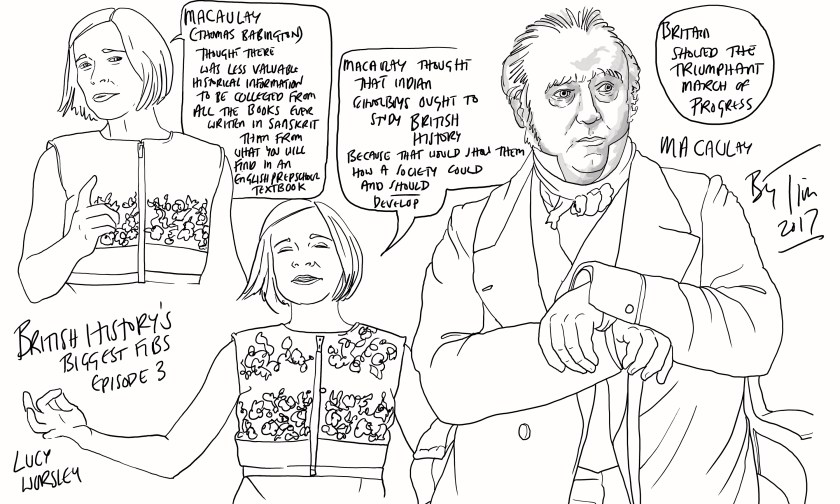
Last night, the final episode of Lucy Worsley’s programme screened.
Here is my scribble from watching it, though the drawing of Macaulay is not based on the image used in the programme…
The Anglican Church will learn, I hope, the harsh lesson the Catholic Church has finally begun to understand, that to interfere too much in the daily minutiae of political debate is to produce a contradictory, confused and ultimately meaningless flood of well-intentioned platitudes. There comes a time when what is said is simply ignored or rejected. The present Pope is indeed experiencing this- He is not necessarily saying the wrong things- he is simply reaping the whirlwind set in motion by his predecessors and his world-wide congregation has tired or what he is talking about.
It is really better to keep quiet.

Today, Archbishop Justin Welby condemns the government for reneging on a decision never taken, namely to accept 3000 children as refugees to the UK. Of course, I warmly encourage our councils and our country to open their arms to these children and to refugees of all ages, but I recognise that there must always be a difference between what we want to do and the way we allocate the resources we have available.
Last year, about this time, the Archbishop made an extraordinary statement that it was not racist to complain about migration. I thought he was utterly wrong then and I still think so now, but his pronouncement today seems to be completely contradictory. The only logical conclusion is that, in the absence of a credible opposition in the House of Commons, the Archbishop has taken it on himself to play the role so resolutely abandoned by Jeremy Corbyn. Sadly, this is not the office to which the Archbishop has been appointed.
This is what he said last year:
He said that to be anxious about “one of the greatest movements of people in human history” was “very reasonable”. He added: “There is a tendency to say ‘those people are racist’, which is just outrageous, absolutely outrageous.” This was noted to echo the claim that “it is not racist to impose limits on immigration”
At the time, there was a good deal written about the difference between a refugee and a migrant, though in fact that distinction is a legal one, requires a lengthy process, and is rarely established at the border.

But this is what he said this year, today:
“Our country has a great history of welcoming those in need, particularly the most vulnerable, such as unaccompanied children.
“Refugees, like all people, are treasured human beings made in the image of God who deserve safety, freedom and the opportunity to flourish. Jesus commands us to care for the most vulnerable among us.”
“I very much hope that the Government will reconsider this decision, and work with church groups and others to find a sustainable and compassionate solution that allows those most in need to find sanctuary in our country.”
I agree with the sentiments he expresses but his own U-turn is astonishing. Ironically, the Coventry Telegraph headlines its article on this subject: Archbishop of Canterbury criticises U-turn on child refugees scheme. Something here about the pot and the kettle!
Leave the talking to someone else.
There is an opportunity to question the Government’s decision, my Lord Archbishop, but not with this dodgy track-record. It is simply unbelievable and it cheapens the debate.
I am just finishing the final sequences of a youtube treatment of the Lear Suite by DAVID WATSON. It should be ready in the next few days for posting!
Meanwhile, here is a recent review of Episode 2 of “British History’s Biggest Fibs”:
Columnist James Waller-Davies gives his view of some of the recent events on television. This column is the most read television column in the entire English speaking world. It’s true. Friendly Russian hackers have leaked the news from a Moldovan website and it’s important this information is shared with you. Yes, it’s ‘fake news’ season. The whole world is gazing, like Alice, into a topsy-turvy looking glass of the make believe. Orwell’s ‘doublespeak’ is topping the book charts again and nothing, it seems, is believable. It is nothing new according to British History’s Biggest Fibs with Lucy Worsley (BBC4). Worsley’s entertaining and informative revision of some the biggest myths of British history is a timely reminder that there’s nothing new about ‘fake news’ – the state, our state, has been up to it for centuries. This week’s topic was the Glorious Revolution of 1688, when Britons cheered the arrival of a new king and queen, William and Mary, from over the channel in what is now the Netherlands. But as Worsley reminds us, that’s a great big lie – it was, in fact, an armed invasion incited by a band of English traitors and an example of ‘fake new’, seventeenth century style. Worsley is a refreshing change to history programming, which in recent years has been overly dumbed down and ruined by soft focus re-enactments and mockumentary dramatisations. That’s not to say Worsley isn’t beyond a bit self-parody and fancy-dress herself, but she is a reminder that an expert, talking engagingly and enthusiastically can be entertaining enough.
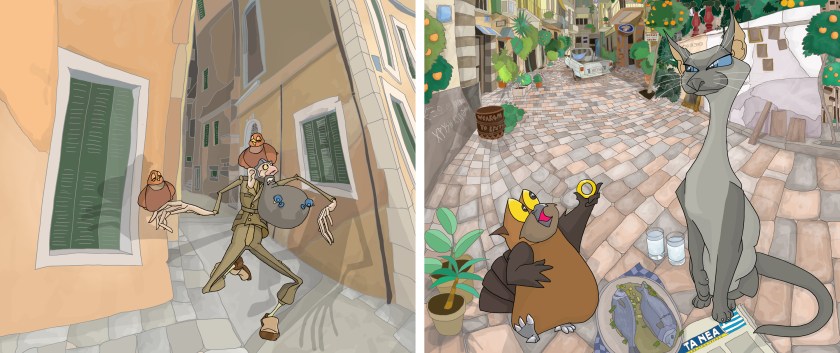
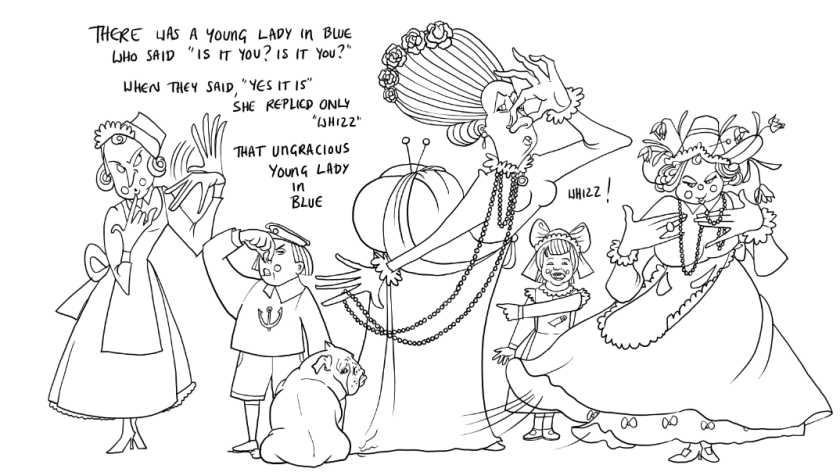
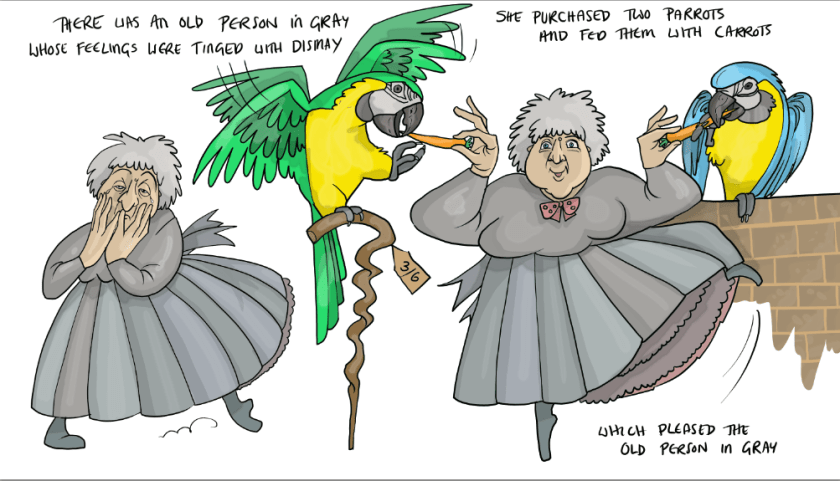
Lear wrote some many limericks that there is really no end to the number of crazy drawings possible. Here are a couple of pictures for the new film that are loose versions of what we are also trying to animate for the “Following Lear” project – when it gets properly or fully financed! In the meantime..


Oh and here is one I did yesterday with a picture of Stirling castle in the background. Sometimes, I rather miss the days when I was at St Andrews… Scotland is such a glorious country in all respects!

THE GLORIOUS REVOLUTION
I have just watched episode 2! Although I did numerous graphics for the show, I have never really watched any of the episodes from beginning to end, and what bits I had seen were often radically changed in the edit. This episode seemed to me to be very slick indeed and I was thrilled at the way my sequences were blended into the story. I was particularly pleased that the nosebleed sequence worked so well! So congratulations to Edmund Moriarty, the Director of this episode, for doing such a brilliant job and making the process of working such a pleasure!

This should be up on iplayer tomorrow!

 Lear wrote 212 limericks.

The Dong with the luminous nose is not strictly a limerick-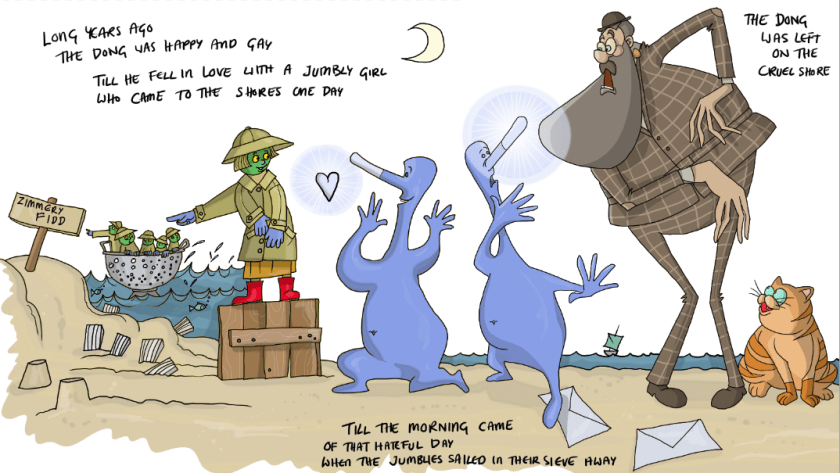
A poster for our exhibition in Wolfson, Oxford showing the owl and pussycat posingfor passports before embarking on their 366 day pea green cruise.

Here’s another review and a few sketches I did
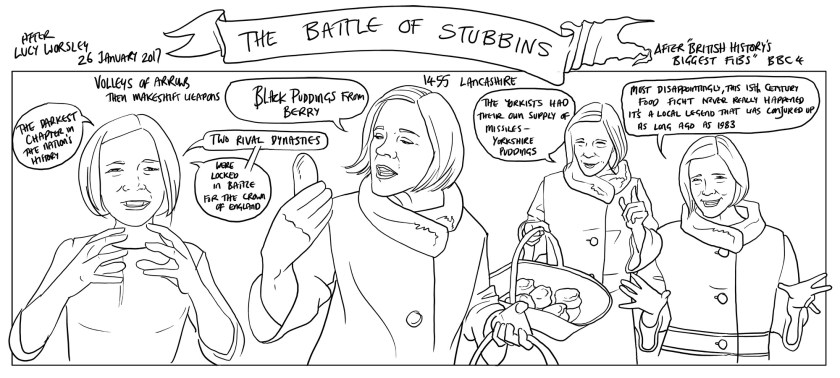

From THE INDEPENDENT:
Well, as British History’s Biggest Fibs with Lucy Worsley, the historian and broadcaster’s latest jolly meander through the past, reminds us, history is there to be spoiled, in the sense that the events we think we know so well – so well, indeed, that they become mythologised – can still offer some revelations. This is exactly how the softly didactic Ms Worsley explains the Wars of the Roses, (and the glorious Revolution and the Indian Mutiny in later episodes). There is, you see, no such thing as a definitive account of anything in history, not even from Ms Worsley. So, there is plenty of fascination left in, say, Richard III, or “wicked King Wichard” as the learned Lucy styles him. This is as good as telly history gets.
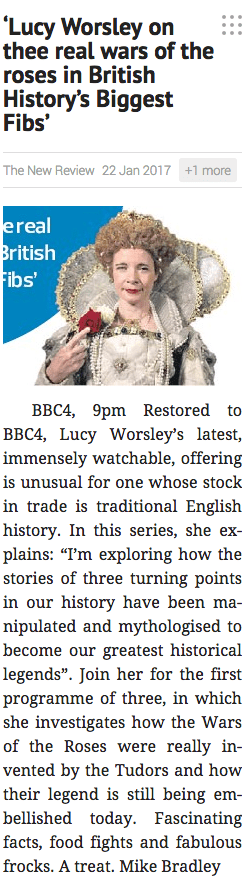
Here are some sketches of the tremendous Lucy Worsley doing her stuff!

From the Daily Mail:
Ruff, bustle … codpiece! Saucy Dr Lucy is playing dress up again: Christopher Stevens reviews last night’s TV
Mr Benn loved dressing up. Every day he went to a fancy-dress shop, where he tried on a new costume — clown, wizard, astronaut, cowboy — and had an adventure, before returning to his mundane life in his suit and bowler hat.
I want to see a remake with Dr Lucy Worsley. No one since Mr Benn has enjoyed dressing up so much.
Historian Dr Lucy Worsley dressed as Elizabeth I for British History’s Biggest Fibs on BBC4
As long as she’s being Grown-up Lucy, in her smart dresses and severe blonde bob, she’s a scholarly and respectable presenter. But let her don a ruff or a bustle, and her eyes glitter with mischief.
British History’s Biggest Fibs (BBC4) saw her pull on a yeoman warder’s finery at the Tower of London.
The effect was as intoxicating for her as three swift glasses of white wine at the historians’ office party. Goodbye decorous Dr Worsley, hello Louche Lucy.
In the show, Dr Lucy tried to debunk mysteries of the Wars of the Roses – but it was confusing
Eyeing the chief Beefeater, she told him saucily: ‘I think I might have a better codpiece than you.’ And while the poor man was trying to think of an answer to that, she added: ‘Let’s discuss our chests.’ Evidently she likes a man in uniform.
When she wasn’t flirting with guardians of the Crown Jewels, she was debunking some of the myths of the Wars of the Roses.


 animate-tim.com