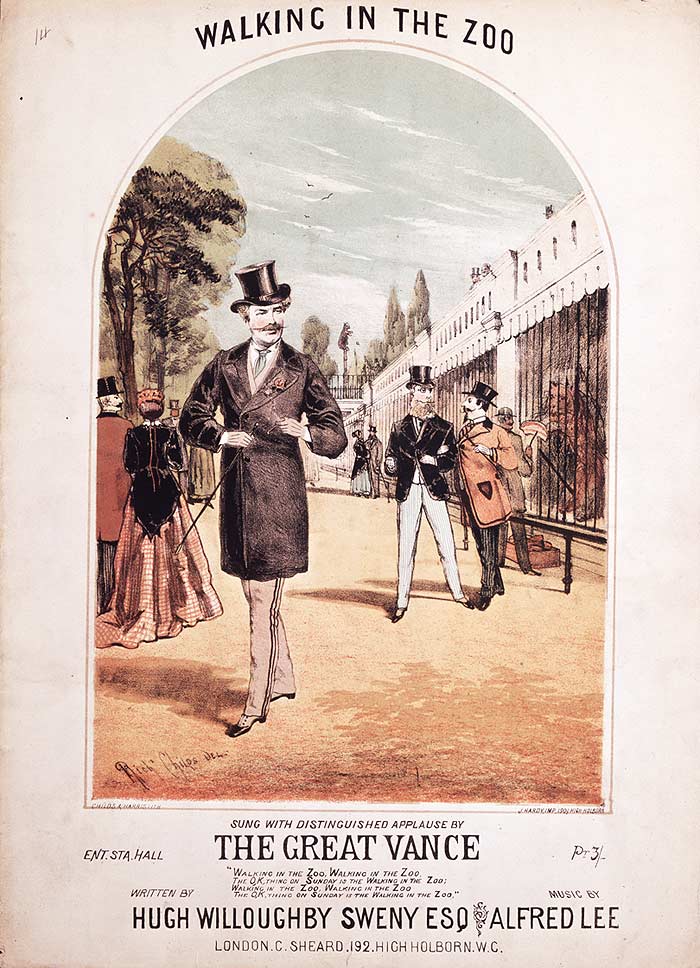
While there is a fairly good account of the introduction of the expression OK into the UK in the song “Walking in the Zoo” sung by Alfred Vance, the Great Vance, one of the great “lions comiques”, it probably emerged from the Greek migrant population in Boston or New York and is first recorded in use in 1839.
The sheet music here is decorated with a drawing by Richard Childs and dates from 1871.
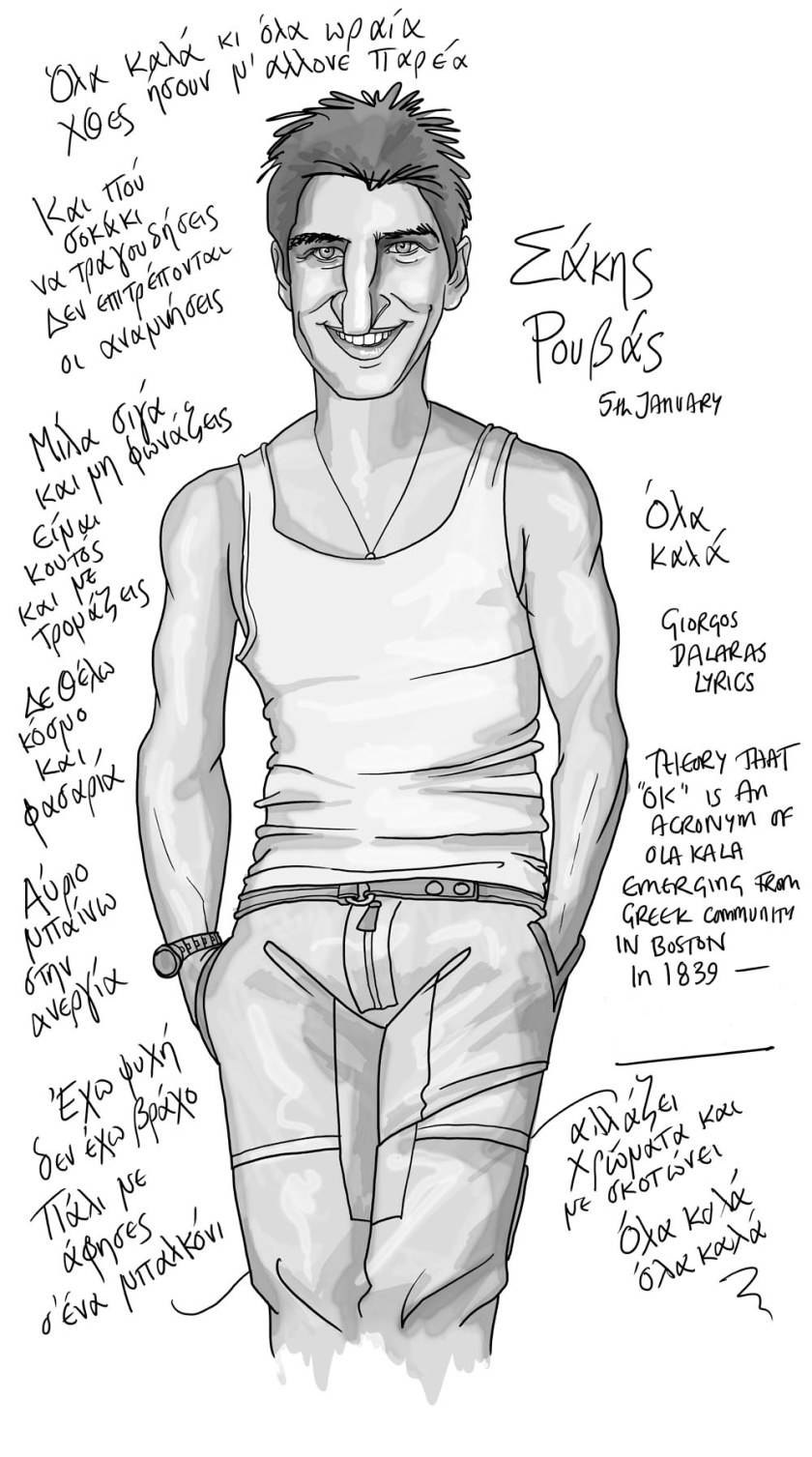
Sakis Rouvas (whose birthday is tomorrow) popularised the term “Ola Kala” in a Greek pop song written by the American songwriter, Desmond Child in 2002. Child also wrote “she bangs” and “La vida Lorca” for Ricky Martin.
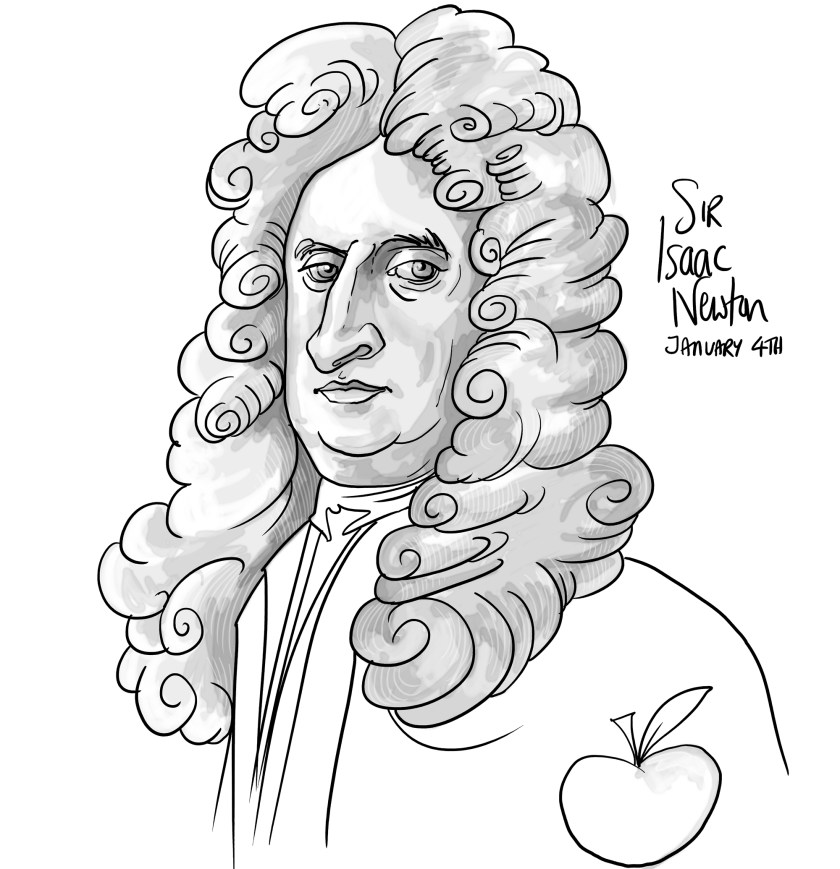
Like the great Margaret Thatcher, Isaac Newton hails from Grantham in Lincolnshire, or as near as damn-it! The anniversary of his birthday is tomorrow (corrected to the Georgian* calendar which was not used in England until 1752) so here is a picture of the great man with obligatory apple. His mother, Hannah Ascough, I presume, is somehow linked to my primary school Ascoughfee hall in Spalding, a place in my day full of gorgeous stuffed birds and rather severe ballet teachers. One of its subsequent owners, a man called Johnson, founded the Gentleman’s society in 1710 which is one of the oldest antiquarian societies in existence and Isaac Newton was a member along with Alexander Pope, John Gay, Tennyson and George Gilbert Scott.
*this should read Gregorian of course! (thanks Chris Oakley!! grin)
Ascoughfee hall features a war memorial designed by Lutyens and I remember playing around it when I was very young. I don’t remember much more about the primary school though.
Newton was an advocate of what has become known as “the glorious revolution”, and deeply suspicious of James II’s tendencies towards Catholicism, the story of which will be a major part in Lucy Worsley’s forthcoming BBC tv series, for which I did some illustrations and title sequences.
Rather more obscurely, Newton was the first to reconstruct the Judean calendar and work out the date of the Crucifixion: he reasoned it should be April 23rd, AD 34, so about a year out of the accepted timing. He based this on the presence of a new moon, not on the documented lunar eclipse which might account for the moon appearing to be blood-red on 3 April AD 33, though a number of later scholars claim he was simply pushing his theories to make them fit a myth that Jesus died on St George’s day. I suppose that confirms that God is an Englishman?
In fact, as Christ was probably born in 6BC, his death is more likely to have taken place either in AD 29 or AD30. The claims about appeasing Herod in Luke (Luke 23:12) again point to an earlier date (following Robert Graves of course) to around the death of Sejanus in 31 AD.
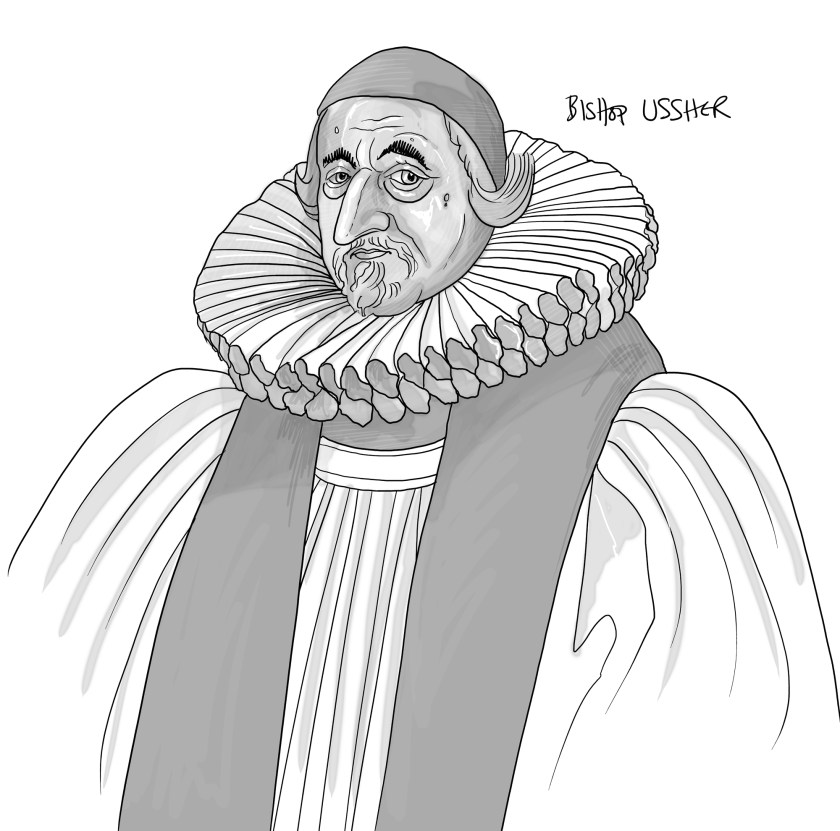
Of course, the farcical Bishop Ussher dated the creation of the world to 6pm on Saturday 22nd Oct 4004 BC and his chronology was printed in bibles form 1701. (Lightfoot claimed it was in 3929 and St Bede in 3952BC) Just for the record, Newton corrects Ussher to 4000 BC, a nice round number.
Whether Sir Ivan is a pro or anti-Brexiteer matters very little, he remains a man of consummate experience and his departure today is a very sad comment on the way debate and negotiations about our future with Europe are so-far progressing.
Sadly, I think in many Brexiteers’ minds, Sir Ivan is inextricably linked to his two mentors Sir Kenneth Clarke and Tony Blair but there is a big difference between what his private views may have been and what his public office represented. With so many years at the top end of the civil service and our ear in Brussels, his will be a very hard act to follow and he will be a tough man to replace.
If he was pushed, it is likely that it was a result of his leaked and pessimistic forecast that it would take 10 years to leave the EU whether a few EU officials may have thought otherwise or not. But it is highly unlikely that he himself was behind such a leak.
Should Sir Ivan have resigned months’ ago when Brexit was announced? Probably not. This is a man who successfully served two different parties as a senior civil servant. He was well-placed to execute policies he may not have liked- but frankly, we do not even know that. All we know is that he gave ministers his honest assessment that completing negotiations in a two year time-frame was over-optimistic.
He was due to resign in Autumn. It’s a shame he was not allowed to wait till then.
When we abandon dignity and kindness, we can all but abandon hope.
I hope we have not got to that point: it would be good to hear at some point that senior UK officials tried to persuade him to stay. So far, there has been nothing reported to suggest that was the case. Quite the contrary.
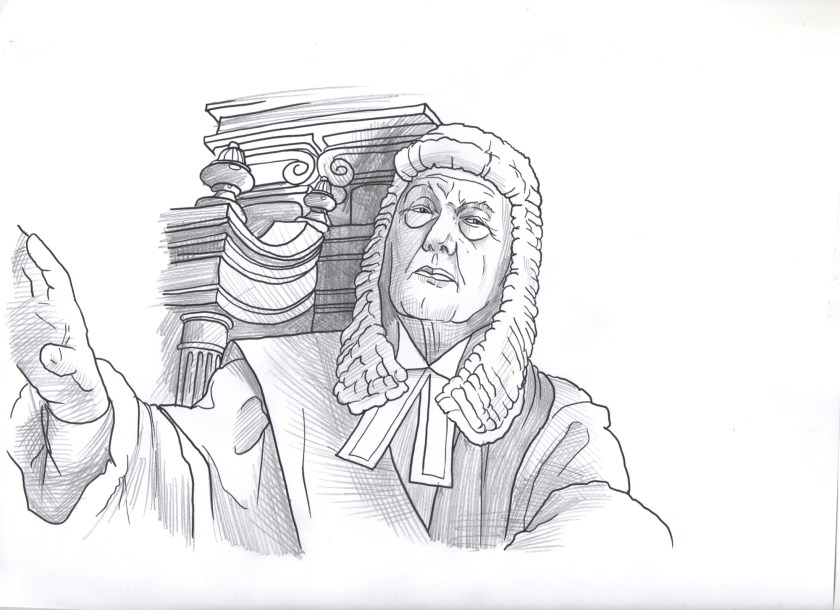
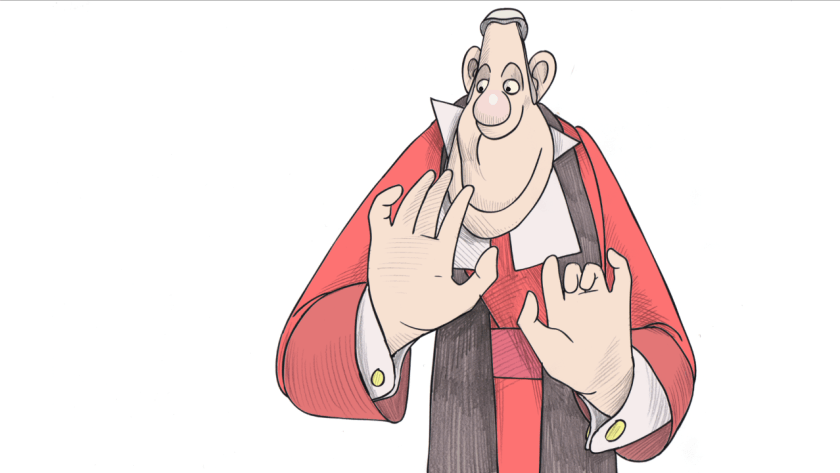
Here is a post on progress on the Judge’s song from “Trial by Jury”.
This is a line test of the first verse. The Right arm and some of the body is still missing as well as the earlier frames of the pigtail and the pupils.
The animation was completed on the Harmony/toon boom system though I note the production of the brilliant and recently-screened “Ethel and Ernest” on BBC was done with TV Paint which seems to offer so much more opportunity in terms of textures and usability. Harmony was a wonderful tool when it was run by the Vogelesang family, particularly Lilly and Joan, but they were taken over by Corus entertainment in 2014 or so and it does not seem to have been the same ever since. I have been teaching in a school in Moscow that apparently promotes the software and it was a devil of a job to get it actually to work at all on the school machines. So much for Industry standard! I note the company also acquired Animo, Pegs’n’co and the Cambridge animation system, rival 2d animating software and has not made any effort to update any of these since, effectively smashing the opposition and leaving precious little choice.
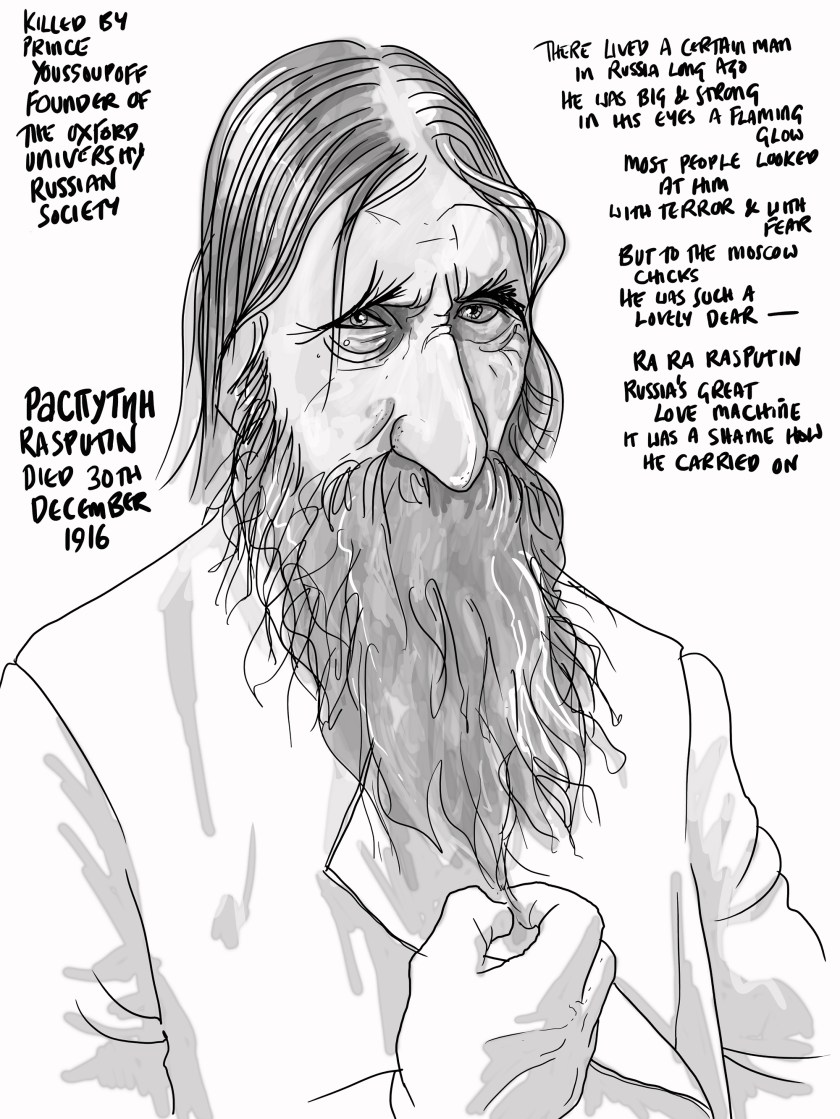
The wonderful Miron who was formerly the president of the Oxford University Russian society and who now sings intelligent Russian rap under the name Oxxxymiron pointed out two weeks’ ago that the founder of the OURS was one of the principle assassins in the death of Grigori Rasputin. Yusopov was apparently a rather fey man who, having been dressed as a child like a girl, continued to do so as a teenager partly to get into the Bolshoi to see performances and partly to attract the attentions of older men. I gather the Prince of Wales, the future Edward VII counted him as a great beauty and Rasputin seems to have kissed him a few times. He was not a very fine student and the University seems to have modified the exact subject he was reading a few times before he sat his finals. Later on, in 1927, he wrote the definitive book on Rasputin.
As a haemophiliac, I have always had an interest in the mad monk! Here is a quick picture to celebrate his the anniversary of his end.
I have been developing some images of philosophers for the University in Moscow. Here are some-
The plan is to make them appear to be drawn in real time on film… I will be teaching this trick in the next month. Above, Rousseau, Maslow, carl rogers, Freud, Guerrier (who founded the university), piaget, and Commenius (who established the principle and discipline of “mathetics”, the science of “learning” as opposed to “didactics” the science of teaching). Below, John Locke-
And below are drawings from the statues outside the National Library on Panepistimiou street in Athens. I have added copies of older busts (Socrates- mid 2nd Century from the Vatican and Plato mid 4th Century after Silanion also from the Vatican) by but the statues were designed in 19th Century by Leonidas Drosis (died in Naples in 1882), though manufactured for him by an Italian company called Picarellis.
The final assemblage would look something like this- which accompanied my talk in Ratcliffe a few months’ ago.
I despair of the way politicians believe they must make binding statements about things! Today, not that surprisingly, David Davis has weighed in against the admirable Nicola Sturgeon to rule out her proposition that it might be possible for Scotland to remain in some form within the EU while yet also remaining within the UK. I had been saying the same thing actually since the referendum result so of course I think the First Minister’s idea is both sound and clever.
Mr Davis loves to be negative. I think what he says does not quite do the the man justice, because I know he has shown a lot of personal kindness to gay MPs in difficulties with the media while yet maintaining a defiance about the repeal of Section 28 and also voting against the gay marriage act. I think, in that strange gurgling voice that must be an imitation of the great, late Daniel Massey, he likes to sound decisive. (he even goes on record supporting the death penalty)
I think, however, that politics is about being ready to change our opinions. If this were not the case, then there would be no point debating stuff in the Commons. We might as well just read out speeches from some grand podium instead. Our British democratic tradition is based on our capacity to adapt to realities. The reality now is that the BREXIT decision has been made in England, though the same is far from certainly the case in Scotland, Gibraltar and Northern Ireland where an overwhelming majority voted to Remain. A clever politician recognises this tension and moves forward. Theresa May did just that (she is a unionist) in her first speech and then, more directly, (she would listen to any options) when she went up to Edinburgh. I was optimistic – until Davis started to pontificate.
Because Davis feels he still needs to win the referendum debate. To quote the great Healey, “What a silly billy” he is being! He has been dealt an Ace and he is still fiddling around with his Knaves. We have heard his points before. They were all made in the Referendum debate- which he won! We now want to hear something else. We do not expect a Minister to be a trained parrot and certainly not one peddled by Farage pet supplies.
This spurred the First Minister to declare that a second referendum could be as early as Next year. Especially if at the point of triggering Article 50, the first Minister is not “on board”:
“I will have an independence referendum if I come to conclusion that is in the best interests of Scotland. I’ve always said that. It would be up to Scottish people ultimately to decide if that is right way to go.”
She told Andrew Marr,
“I think the positive outcome of the meeting I had with the prime minister on Friday was that she said she was prepared to listen to options that the Scottish government would bring forward to give effect to how Scotland voted and we will certainly bring forward options. Let’s see what progress we can make.” Don’t you love this woman!
I hope to God that the wise women here win this discussion, because the testosterone-driven declarations of Davis do no one any good.
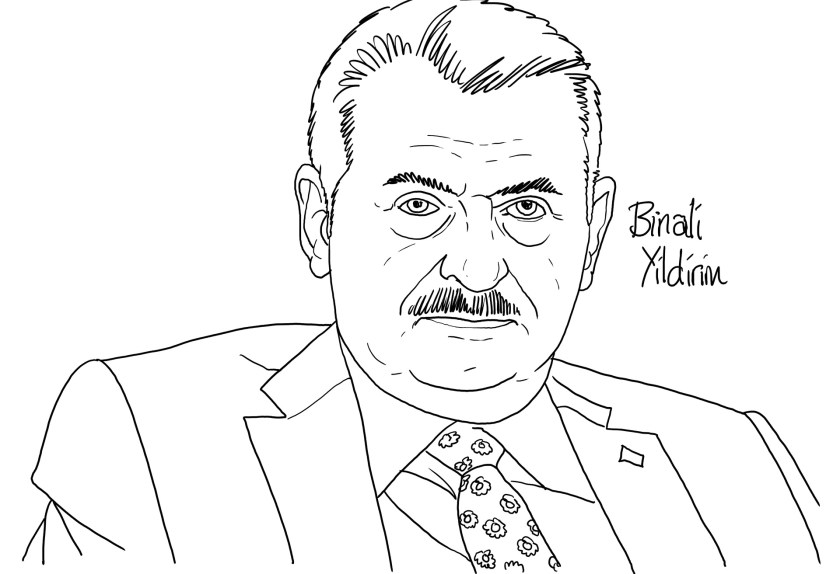
I was due to give a talk at a conference in Ankara yesterday. I made a video for the conference, finishing it just a few hours before the attempted coup.
I have now posted this online and added a brief introduction. I am pleased it has attracted some attention, and one particularly brilliant person added the following:
The military coup was not handled with a precise hand. It was a sloppy grab at power and hopefully Turkey won’t forget the collateral damage. And instead of letting it justify more death and destruction, will use it as a motivator for peace and civility.
I kind of want to get some things about debate off my chest. I don’t mean to be pessimistic, but modern debates often suffer from a type of information overload. I should probably point out that I am from the USA, so I have a very limited perspective on European events. I think if you asked any common person in any system, they are well aware that politicians shift focus and are masters of rhetoric designed to conceal any information they desire to conceal. But this isn’t really what I mean by information overload.
It seems to me that any “viral” idea or claim can become popular without any evidence or relevance in a post internet era. I see this constantly on social media and have been both a victim and a perpetrator of spreading some of these fallacious and incorrect views.
It was interesting to see that happen with the EU referendum. Claims that could not be substantiated and debate that was more nationalistic than informative spread much quicker because people got more caught up in the message rather than the truth.
So debates often end up being events where experts try to clarify why certain ideas or views lack evidence. But in these modern debates the side with the confident leader that recapitulates their views with impunity often ends up being more popular. I guess what I am trying to say is that people are more concerned with how people perform, in a sort of theatrical way, instead of challenging ideas and views.
This ended up being more of a rant than I wanted it to be, but I would love to see you do a video on effective debate as mentioned above. And thanks for the great content.
He is right in so many ways. How Erdogan deals with the army will determine the rest of his Presidency and the future of Turkey, but it will also send out a message to other states controlled by a powerful military. Personally, I see no real distinction between what happened on Friday night and what happened in Nice- both events seem to me to be a form of terrorism and innocent men, women and children mindlessly killed.
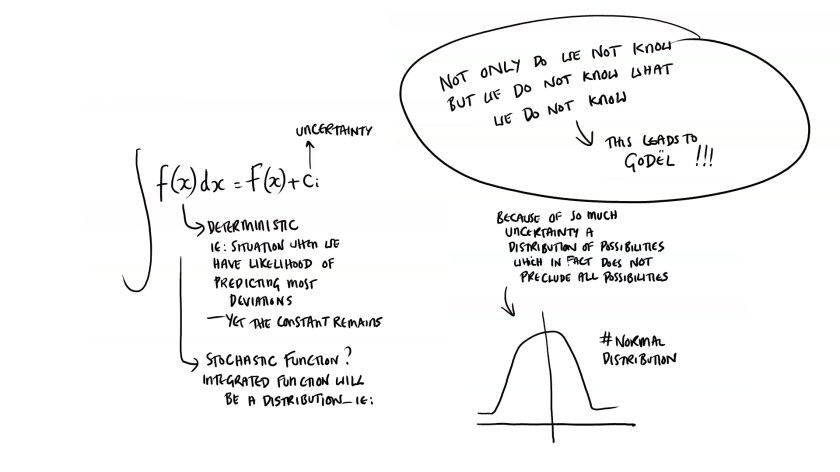
I was asked to give out prizes this year, and this is the text of the speech I gave. I also had projections and the accompanying images give an idea of these though they were also animated.
I want to congratulate all those who won prizes today- and also, as Fr President observed this morning, those who did not- but who clearly have been working very hard. And Anna- I don’t want to sound like Simon Cowell but this afternoon, you have made that Sondheim song entirely your own. Congratulations one and all!
Now, I want to talk about change.
We often find it hard to adjust to demands for change. But we are all as any mathematician, – or indeed as Heraclitus or Pocahontas might have said, in a state of flux. We cannot step in the same river twice. You know the song, “Once more round the river bend” – frankly, Disney says it just as well as the ancient greeks.
The demand OF constant change is uncertainty. Check out the Maths which is appearing on the screen to my right! Maths might help us understand what is happening but it is often experiences from the past that can help negotiate this uncertainty.
So, I hope you will indulge me, if I talk about an event when I was a boy here at Ratcliffe. When I was doing the Oxbridge exams and in the same week a production of Merchant of Venice, and I was caught shouting at the cricket pavilion. This was not an architectural statement. Rather, a pointless and a slightly loud display of fury and the then headmaster, Fr Anthony Baxter, took me into his office and suggested I should accept as providential things that I could not control. (Incidentally, I cannot quite control the projection of the maths – those of you who have just finished the Maths A level will agree that maths happens at its own pace. We must be patient.)
Fr Baxter urged me to follow the example of Rosmini, the man who imagined setting up this school in the first place. Antonio Rosmini was really a tremendous writer who incidentally had irritated Vatican bigwigs and had made powerful enemies. but it was the march of history that was his chief adversary. A few years before his death, he was due to be created Cardinal secretary of state by Pius IX but even as he received a set of buttons specially embossed with his family coat of arms, The pope went into exile and Rosmini’s preferment went up in smoke. Now this is the point: and I checked it yesterday with Fr Ted but neither he nor I could remember the exact words of the account, so here is the gist, in Fr Ted’s words, Rosmini took a little time time getting his head round it and then he moved on – and it is that time for pause that is important. So is the fact that he accepted the reality of the new situation. Over the next few years, it simply got worse, by the way, and his his life’s work, his writings were condemned, yet at the end of his life he says, “Be still, adore and rejoice”.
a cloud of suspicion hovered over Rosmini’s work until Vatican II. Today, He is accorded the respect he is due, and even quoted in Papal encyclicals. But it took a century, at least, for his ideas to be accepted. It takes time. Change takes time. A phrase we will get very familiar with in “post referendum”.
So, I was told to accept things that did not go to order. “Be still, adore and rejoice!” Well, I was far from rejoicing, and, by the evening, I was seething. I explained this to another one of the Rosminian priests, a man called Fr Basil, who made me a cup of tea, listened very politely and then gave me a book with a bookmark on which he had hastily inscribed the words “Ephesians 4.26”. I looked it up the following morning: “Never let the sun go down on your wrath.” So, that was a bit late! Here were two principles- to accept providence and curb anger. Let’s put that another way- to work with reality and to do it with kindness.
Nurture your own talents because that is what you will be good at. Think of Rosmini- his writings: two of his books were placed on the INDEX, the list of books no good Catholic should read, (these books- his life’s work) were forbidden and yet he never stopped writing. We are not meant to bury our talents but to develop and use them – as we heard in Church this morning St Paul says we must fight the good fight, or as I recall the wonderful Doc Orton used to point out- and some of you received prizes today in his name – Winston Churchill simply told the country during the dark days of world war 2 to “keep soldiering on” (or words to that effect).
There is a danger to determination, of course. Some years ago, I was directing Hamlet and had this insane idea that fish should play a major part. I would like to think I was inspired by the old baldicchino in the church here which was covered in fish- But we did a deal with a salmon farm and every night, the stage manager’s last job was to defrost a fish, put it in a bucket of cold water, for the following day. It all came from the line, “you are a fishmonger” (act II, sc 2) which had a slightly different meaning for Shakespeare. Anyway, the fish made its first appearance when Hamlet was feigning madness, and he produced the fish and slapped it around Polonius’ head; he dissected the fish in the big “To be or not to be” speech and then later the fish was brought on stage on a dog-lead by the mad Ophelia. We won’t do anything new unless we are prepared to take a risk. But being prepared is a key part of the process!
Sadly, one day the stage manager forgot to defrost the fish so it was hastily done with a kettle of boiling water about 10 minutes before it was due onstage. and that meant that the fish was not so much defrosted as cooked, and it fell to pieces, bits of fish here and bits of fish there. The place stank of fish and I had to spend much of our profits paying for the theatre to be professionally cleaned. Sometimes, we take unnecessary risks – just as fish seemed a great idea before it was cooked and scattered around on stage, so it’s always good to pause before a risky decision.
In other words, our understanding of providence needs to be active rather than passive. We must do our best at everything- Providence is no excuse for indolence- we must work at our future; we must be prepared, we should throw our hearts into it (some of you are looking a bit sleepy: I nevertheless want you to throw your hearts into life) whatever you do and however many hearts you may have! I think there are no “Time Lords” here, but do you know that a worm has more than one heart? (It has five) and can anyone tell me how many hearts a cockroach has (This is one of those useless bits of information that I promise you will remain with you for the rest of your life!) It has 13 hearts! That is why it is such a survivor I suppose. You should be as cunning, as determined and as resilient as a cockroach!
Exams are one way we can test the value of what we have learnt, but we also test our ideas every day simply by discussing them with our friends. Believe me, I would rather hear a friend tell me that I have a really loopy idea before I act on it. That is real kindness. And, frankly, it was fairly kind back then to tell me to stop screaming at the cricket pavilion.
Let’s go back to Rosmini for a moment, because even at the end of his life, Rosmini is talking about action- rejoice is something that we have to do fairly actively. We could bring Rosmini’s words into everyday usage- “stop, be kind and be creative.” Indeed, Providence without kindness is simply fatalism.
Kindness is something I remember about Ratcliffe. and I know that Mr Lloyd today sees kindness as a great feature of this school and a great tool for communication. “Be still, adore and rejoice”
To be still is very important. I worked for a director of an animated film who thought we should all work in silence. He went around the studio unplugging people’s radios. I thought he was wrong then. I think he is right now.
Stillness is something that can be encouraged in school, but the place where it is also needed is back at home. You cannot listen unless you are silent, and – you know I have been setting up an educational faculty in a University in Moscow, and I do occasional lectures, in English. My Russian is execrable, so they started to provide me with a translator and then gave up. These days I just vigorously wave my arms around – but I noticed that when students of any age put up their hands, they tend to stop listening. They are only thinking of what they plan to say. The same is true in politics. I was at a referendum debate a few weeks’ ago and three fairly robust councillors in a row, all asked exactly the same question. They also happened to be in three different parties. Nice to know they were thinking the same thing, but interesting that they were not listening to one another.
We need to change that. We need to listen to each other much more.
Rejoicing or happiness is again difficult, particularly in times of crisis, and we need to practice it a lot for it to be natural. This is about positive thinking and creativity but it is also about discipline and about confidence. We need to keep alive a spirit of optimism and hope, in small things and in big. We do not need to rejoice just about the past- we should enter the future in that self-same spirit of optimism.
The role of parents at home is vital to the well-being of a school like Ratcliffe. we expect there to be Inspiration and discipline at school, but we also need it at home – there may even be a place for distraction, but in my experience, children are perfectly good at doing that themselves, beginning with Minecraft, then warcraft and even game of thrones or call of duty. We need to be ever encouraging, always rejoicing in what children are learning. The more they learn, quite frankly the more we learn too, and that is no bad thing.
For the last few years I have been an academic guardian, looking after children, often from other countries while they plough ahead with their education in the UK. Sometimes they make mistakes, and I think it is my job to try to keep them focused on the goal despite these mistakes. Frankly, if English is not your native language, it is very easy to get confused. I want to tell you about –let’s call him George- who is doing an exam this evening so even as I am speaking, I am slightly on tenterhooks. He badly wanted to study Astronomy for GCSE. The school said this was impossible, that his timetable would not work, that the subject was only available to a very small select number. George really wanted to do it, his parents said, and so I spoke to the housemaster and the director of studies on his behalf. After negotiations which might well put Mr Junker to shame, George got his way. However, it soon became clear that there had been a misunderstanding.
Fuelled by Harry Potter, George’s interest, it turned out, was rather more in Astrology than in Astronomy, and quite frankly, he would have been better off with a subscription to the Daily Mail. Still, to his credit, and with a lot of encouragement, he has persevered. That means, we have spent a lot of time discussing astronomy: and this morning, just after I got out of Church, he rang me for a last minute revision test- so as I speak to you, I am also still thinking of the dwarf planet Pluto, its twin Eris, and its moon Dysnomia – this was never a subject I expected to enjoy. But you remember the line from “The King and I”, “When you become a teacher, by your pupils you’ll be taught.”
And more broadly, if we are teaching children the skills of analysis and evaluation, then maybe we should not forget that all forms of entertainment can and should be open to examination, and who knows, it may only be a matter of time before we see Assassins creed on an A level syllabus, but I trust and hope that this will not be at the expense of Shakespeare, Milton and Chaucer. As parents, teachers and children, we need to practice celebrating the unexpected and we should perhaps reflect that an idea not worth examining is not really worth having.
I want to finish with a few words of praise in the same spirit – the past 6 years at Ratcliffe have seen great change and stupendous leadership. I have got to know Ratcliffe again under the robust headship of Mr Lloyd and we can all be very proud in what Mr Lloyd has achieved. I have mentioned the kindness which I knew in my day and I know that same kindness is treasured today. I have also mentioned providence and the idea of rejoicing both in what has past and rejoicing in what is to come.
This year, Gareth, as you enter your final year at Ratcliffe, you can be assured you will go forward in the sure knowledge that the ideals of the school are secure, that your future is sound and you will look back, I assure you, with great pride on your days as a Ratcliffian.













 There is a danger to determination, of course. Some years ago, I was directing Hamlet and had this insane idea that fish should play a major part. I would like to think I was inspired by the old baldicchino in the church here which was covered in fish- But we did a deal with a salmon farm and every night, the stage manager’s last job was to defrost a fish, put it in a bucket of cold water, for the following day. It all came from the line, “you are a fishmonger” (act II, sc 2) which had a slightly different meaning for Shakespeare. Anyway, the fish made its first appearance when Hamlet was feigning madness, and he produced the fish and slapped it around Polonius’ head; he dissected the fish in the big “To be or not to be” speech and then later the fish was brought on stage on a dog-lead by the mad Ophelia. We won’t do anything new unless we are prepared to take a risk. But being prepared is a key part of the process!


 animate-tim.com