
The speaker has refused to answer Freedom of information relating to Keith Vaz’s travels. BBC video records an interview with Jenny McCulloch…
Category: caricatures
Pork Chops
In Chapter 16 of Nicholas Nickleby, Mr Gregsbury is supposed to have a “Gammon tendency”. He is “a tough, burly, thick-headed gentleman with a loud voice, a pompous manner, a tolerable command of sentences with no meaning in them, and, in short, every requisite for a very good Member.” He is an MP, and at this point in the book, his constituents have called on him to resign. (You are dissatisfied with my conduct, I see by the newspapers) When he hears what they are calling him, however, he says,
“The meaning of the term, gammon, is unknown to me. If it means that I grow a little too fervid, or perhaps even hyperbolical, in extolling my native land, I admit the full justice of the remark.”
It is worth noting Dickens’ punctuation here- he adopts two commas rather than interted commas to isolate the word. I was amused to hear today that the ubiqity of “like” in street-english is simply a vocal comma. Think about it!
Anyway, the word “Gammon” has re-appeared in print. The novelist, Ben Davis, was annoyed by the number of Brexiteers on Question Time and wrote that “the Great Wall of Gammon has had its way long enough.”
The word “Gammon” was always about jingoism, describing now a right-wing white male who probably supports Brexit; it is clearly prejorative, but then there are many words that are abusive in the English language, and Gregsbury is positively proud of the insult. It does not make these words any the less authentic, or negative but it does mean we should be careful about how they are used. There is some debate about whether the word “Gammon” is today itself racist. I think not though I am sure that many “Gammon” may well be.
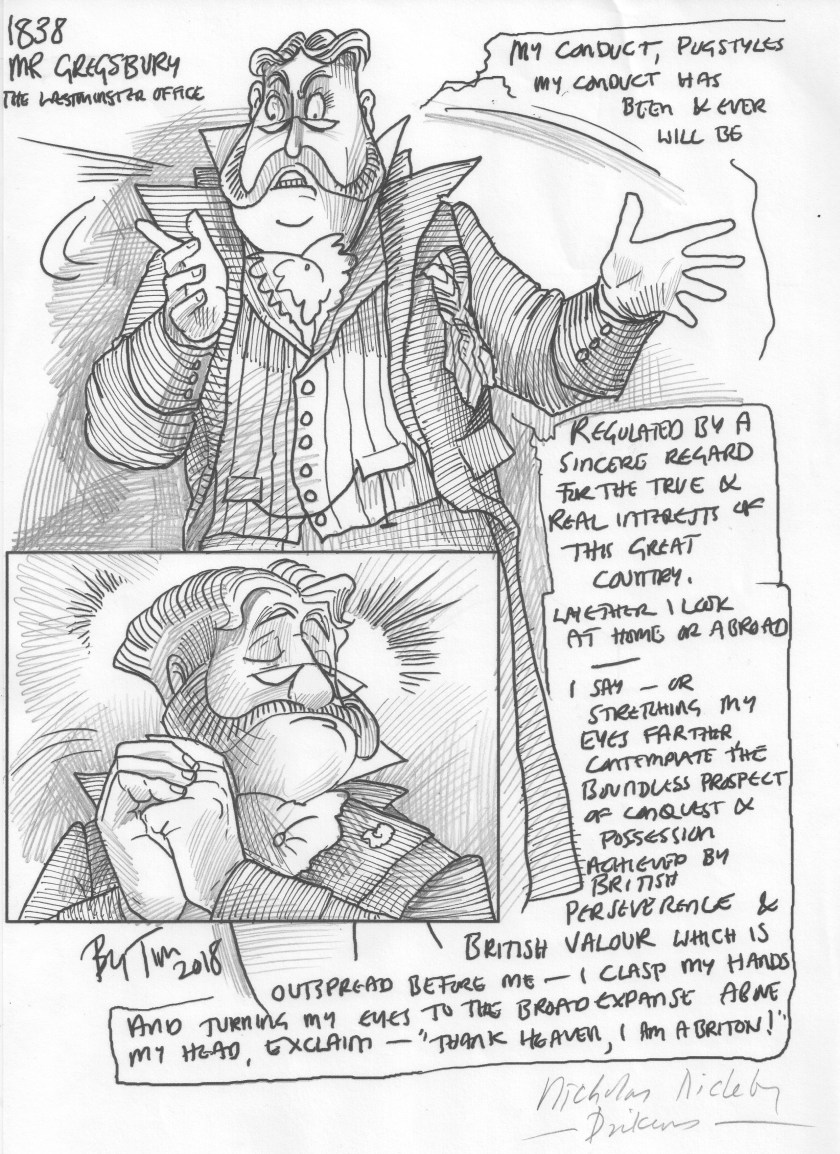
Nicholas Nickleby meets Mr Gregsbury when trying to get employment as a Parliamentary secretary. Gregsbury thinks he is being generous when he offers him 15 shillings and goes on at length about his various duties; Nicholas thinks the job is beyond him and says so.
‘Good-morning, sir,’ said Nicholas.
‘Door, Matthews!’ cried Mr. Gregsbury.
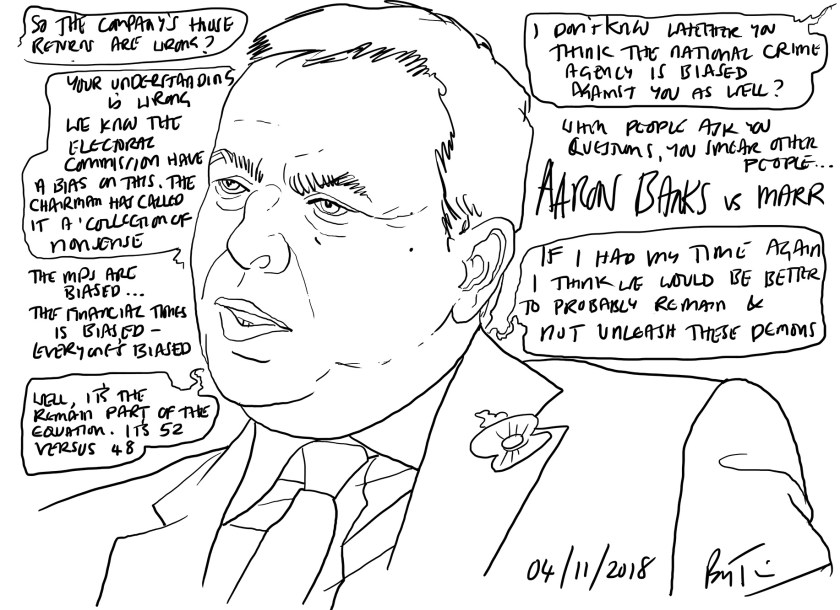
Aaron Banks and Andrew Marr
The details about Mr Banks’ apparent deception of Parliament along with the opening of a police investigation mark a new stage in the misery of Brexit, but not really one we could not have anticipated. It is surely right to ask whether, if the Leave campaign was funded with dodgy money, it is time to call for another properly organised referendum. This would not be a second referendum or even a referendum about the preferred exit details, but rather an entirely new process as the previous efforts are rendered null and void by potentially criminal activity.
We could run the same question again, and see what happens this time. There is now good reason to rerun, and more than that, we now have enough evidence to know what both “Leave” and “remain” might mean in practical terms. Somehow, I suspect the result would no longer be in favour of Leaving. But if “Leave” is so confident it is right,(Farage says “Leave would win by a much bigger margin”) it should be prepared to be tested again, when the competition can be properly monitoring and judged to be fair.
Indeed, before Banks, the Electoral Commission had already castigated the Leave campaign. It found that ‘Vote Leave’ officials were guilty of overspending £449,079.34. A criminal offence. More than that, the Facebook fiasco during the Referendum debate still threatens a £500,000 fine from the Information Commissioner. To cap it all, the House of Commons Digital, Culture, Media and Sport Committee on ‘Fake News’ concluded Russia has engaged in ‘unconventional warfare’. So there are three strikes and all pointing to wrongdoing to secure a Leave vote.
When MPs and Councillors are found guilty of electoral fraud, they are suspended and in the case of Bob Spink, for instance, given a prison sentence (admittedly suspended). In the case of the Leave campaign, no real action is taken.
This is what happens as a rule: four people were jailed and a fifth person was given a suspended prison sentence for electoral fraud after a local by-election in Maybury and Sheerwater in Surrey in 2012: Shaukat Ali, Parveen Akhtar, Shamraiz Ali, Sobia Ali-Akhtar and Abid Hussain, from New Haw, were charged over claims that postal votes were being fraudulently submitted. They were all convicted of conspiracy to defraud at Reading Crown Court. Shaukat Ali was jailed for 15 months, Parveen Akhtar and Sobia Ali-Akhtar were both jailed for nine months, and Shamraiz Ali was jailed for six months. Abid Hussain was given a six-month prison term suspended for 18 months.
In other words, in normal cases of Electoral fraud, there are consequences for the people who tried to benefit from criminal activity. The electoral result that was skewed by their malpractice is voided, the people involved punished and the election run again.
Not so with Brexit. Not so for those involved in damaging the integrity of the Leave Campaign.
One might argue, of course, that there were only a few “bad boys of Brexit”…
But so far, nothing is emerging about naughty Remainers. Their campaign, which was almost successful was not dogged by suspicions of outside interference, the abuse of facebook, or proven overspending. Now, finally, at the 11th hour, the Banks’ stuff emerges.
Now is the time to act.
Today the Observer ran an article exposing what seem to be dodgy dealings in the Banks’ empire. Allegedly, Eldon Insurance employees were made to work on the Leave campaign, some against their will. Together with the racism that invaded the campaign, some of it apparently printed by Rock services, and much of it informed by the darker forces allied with UKIP, the questions surrounding Mr Banks at least demand a proper debate before it is too late and we are fully committed to Europe in the half-way house peddled by Mrs May’s Chequers’ agreement.
As for Banks’ performance on Andrew Marr, well- the question was asked: “Where did the 8m come from?” and the answers that emerged were a mixture of obfuscation, aggression and arrogance that had Marr floored (“this is what you do, you smear other people” was what Marr was left to observe).

But Banks says he would have voted remain if he had known what a Leave vote might mean. This from the man who is alleged to have bullied his staff into working for the Leave campaign. If there was another vote today, in other words, the leading Leave campaigner would be voting to remain. That beggars belief!
Banks is a great puzzle. A former vacuum machine salesman, he amassed a fortune quite suddenly and then bankrolled UKIP. His CV needs a good deal of explaining- he may or may not have worked for Norwich Union or Warren Buffett and he may have made £100 million out of his sale of Brightside, though records suggest the figure was closer to £22. His mother-in -law, Olga Paderina, says today that he has done nothing wrong. Nevertheless, a cloud hangs over him.
If Banks is dodgy, and it remains to be seen- any trial will be too late to repair the damage he has done.
The risks of Brexit alone, with or without Banks, as they have emerged, might make it expedient to hold another public vote.
In any other situation we would have called time. Instead, we persist with a charade that we are doing “democracy”. We are not even doing that.
There are a number of ways to analyse the events of 23rd June 2016. the Brexiteers might cite the 263 that voted to leave in contrast to the 119 that voted decisively to remain. That would be a 68.85% majority vote. But this is never the figure put forward. Instead, people concentrate on the overall percentage of voters throughout the kingdom who voted to leave. That is just 17,410,742 votes.
In other words, with 51.89% voting leave out of a 72.21% turnout, that is not even a 50% majority. This is hardly decisive.
My friends in the Leave group, particularly from UKIP, tell me that should the Leave vote be ignored, there will be riots in the streets. I suppose that is a threat and we should not give in to that sort of thing. Maybe they will turn on Aaron Banks now he has said he would vote to Remain.
But much more than all that, the possibility that there was major wrong-doing behind the campaign makes the strongest case for pulling the plug now. We cannot do so after March. Stronger than expedience, stronger even than resisting bullies who threaten disorder is we do not do what they want. No. If we do nothing about electoral mal-practice, we condone it. That means the integrity of our political system is under threat.
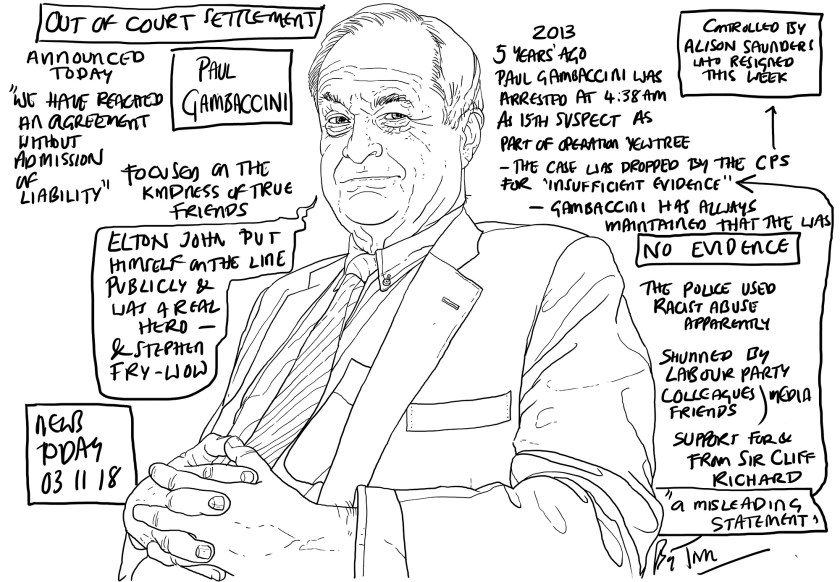
Some news today

Some drawings from the past

The other big story today:
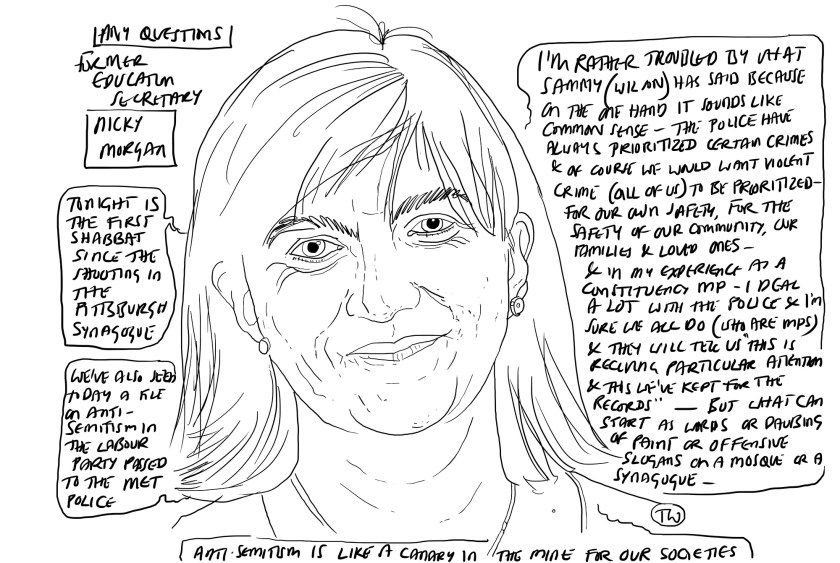
Nicky Morgan
Nicky Morgan drew the connection between words and violence in “ANY QUESTIONS”. The old nursery rhyme “sticks and stones make break my bones but words will never hurt me” is actually complete nonsense. Words can be as damaging as punches. They are the favourite tool of the bullies, used often against people they regard as “different”, who do not conform to their own narrow measurements and restricted sense of “right”. More than that, words may often be the first wave of a campaign of violence and so, to ignore verbal abuse is to invite, permit or tolerate something stronger. We cannot avoid or shelve the problem. It should be confronted and documented. Well done on this!
I am inclined to think that once the genie is let out of the bottle, though, there is no getting it back, and while Trump, for instance, may not be directly responsible for all the various expressions of violence in his country, his own brand of rhetoric gives the crazy a feeling that they now have a special licence to give vent to their anger. It is time for the moderates and the kind in the Republican party to step up, because the party will not go away- it needs to be transformed ideally from the inside. We need to take responsibility for the words we utter and we need be very careful about how they might be interpreted. As the man who is running for Mayor in London, Shaun Bailey, has found, words from the past can come back and haunt us. A world where everything is digitally recorded and stored is a very dangerous place. We need to be particularly vigilant.
Why Mary Beard is right

Recently, Mary Beard gave a lecture which some of my friends attended. The report I received from them was rapturous – she was controversial and authoritative. Actually, she was more than that. She was right.
Recently, Professor Beard was attacked by AA Gill. It is part of the same story- that people can be judged today more for whether they conform than whether they have something important to say.

The two issues Professor Beard specifically raised in the Listener talk were the abuse she suffered when her presentation in “CIVILIZATIONS” was cut when it was broadcast in the US, and the second was to make a firm stand against re-enactments or recreations in History documentaries. These are all over the internet, and particularly noticeable on PBS.
It would, however, be wrong to suppose that America is only to blame.
I was once engaged by a UK company to play the part of Socrates for one such history documentary, so I know from the other side how silly and absurd such recreations can be. More than that, we were filming not in a genuinely Attic setting but in the 19th Century Zappeion, a bit of the modern Greek parliament complex built specifically to celebrate the first modern Olympic games in 1869. It looked pretty and it might have been appropriate in a hollywood “swords and sandals” epic, but it is not “history” and nor does it actually tell the viewer anything useful. The reason is simple- because it dodges the issue of interpretation. All art is interpretative but because live-action film feels like ‘reality”, that is exactly how the viewer accepts it. The viewer is plunged into a magic realm and is the passive recipient of the director’s agendum. The viewer is a willing party to deceit.
Fine in a film like “Gladiator”, but not fine in a serious documentary about history. We need to know what is real and what is recreated.
This is frankly where my own work slots in: 2d animation can never masquerade as reality, but it can offer something more than “live-action recreation” to the documentary medium. If supported by the proper research, it can provide an insight into the way history has already interpreted events, much as quoting a specific writer as an authority can do. This is most beautifully illustrated by Richard Williams’ animated sequences in the CHARGE OF THE LIGHT BRIGADE.
Here, Williams shows us exactly how British newspapers peddled propaganda and half-truths to a gullible public, showing the glory of the empire in contrast to the gore and disaster that unfolded on the battlefield itself. The greatest moment is the Victory sequence which is brought to a sudden close by a canon firing. There was no victory- just a squalid collapse of authority and a chain of misunderstanding.
Williams’ animation tells us something valuable in its own right. And because we can never pretend what we are watching is anything other than a drawing, we cannot be bewitched into thinking that this is “reality”. But it might very well be a way to access Truth.
Because we often associate animation with Disney, we can get confused, but because 2d animation remains ostentatiously artificial, we can be sure we never forget that we are watching an interpretation. The Disney technique means we can do almost anything with animation that we could do with live-action. More maybe! Though it takes time.
Of course, I nurse a desire to bring the stories of Greek mythology to life through the red/ black figure images on greek vases- who would not immediately see the potential in this! But even more interesting would be to animate Flaxman’s illustrations for the Iliad and Odyssey which informed the way we have understood classical texts since the early 19th Century. His work led to the development of the blue and white jasperware that even today is in most of our houses. This is not about recreating or re-enacting events but about making a conscious decision to give us an insight into the way we now view these stories.
I am terribly proud of the work we did in the two Lucy Worsley programmes, the second of which is due to air in January- we used the device of turning the pages of a book, and of capturing images from framed pictures to comment, introduce and develop the ideas that were being presented.
When we forget that we are examining what people have said and recorded in the past, we simply enter a world of make-believe. It might be entertaining but it is not history.
ttps://rts.org.uk/article/mary-beard-cut-us-version-civilisation
The Day After

By all accounts and reactions, the budget seems to be very good, but with this caveat, that if the EU negotiations go wrong, or if the deal is voted down in the House, as has been threatened, all this positive energy will be wasted and all the promises ditched. The budget is, in other words a tantalizing glimpse of what might happen if there is a properly negotiated Brexit in March. In other words, as much of a threat as an offer.

The budget

Awaiting John McDonnell’s response
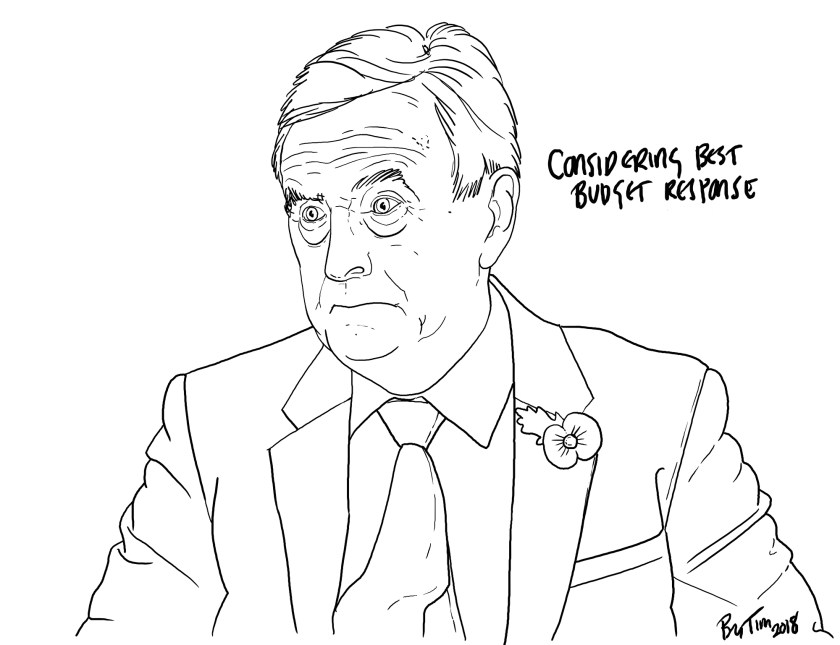
Just listening to the budget on Radio 4
As the Philip Green story unfolds on the News
Peter Hain was able to “out” Sir Philip Green because of a 1689 bill that established “Parliamentary Privilege” granting freedom of speech and a right that whoever speaks in the house “may not be impeached or questioned” by a Court. This, then, overturns the various injunctions that Sir Philip had laboured to put in place.
We may , of course, feel that Sir Philip should not have been allowed to “buy” even a temporary injunction. This is a form of privacy afforded the wealthy alone. And certainly the BBC should reflect on their own treatment of celebrities like Cliff Richard… but the law should be blind and should be allowed to get on with its business.
The evident joy in the newsroom should, however, be tempered by a reflection that, frankly, the British media has aided and abetted the sort of bullying behaviour that is alleged and that has been going on all over the place for years.

 animate-tim.com