

Category: Uncategorized
A great film about abuse
What tremendous animation for Day One from BBDO
animated by Lobo Creative Director Guilherme Marcondes
Lobo was started in 1994 by Nando Cohen and Mateus de Paula Santosin in Sao Paulo. they now have a second office in New York.
Produced by Aron Matschulat Aguiar
Animators: Andrea Delfino, Bruno Carias, Bruno Hamzagic, Daniel Alvite, Daniel Bahia, Daniel Vasconcellos, Janaina Bonacelli, Jorge Zagatto, Leonardo Cadaval, Marcelo Zanin, Marcio Nicolosi, Raphael Vinicius Seixas Silva, Renato Sena, Rodrigo Souza, Ronaldo Brito, Ste Kajimoto, Thiago Martins, Victor Fernandes
Animation supervisor: Marcio Nicolosi
3d modelling: Milton Dias, Frederico Martins, Diego Esteves, Eiti Sato, Daniel Adami, Felipe Bassi, Leo Rezende, Marcel Fukuwara
music: “Walking on Sunshine



Silence is not an option
Silence is not always Golden.
It is the result of repression are rightly resisted by feminism. In Ovid’s Metamorphoses, Philomela, who is part of the ruling family of Athens, is raped by her brother in law, Tereus. He tells her to be quiet, and when she refuses, he cuts out her tongue.
But her story lives on.

Silence is often about the brutality of authority. That is why, when we witness abuse of any kind, we should speak up. The victims have suffered enough already. Glossectomy or rather Elinguation is rarely practiced today, but our rulers have other ways to enforce silence.
New Laws in Scotland in 2014 make it now illegal to march a brass band past a church. A military band can certainly go past (if there are no more than 6 people abreast) but it must do so silently. It is quite literally the beginning of a gagging order and very disturbing: it might well interfere with our right to free expression. It makes scenes, for instance, like the brass bands of Corfu and like the big number just before the Interval in Hello Dolly quite impossible to stage on the Royal Mile. It makes a nonsense of The Music Man! Then again, there is little information about Nicola Sturgeon’s reverence for Hollywood or for the Greek Church!
Here is another story of ELINGUATION:
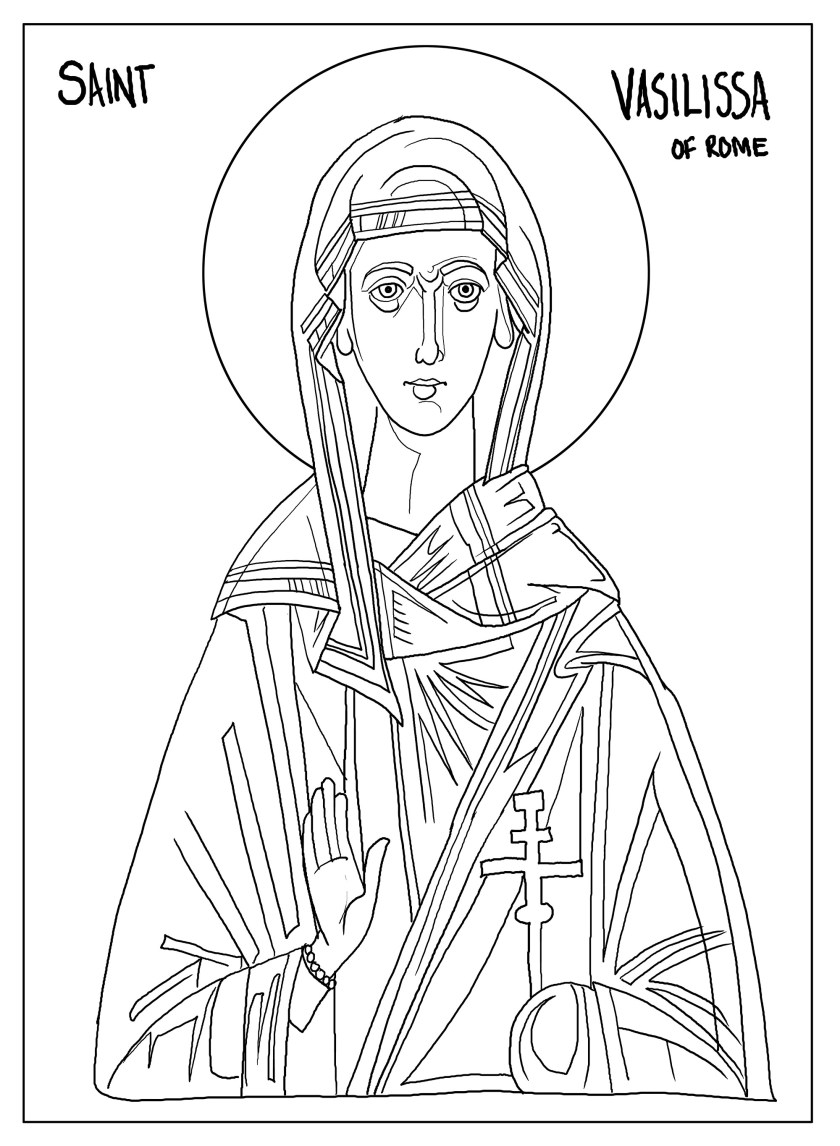
Years ago, I was required to read texts like this, over breakfast to the assembled monks:
“15th April is the Anniversary of the Saints Vasilissa and Anastasia. These were natives of Rome, the capital; they were ladies distinguished by birth and wealth, and disciples of the Holy Apostles. When the Apostles were crowned with martyrdom, Basilissa and Anastasia had their holy relics collected and moved by night. For this the two women were denounced to the Emperor Nero, and were accordingly thrown into prison, and, when they remained steadfast in their profession of Christ, were brought forth again, hung up until their breasts, hands, feet, and tongues had been cut away; after which, they were both beheaded.” (de SS Martyrum Cruciatibus)
We may never quite know who killed Jamal Khashoggi. What we do know, however, because he reported it at the time, was that he was ordered in December 2016 by the Crown Prince of Saudi Arabia to be silent. “He said, ‘You’re not allowed to tweet or write your column or give comments to foreign journalists,’” The following September, he went to Washington. Up to this point, Khashoggi had been, oddly, not unsupportive of the Prince. “He truly wants to make Saudi Arabia great again. But he is doing it the wrong way,” he told other journalists. But this was before MBS arrested and imprisoned Saudi journalists. Of course, the Prince is not alone in this part of the world in using an anti-corruption ticket to clean out his political rivals. But imprisoning or detaining people without trial, effectively silencing all opposition, is not a positive trait in any National leader.
We now know that MBS thought Khashoggi was a member of the Muslim Brotherhood, by all accounts a dangerous group, and something his family firmly deny. Whether it is true or not remains to be seen, but surely that allegation alone suggests a motive? All very worrying.

One final point- the death of Khashoggi and the pressure this now puts on the Saudi administration may well mean there is finally room to call for a credible ceasefire in Yemen. So far, our silence on this issue, particularly in the UN, is shameful. Once again, silence is not golden.
Trial by Jury

Quick cartoon

Some RS notes
State Three religious traditions, other than Christianity, in Great Britain.
Explain Two reasons why the Trinity is important to Christians.
Explain two ways Christians respond to the problem of evil and suffering.
In your answer you must refer to a source of wisdom and authority. (5)
Atheists believe in NO GOD
AGNOSTICS believe it is impossible to Know
Quotations:
On evil
he promises to comfort his servants (Psalm 119: 66-76)
Cursed is the ground because of you; through painful toil you will eat food from it all the days of your life. It will produce thorns and thistles for you, and you will eat the plants of the field’ (Genesis 3: 17-18)
‘inasmuch as ye do it unto one of one of the least of these… ye have done it unto me’ (Matthew 25:31-46)
on creation and arguments for God:
I am alpha and Omega, the beginning and the end. Revelations 1:8; 22.13
Genesis 1-2 God creates in 6 days (some people take this literally – see my drawings for this)
Koran 79:27- Allah constructed it
All humans descend from Adam
Isaiah 42: 12: It is I who made the earth
Maimonides (Jewish scholar): “If it is created in time, it undoubtedly has a creator”
Upbringing:
Proverbs 22:6: Start children off on the way they should go,
and even when they are old they will not turn from it.
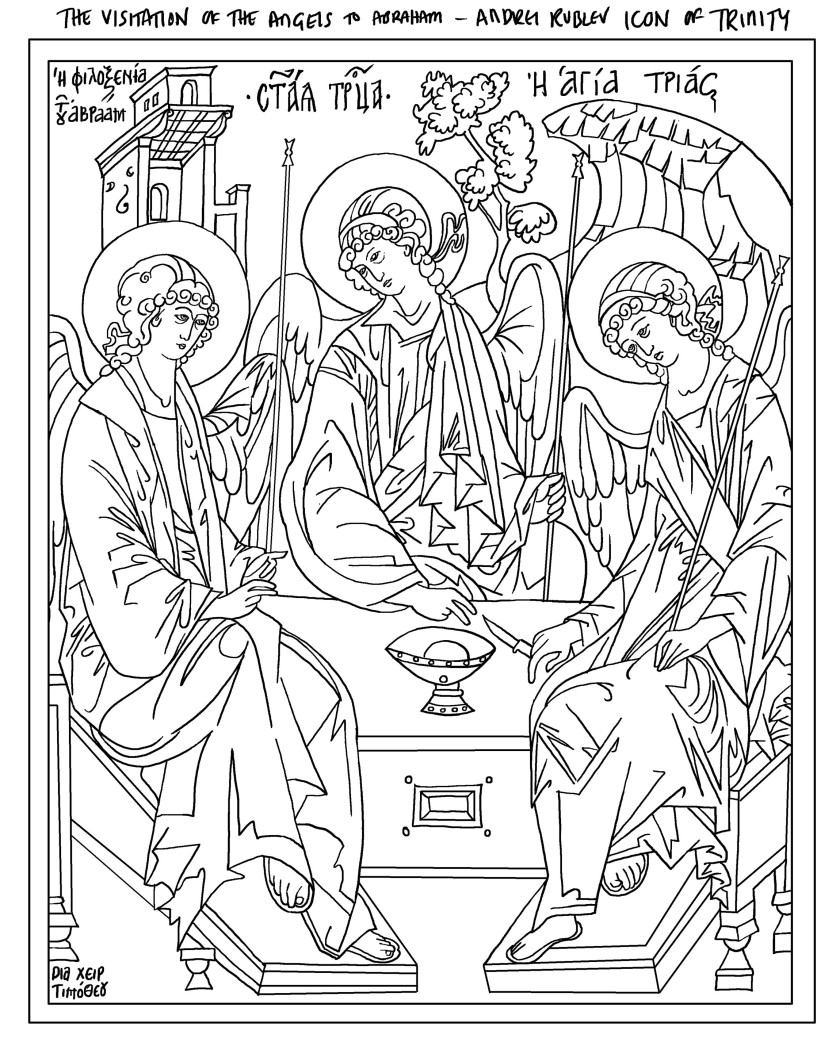
The Trinity:
Matthew 3:16-17
As soon as Jesus was baptized, he went up out of the water. At that moment heaven was opened, and he saw the Spirit of God descending like a dove and alighting on him. 17 And a voice from heaven said, “This is my Son, whom I love; with him I am well pleased.”
325 AD The Nicene Creed (written) at the council of Nicea and recited in Church services especially on Sundays (Orthodox, Catholic and Anglican)
and the Council of Constantinople in 381 defined the concept of the TRINITY
John 14:16-17: And I will ask the Father, and he will give you another advocate to help you and be with you forever— 17 the Spirit of truth. The world cannot accept him, because it neither sees him nor knows him. But you know him, for he lives with you and will be in you.

Genesis chapter 2 (slightly different story:)

Design argument: the classical design argument for the existence of God and its use by Christians as a philosophical argument for the existence of God; divergent understandings about what the design argument may show about the nature of God for Christians, including Romans 1:18–24; Christian responses to non-religious (including atheist and Humanist) arguments against the design argument as evidence for the existence of God.
Many Christians believe in the design argument- this proves the role of God in the universe.
The universe does not exist just by chance- there (a) is a purpose to everything or (b) a rule that governs everything
Surah 2:164 “the creation of the heavens and the earth, night and day, winds and clouds are a sign for people who use reason”
Romans 1:20: “For since the creation of the world God’s invisible qualities—his eternal power and divine nature—have been clearly seen, being understood from what has been made, so that people are without excuse.”
Two main ideas of design argument: 1) by Aquinas- the rule argument. (inanimate things still are governed by “rules”; today this still works if we think of the universal rule of “gravity”)
2) purpose or complexity: idea of William Paley (the watch metaphor on the heath. Every part of the watch was designed) even the smallest items in the universe seem to have a purpose. Think of the way climate change has spiraled out of control because we used fossil fuels.
William paley thinks of the complexity of a watch and compares this to the complexity of the human eye (many parts combine to support a single function)
Could not happen just by chance!
Many parts
Sophisticated machinery
(think of the fibonacci sequence in spiral shells and the arrangement of petals on a flower. They follow a RULE)
(Fine tuning theory of science: the existence of water, the goldilocks region where the earth is situated in the solar system.. the conditions of earth are uniquely suitable for sustain human life)
BUT: This is not the God of religion:
But even if God were a divine watchmaker or rule-giver, he does not need to exit now, and does not need to be a single God. Could be a factory of watchmakers…
Some people are not convinced. CHARLES DARWIN puts forward the theory of evolution (the survival of the fittest)
In 2009 a survey found that 37% of people in Britain accepted the principle of evolution. (is beyond reasonable doubt”)
Some people think that evolution can be reconciled to the design principle: God started off the process (maybe he no longer exists)
Everything has a beginning. Nothing comes from nothing (Parmenides)
2.7 Cosmological argument: the cosmological argument for the existence of God and its use by Christians as a philosophical argument for the existence of God; divergent understandings about what the cosmological argument shows about the nature of God for Christians, including Thomas Aquinas’ First Three Ways of showing God’s existence; (Cosmological argument) Christian responses to non-religious (including atheist and Humanist) arguments against the cosmological argument as evidence for the existence of God.
The Cosmological argument has its origins in ISLAM:
Kalam, argument by al Ghazali
actual infinite cannot exist
Everything that begins to exist has a cause of its existence.
The universe began to exist.
The universe has a cause of its existence. (so, the universe ‘s existence proves the existence of God)
Ghazali wrote: Kitab al-lqtisad fil’ltiqad =moderation in belief
He believes in the dignity (sharf) of knowledge
If All knowledge comes from God (God created us as thinking beings) then we can use our knowledge to get to the point where we can understand revelation. Religion and reason should be in harmony.
(1) Thus, all knowledge or science must lead towards reaching the ultimate reality of God, to the extent possible given human capabilities.
(2) The potentialities of human knowledge are affirmed by Islam in its recognition of various registers and abilities, including external and internal senses, reason, intuition, and revelation.
(3) Moreover, all knowledge must be established with certainty,
knowledge. the rational and logical method, independent of intuition and revelation, could also lead to a level or a form of certainty
Surah 79 27-33
The Mediaeval scholars in Europe like Thomas Aquinas were influenced by Muslim thought (because of the Muslim population in southern Spain)
Aquinas (13th Century 1225-74) defined 5 ways to philosophically prove the existence of God. The first three form the COSMOLOGICAL argument
-argument from Motion (everything is in motion(Heraclitus). Something started all that motion)
Argument from Cause (everything is caused in a long chain of cause and effect. There was an original first cause)
Argument from Contingency
(Everything we know is dependent on something else. At some point there was therefore nothing. As nothing can come from nothing, and as there is clearly something now, them must be a being on which everything else depends. So that non-contingent/ necessary being is God)
There is also a 6th way invented by Anselm of Canterbury (11th century) called the Ontological argument which tries to prove the existence ofn God by simply defining what God is (that than which nothing greater can be considered, or in 17th Century, God is perfection, a re-boot of the argument by Rene Descartes)
OBJECTIONS:
1) BUT: If everything has a cause, why is there an exception for God. (God is the uncaused first cause. Why could we not say the universe is the uncaused first cause?)
2) no evidence that the first cause is actually “God”
3) some people think the big bang is the first cause. Some other people ask what caused the big bang – In fact, this is a silly question. The big bang creates TIME and SPACE so we cannot ask what is before time and space…
Big bang first defined by Georges LeMaitre (Belgium catholic priest)- so religion and science do not have to be in opposition)
2.8 Religious upbringing: Christian teachings about raising children to believe in God, including reference to Proverbs 22:6; features of a Christian upbringing and why they may lead to belief in God; Christian responses to non-religious (including atheist and Humanist) arguments about why a religious upbringing may result in a rejection of God’s existence
Atheism assumes an initial belief in God
Atheism is about a rejection of THEISM
Principles of the family:
Ideas of modesty and the role of women may be rejected by some people today
Ideas of gender equality may be more emphasised today than in Bible
Traditional role of the marriage may be questioned by development of legally recognised gay marriage
Laws that redefine marriage:
Same sex marriage legislation: Marriage (same sex) couples act 2014
Adoption and Children Act 2002 –allows single parents and gay couples to adopt
Statistics:
In UK, in 2011 only 1 in 3 marriages involves a religious ceremony and 33% end in divorce (society has become more secular)
St Paul to Ephesians: 5.21-22: Wives, submit to your husbands as to the Lord. For the husband is the head of the wife as Christ is the head of the church, his body, of which he is the Saviour. Now as the church submits to Christ, so also wives should submit to their husbands in everything.
Galatians 3: 28: There is neither Jew nor Greek, slave nor free, male nor female for you are all one in Christ Jesus.
Pope John Paul II: Men should truly esteem and love women with total respect for their personal dignity, and society should create and develop conditions favouring work in the home.
Genesis 2:8: The Lord God said ‘It is not good for the man to be alone. I will make a helper suitable for him’
1 Timothy 5:8: If anyone does not provide for his relatives, and especially for his immediate family, he has denied the faith and is worse than an unbeliever.
Ephesisans 6:1-4:
Children, obey your parents…Parents, do not exasperate your children; instead, bring them up in the instruction of the Lord.
Passing on traditions:
Deuteronomy: 6:5-6: These commandments that I give you today are to be upon your hearts. Impress them on your children. Talk about them when you sit at home and when you walk along the road, when you lie down and when you get up.
Constable
Deeply distressing to see the two Russian men claiming to have been in Salisbury to look at a 123 foot spire and an old clock! There is really only one credible reason to visit Salisbury and that is because the Cathedral was painted twice by John Constable. The second painting (immediately below) is about 10 years’ later than the more famous Hay Wain which, incidentally, was in the news not so long ago for having a photo glued to it by Fathers4Justice.

The other painting was done in 1823; it is a bit brighter. This version (in the V&A) was, nevertheless, considered a bit “dark” and there are brighter versions without the dark clouds currently in Brazil and New York.

more on Edward Lear
here is a screen capture of the background to the song “there was a young person of Smyrna” which I have been working on for the last week or so.

the song begins with Lear singing in the wings and then moves to a full stage show with a chorus of cats and a lady with a purple handbag…the background should give the impression of Lear walking from backstage on to the stage itself.
Archbishop Angaelos of London and others
Here are some recent pictures, the first of which is of the cleric who read prayers for Harry and Megan. I rather hope that my former students will have recognised him!

The archbishop was enthroned in November last year. He is the first Coptic Archbishop of London.


WATER
Here are some notes which were prepared for a school…do feel free to borrow as you wish.
the illustrations are fun
ZEN BUDDHISM:
In Japan, in Buddhist temples you will sometimes see a basin called a “tsukubai” which is used for washing before ceremonies. It is also used in the tea ceremony People wash their hands or mouth at the “tsukubai”. It is on the ground so you must crouch. The word “tsukubai” means “to bow down” or “to crouch”
The tsukubai are made of stone and have a small spoon to scoop out water and pour it on your hands etc. both the person giving and the person receiving HOSPITALITY plays an important role in the ceremony.

The Japanese tea ceremony is part of this image of pure water Note the kanji (special ceremonial/religious writing) from the first picture and the translation below. Everything has a meaning
 The tea ceremony (Cha-e 茶会) involves waiting. Guests come into the tea garden from an outer garden called the Yoritsuki. They wait in the KOSHIKAKE MACHIAI before they are invited into the teahouse.
They walk down the garden path (ROJI) and they are made to feel they are entering a different world. Time is slower.
The Teishu opens a sliding door to the teahouse (Chasitsu: 茶室) to greet the guests
Guests begin the ceremony by washing their hands at the Tsukubai
The floor of the teahouse is covered with Enza (special mats)
People kneel on the floor
They are given tea by the TEISHU (tea maker/ host)
They eat WAGASHI (sweets) and drink tea.

THINKING ABOUT WHAT WE ARE DOING
The tea ceremony is about doing something very simple in a perfect way. It is about hospitality and it is about making simple things beautiful.
It is about THINKING about what you are doing.
Most of the time, we do not think about what we are doing. We listen to music. We talk. We think about OTHER things.
The tea ceremony shows us about conscious learning.
This is something that we practice in mediation.
Forms of meditation exist in all the main religious traditions.
HINDUISM
Brahmins follow the strictest idea of ceremonial washing.
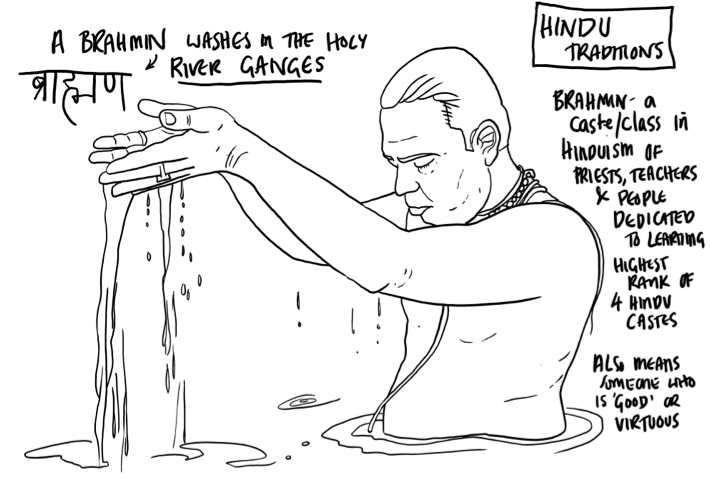
Many Brahmin wash in the holy river Ganges.
(the man in the picture is wearing the “sacred thread” or UPAVITA which shows he is following a guru or teacher. The sacred thread is won in the same way -over the left shoulder- that a woman will wear a sari)
Every year, up to 40 million people travel to the river Ganges to wash. (Pilgrimage)
A Pilgrimage is a journey where people feel they are doing something to get closer to God. Pilgrimage happens in all the main religions.
Hindus try to make one pilgrimage in their lifetime. The river Ganges is a favourite place of pilgrimage. It is sacred to the Goddess GANGA. Bathing in the river washes people of their sins and helps people to MOKSHA (Release from death as well or “awakening” and it also leads to a greater knowledge of themselves)But many people also travel to sacred mountains and temples linked to particular gods and goddesses
Some people believe in achamana which is drinking and touching pure water from the palm of the hand (this is an important p[art of Brahmin rituals but actually any Hindu can perform this ritual) when reciting special prayers called Mantras

It also involves putting a tilaka on your forehead
Special washing ceremonies called Punyahavachanam are used before marriage, Homa. Water is generally sprinked on people (ASPERGES)
Traditionally, the bride’s parents wash the feet of the groom before the wedding.
Abhisheka: a deity’s murti or image is washed in water, milk, yoghurt ghee, rosewater
It is an important part of the ritual of a coronation (does not happen very often now!)
When a death happens, Hindus may take a bath to clean themselves
Women often take a bath after they have a period.
Many of these traditions are shared across the various faiths.
ISLAM
Before praying, Muslims wash: they wash hands, mouth, nostrils, arms, feet and head It is called “al WUDU” الوضو In Turkish and Albanian, this is known as “abdest”, and in Persian as “dast-Namaz” (literally means: “Before praying” The word Namaz in Punjabi/Sanskrit/Persian means “Prayer”)

1) After receiving the bread and wine, a priest washes his/her hands in the Anglican/Catholic/Orthodox Church
2) On Ash Wednesday a mark is made with ashes on people’s foreheads. What do you think this symbolizes?
3) Catholics believe that Baptism washes away people’s “original sin”
4) Baptism is a form of “initiation” (Beginning)
Initiation: an important word. Do you remember we talked about the way we “initiate” a class- how does a class begin? When does a class begin?
5) In Judaism people often visit the MIKVEH if they are “unclean”, that is if they have been in contact with dead people, blood –
6) Many people in Christianity make pilgrimages to Rome, Jerusalem (2 million tourists a year), and in the middle ages, people famously travelled from across the kingdom to Canterbury where ArchBishop Thomas a Becket had died. A famous book called “the Canterbury Tales” was written about the journey and the stories people told to each other. Some of the stories are serious and some are very funny. The book is one of the first great bits of English writing by Geoffrey Chaucer.
Sikhs may visit the golden temple of Amritsar. Hindus may visit the Vaishno Devi Temple in the mountains of Kashmir. Buddhists may visit the Bodhi tree or life tree where Gautama meditated for 49 days before his enlightenment. 13 million Muslims visit Mecca every year. In Mexico, 10 million Catholics visit the Basilica of Our Lady of Guadalupe.
7) Meditation. There are many forms of meditation in Christianity. In Catholicism, some people say the ROSARY (a series of prayers based on a string of 50 beads), some Orthodox Christians recite the “Jesus Prayer”, some Christians believe in silent prayer. There is a tradition in Sufu Islam of dancing (the Whirling dervish). In Hinduism and Buddhism people often use a simple word or mantra repeated over and over again. They feel this is relaxing and brings them closer to God.
Some people practice meditation without religious belief. It can be a very therapeutic exercise (therapeutic/ therapy- from the greek θεραπεύω I serve, cure, heal)
8) Sharing a meal, hospitality. Remember the story of Abraham and the 3 angels. In Christianity, Hospitality might involve “Holy Communion” where Christians celebrate their community together by sharing a simple meal. “Eucharist” simply means “thankyou”.
9) Images and words help us to “enter another world” and to concentrate.
10) Icons, statues and religious pictures are sometimes blessed and washed in Christian ceremonies. On the first sunday of Lent in Orthodox Churches, it is traditional to bring icons to church to bless them and carry them in procession.
 animate-tim.com