
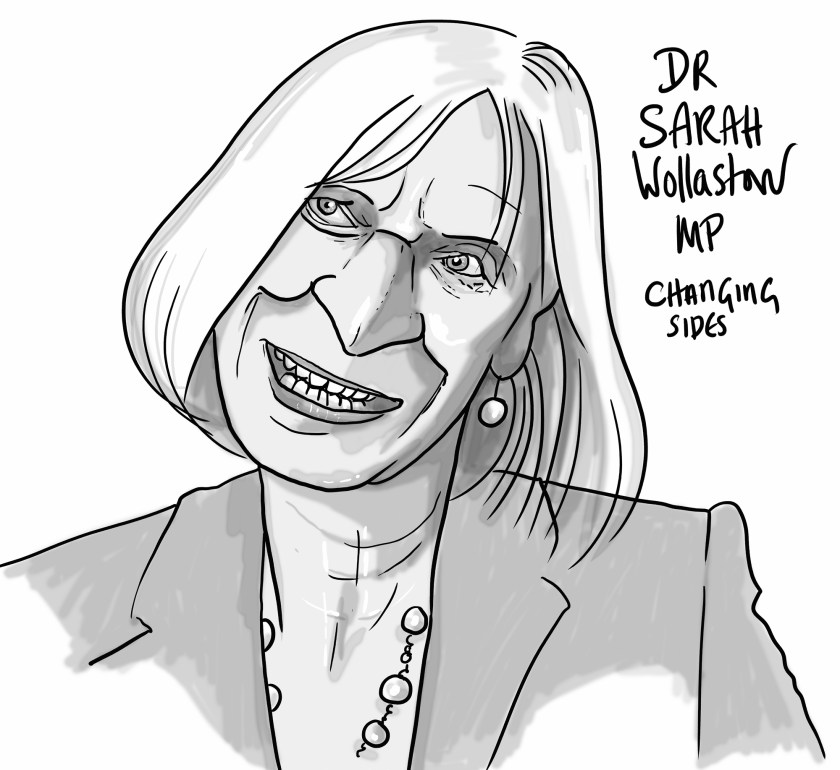
Yesterday, Dr Wollaston changed sides. I quite admire people who change their opinions especially in the middle of a race. It is rather noble, I think, to defy the school 400m, turn tail and run backwards to the starting point. It requires guts and self-judgement as well as a fair degree of élan to pull off this sort of manoeuvre successfully.
It is also something that, quite frankly, you can only do once. (I did it so that is the end of that)
In this case, I think Dr Wollaston has actually drawn attention to a disturbing trend in the Referendum campaign. She said that she was not comfortable with the claims being made about the potential money, potentially £350 million a week, available to spend on the NHS (and the simple fact is that she is right). This is what she has said,
“For someone like me who has long campaigned for open and honest data in public life I could not have set foot on a battle bus that has at the heart of its campaign a figure that I know to be untrue.
“If you’re in a position where you can’t hand out a Vote Leave leaflet, you can’t be campaigning for that organisation.”
This is all well and true, however, and I have been saying this for a while, but the problem here is that the claims made about the £350 million were being made quite a few weeks’ ago, so her sudden defection seems a bit tardy. Was it that she did not think the claim mattered as long as it was not plastered over her own bus? The timing of her move is just not quite right.
Dr Wollaston is quite good with warnings – she warned us before the General election about the need for a £15 billion spend on the NHS to avoid the whole system imploding during the present parliament. So prophetic and right again, but late, and she is doing the same here.
We also heard about fraud (£670 million lost last year with 9000,000 Euros lost to dishonest EU staff!) but the figures were drawn from Olaf, the EU fraud office, which presumably is in the process of catching the fraudsters and putting the money back where it belongs.

Boris has made the £350 million claim fairly often-“We send the EU £350 million a week – let’s fund our NHS instead.” -that is 350 million a week going to Brussels (17.8 billion a year), but with the rebate (1984) the actual figure is closer to £240 million and the rebate takes place before any money is sent to the EU so the claims made about Britain sending £350 million a week to Europe are blatantly false.
More than that, the £240 million odd that is sent to Brussels does not include the money spent by the EU on UK projects. Scientific research (in 2013 was £1,4 billion a year), education and the arts all benefit from EU investment and bring the overall net fee to around £130 million a week- still arguably alot of money, but significantly less than the claims made by Boris.
The letter
The UK Statistics Authority wrote rather apologetically to explain to the leave campaign that their figure was wrong, but still the sum is peddled out…


But there are other more serious errors. The first is the simple fact that even if we save £350 million every week, there is no guarantee it will be used in the NHS or can be ring-fenced at all. If a “Leave” result causes the economy to tumble as some predict it will, then much of that savings will be lost anyway and the reality of the post-Brexit negotiations certainly does not guarantee any substantial savings if we follow Norway . So the simple fact remains- if I do not spend money as it is currently spent, that does not automatically mean I have saved it- It may mean I no longer have the money to spend at all.
The Philosophical problem
There are good reasons for voting “Leave”- supporting our declining fishing industry is one of them, and I contributed advertising to that end.
I still think this is an important cause, but on reflection, I am not sure it is enough to see us quit the EU. That alone is not enough- a big negative gesture will not bring about anything positive. Again, back to the Wollaston issue- saving £350 million does not mean we can or would automatically use that money on the NHS.
Here is the mistake of the BREXIT campaign in this instance and it is a serious one: not doing something bad does not mean we are automatically committed to doing something good.
And back to Statistics
But the Remain side has been equally plagued by dodgy statistics, so once again Dr Wollaston’s desire for honesty is compromised. The Osborne claim that families would be £4300 worse off after Leave is again fairly spurious and based on a misreading of Treasury data. Jacob Rees Mogg is someone I respect a great deal and this is his conclusion-
“I care nothing about the bus. I am not concerned about charabancs. That is not at the heart of the debate.
“I have always used the net figure. What is far more shocking is that the Chancellor has been using a figure he knew would be misleading.” Mr Rees-Mogg is in the Brexit camp.


 .
. Still, what Cameron said seems fairly legitimate: Nigeria is demonstrably corrupt. However, what has happened is a home goal because President Buhari’s brilliant, evasive and commendably concise response has had the effect of turning attention from his country’s dodgy dealings to questions about the lingering impact of Empire and the slow progress of restoring money after it is confiscated by the British legal system. More than that, Buhari readily admits his country is certainly corrupt- or rather, as a representative of the new Nigerian Administration, he says this is something he has discovered himself. “He was telling the truth. He was talking about what he knew.” The previous government had stolen an estimated £10 billion through arms trafficking. Buhari is determined to tackle corruption which he calls a “hydra-headed monster”.


 Last week, I wrote to Lord Dubs to express my concerns that his amendment had been defeated to take into Britain 3000 Syrian children who have already made it to mainland Europe. The Government is prepared to take children directly from Syrian refugee camps by 2020, but I think this rather misses the moral issue and the urgency involved. This is not really a numbers’ game. We cannot- or should not- pick and choose how we do our charity and how we respond to those in need. When someone turns up on the doorstep asking for help, I think this is a God-sent opportunity, and it is also of course a political hot-potato. We can take it or leave it- that is about us, and that aspect of charity has always seemed a bit self-centred. Instead, we should ask- how about the Refugee child? How many parents can really imagine what it would be like to know their own children are stumbling across a foreign continent without much hope? I think, very few. We cannot expect others to suffer what we would not.
 I am astonished that the BBC report on the Livingstone affair today lets him get away with the perverted chronology that he presents as “fact” on BBC Radio London. Either he is wrong and the BBC have avoided making that clear or he is right. No subsequent BBC report makes it clear that his so-called “facts” are wrong.
 I need to choose words very carefully here- I am stepping over (or into!) the shoes of the current Archbishop of Canterbury. I am certainly challenging what he said. Justin Welby preached “fear” and that, to me is a red line that should never be crossed. Gone are the days when the pulpit offered such entertainment. Today we can cast our minds back to “Hammer Horror” if we want a thrill, or we can look to the diet of films that have played out in the few years since the millenium. Here are a selection of such films for a man evidently hooked on “fear” like the current Primate of Canterbury- “The others” (2001), and Mulholland Drive (2001), “the Ring”(2002), “Orphan”(2009), “the descent” (2005), “Bug” (2006), “Let the right one in” (2008) and its sequel “Let me in” (2010). We do not need fear-mongers in the pulpit and certainly not those who advocate principles that fly in the face of their own vocation. At a time when the TV is filled with the xenophobic rants of Trump, I believe Justin Welby makes a bad problem worse. In short, as the senior cleric in the UK and leader or guardian of our moral health, he had no right to sanction our fear of migrants.
 There is a great moment in the play “A Man for All Seasons” by Robert Bolt when Thomas More is finally brought to trial for treason and faces Sir Richard Rich (played in the film by John Hurt), the man who has perjured himself and More asks, “Is it probable that after so long a silence on this the very point so urgently sought of me, I should open my mind to such a man as that?” As Richard prepares to leave the chamber, More looks at his new chain of office- “the red dragon?.. Why Richard it profits a man nothing to give his soul for the whole world, but for Wales?”
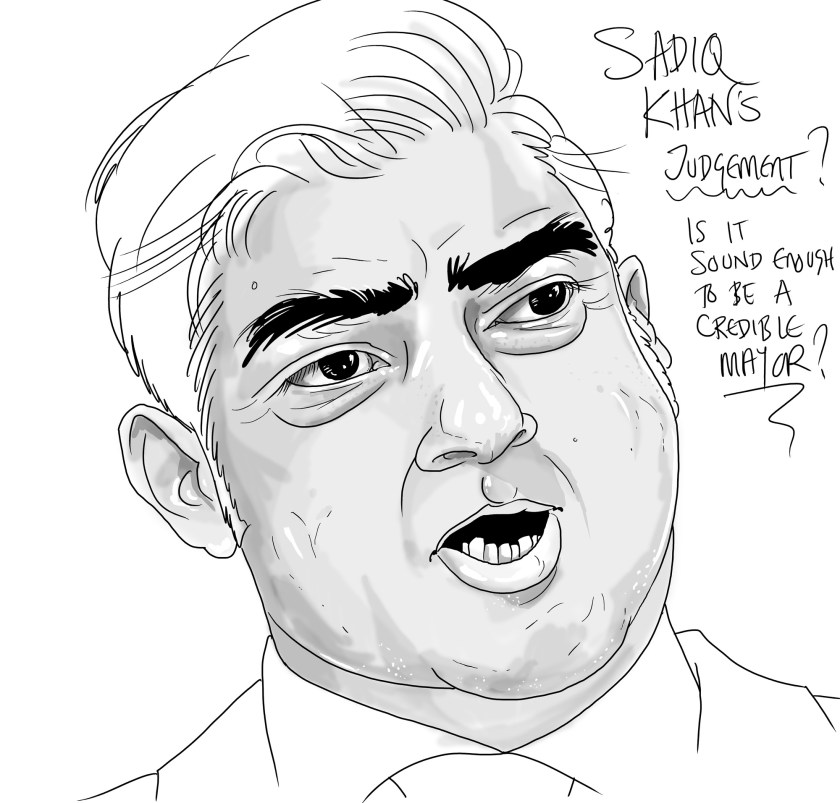 Sometimes, even as an artist who admires Aubrey Beardsley and Erte, I have to bite the bullet and admit that substance is more important than appearance. The race for the London mayor is one of those times. It may seem like some sort of abstract Platonic argument- that we need to ignore the glitzy images and look at the reality behind the razamatazz, but that is how it is. The reality stinks and we have to identify it for what it really is: bad judgement, and demagogy.

 animate-tim.com