
David Watson has put together many of the Edward Lear compositions to form a Suite. We shall post a version of this shortly. In the meantime, in celebration, here are some Edward Lear illustrations.


Here is the Dong with a luminous nose-

David Watson has put together many of the Edward Lear compositions to form a Suite. We shall post a version of this shortly. In the meantime, in celebration, here are some Edward Lear illustrations.
Here is the Dong with a luminous nose-
On Thursday, a BBC 4 programme airs about three distortions of history- Richard III’s death, the Glorious Revolution and the formation of the British Raj. I was asked to provide titles and animated sequences throughout the series. the sequences show some of the contemporary images, initially on manuscript paper, and finally on what appears to be the pages of the Illustrated London News. Lucy Worsley presents and I am confident that it will be a good show!
Here, meanwhile (though it is NOT in the show!) is a quick drawing that I did of Lucy as Richard III.

Here is an earlier post:
https://animate-tim.com/2016/12/11/some-history-work/
I saw this the other day- wonderful!
a homage to Remy the Stunt driver in “the Italian Job” – original here:
And here are two cartoons that I did for the Turkish press. Following the vote on the Presidential system, one MP bit another and a particularly outspoken MP chained herself to the Speaker’s desk.

Last year, I did a speech about the change in system and particularly suggested that, in a modern democracy, it seemed the army should no longer play a central part in political life. One hour later, there was an attempted military coup. The coup was thwarted. Things change slowly.

Here is the first frame of animation for the matilda song:


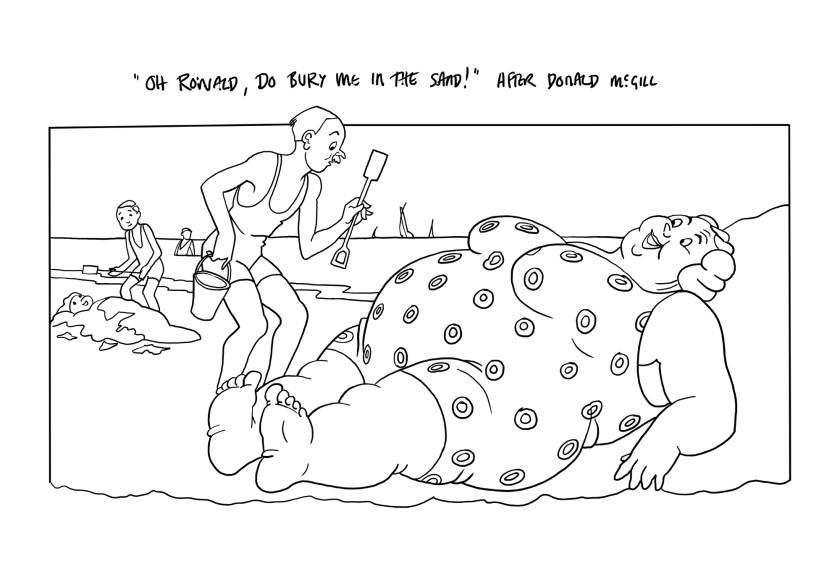 A sequence I am working on at the moment (Matilda by Harry Champion*) to complete the two music halls films draws inspiration form the work of Donald McGill.
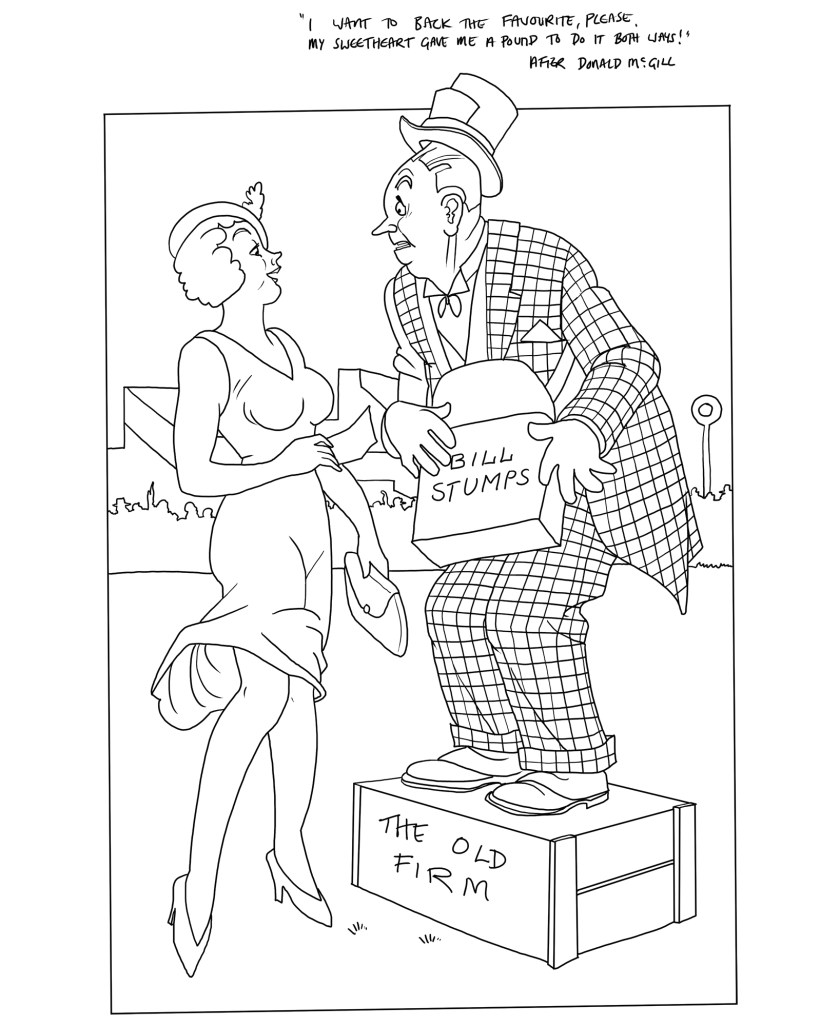
Just after the war, about 1300 subversive picture postcards, redolent in double-entendres, were seized by the police and a court case was held to judge whether these cards were undermining public morality. Oddly, it is exactly the same sort of humour that turns up on screen a few years’ later in the “carry on films”. They got away with it. The postcard industry was not so fortunate. The line taken by the postcard artists in court, however, was that the pictures were only offensive to those people corrupt enough to appreciate the risqué jokes. Quite a brilliant bit of legal subterfuge in itself.
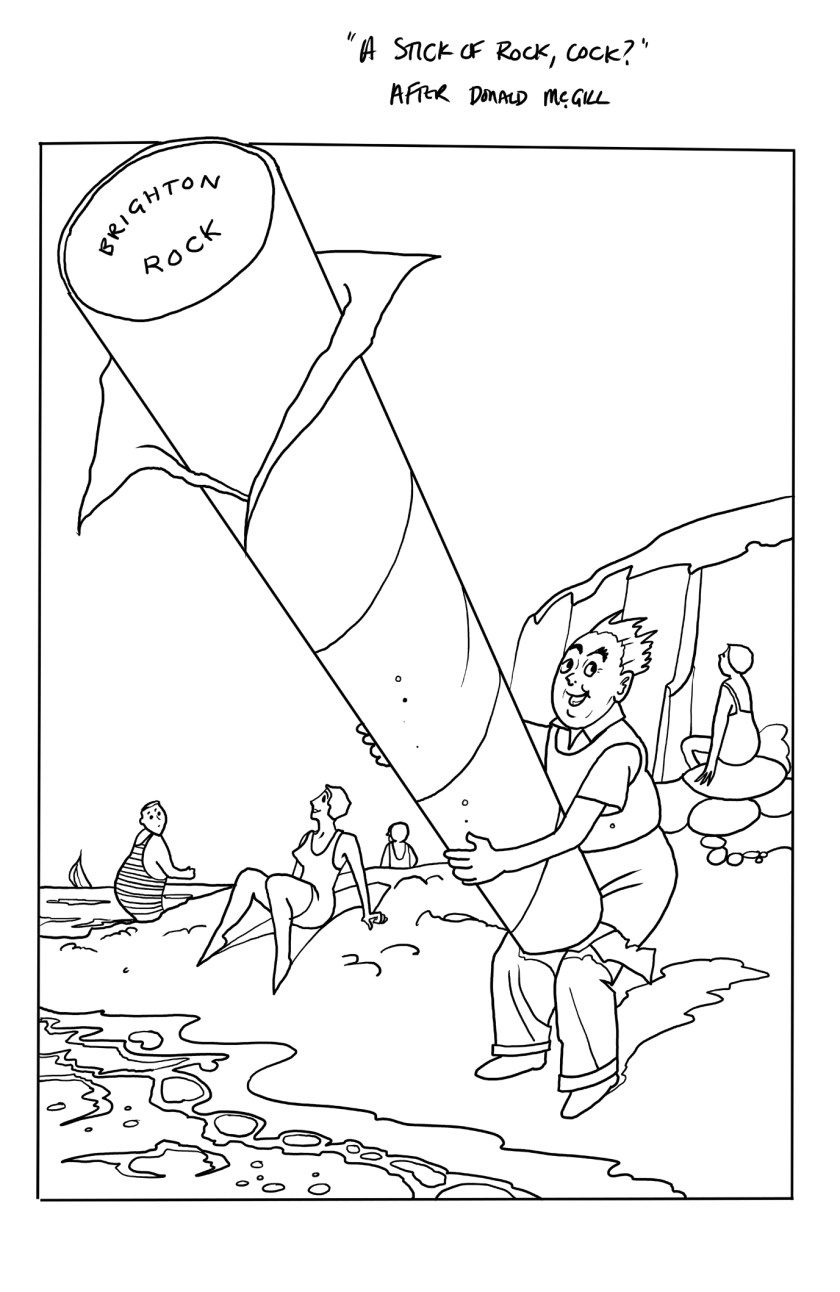
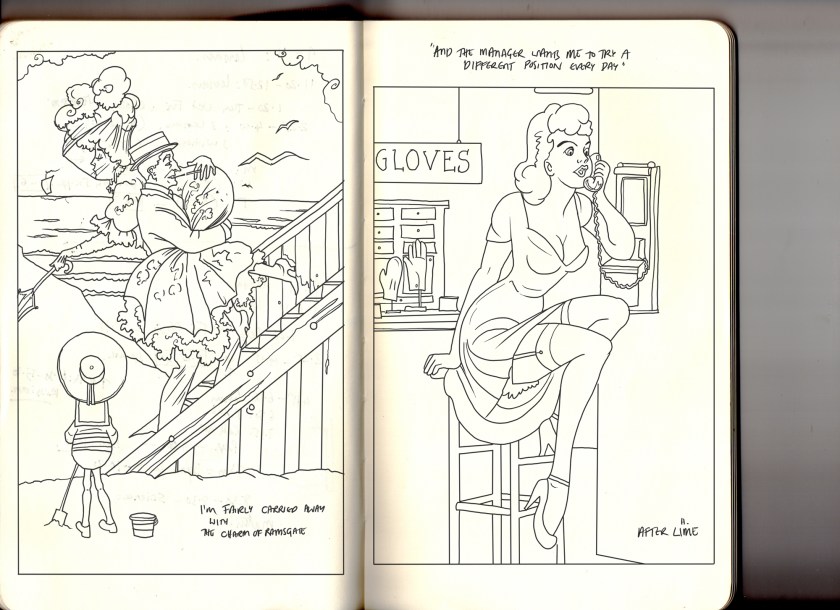
The king of the seaside postcard was Donald McGill. I have spent many months copying his images and my moleskin is stuffed with them! It is only when you look at what an artist does very carefully that you appreciate the cleverness of composition and the recurring features. Donald McGill is really a very good draughtsman! What I love perhaps more than the expressions which are excellent and well-observed are the ways he breaks the frame- constantly!
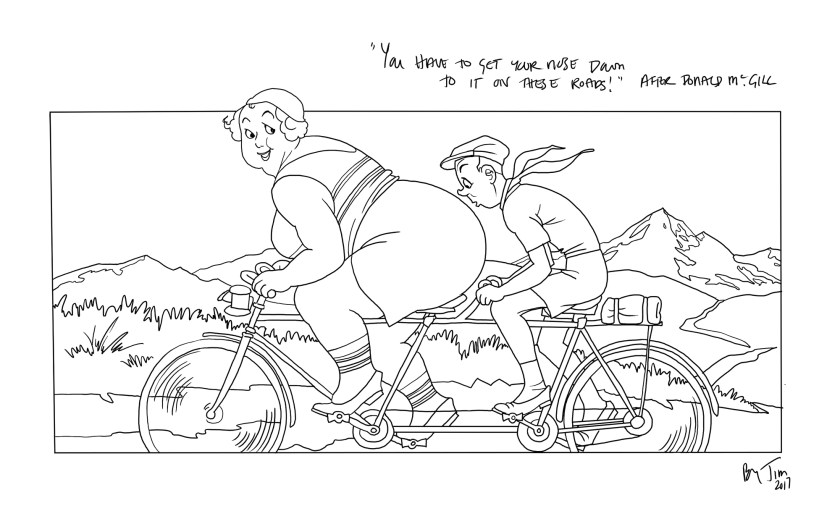
His images are just the flip-side of the Dandy and the Beano. The adult-version. His men are whimpy, his women rubenesque. Here are my copies of some pictures by other postcard illustrators – the first one is clearly Edwardian so there is some history to this…

*Really interesting lyric which I have avoided:
“Matilda she went to a fancy dress ball and she played an original part.
She rubbed herself over with raspberry jam and she went as a raspberry tart.
I went up to hug her and give her a kiss. Well, the jam was all over my kite.
I know she’s a sticker, but lor’ what a licker! I shouted, “You’ve done it tonight.”
The kite in this case would be his belly as in the expression “stuff my kite”. The expression is also in the other song “Boiled beef and carrots”- ‘From morn till night, Blow out your kite on Boiled Beef and Carrots’
“Played an original part”, which I have retained, is a great line with the suggestion that Matilda was not only dressed as something unusual but that she was being a bit rude too.
In rhyming slang “a raspberry tart” is flatulence.
“discovered that I was a jay” – in 1880, this generally meant a fool and is retained in the US in the word “jaywalker”
“the dicky”- slang for shirt.
There was an article in The Telegraph a few days’ ago about Ian Knowles who runs the two-year old icon-teaching centre in the West Bank. His work is on the israeli wall that divides the land and also in cathedrals and churches around the globe. The West bank centre began in a Coptic Church, is now housed in the Bethlehem university near the Church of the Nativity and is funded almost completely by private donations.
As I understand it, the Bethlehem school was an outreach programme from the British Association of Iconographers, for the most part a Catholic-inspired organisation centred around the benedictine Abbey of Our Lady of Peace in Bedfordshire.
Some years ago, I was taught how to gild and my gilder’s cushion is to hand even as I am typing in my office this evening! Gold is an essential part of the iconographer’s trade, but I am afraid that I have taken the Icon form cautiously into the digital realm: I explained many years ago to Metropolitan Kallistos that I had a plan to animate icons in some way and he was rightly suspicious. He did not completely dismiss my plans but -“I do not think I could pray to a cartoon”, he memorably said. I have not given up this idea, however, though I am aware of the time it takes to realise the detail of an Icon in a new medium, quite apart from the technical issues of trying to move in an inverted perspective. For now, I see my work as an academic exercise and I am currently writing a short course which I believe I will deliver at the Moscow State University sometime later this year. I will use animation simply to define the differences in posture and the significance of the arrangement of characters in traditional iconography. I will also, I hope be able to demonstrate on screen exactly what inverse perspective means and what it does to objects like tables and chairs. While Icons are religious artifacts, they are also an art form telling very specific stories with layered meanings. I see the Icon as the perfect combination of art and religion, so perfect indeed that even with the advances of the Renaissance, and the influence of Western art on both Greek and Russian culture in the 19th Century, the revival of the traditional icon by Photios Kontoglou in the 1950s continues to be a powerful force across the Orthodox world and beyond. It is now not uncommon today, for example, to see Icons in both Catholic and Anglican churches.
On 22nd January according to the Greek Calendar, and on 26th January (transferred from 24th) in the Catholic Church, is the feast of St Timothy, my patron saint.

I am not a natural rap fan, but I am always impressed by people who do it with intelligence. Words are words after all and there is a history of rap arguably as old as the G&S nightmare song in Iolanthe, but certainly going back to Edith Sitwell and William Walton’s “Façade”, a series of sound poems or Klangdichtung. Sitwell simply called them an “entertainment”. This nonsense incantation is the stuff of magic and religion. With my own interest in Edward Lear, it is not perhaps surprising that I should be a fan of Façade!
Sitwell first performed Façade standing behind a painted curtain and speaking through a papier-mâché megaphone, the “Sengerphone”. Noel Coward hated it.
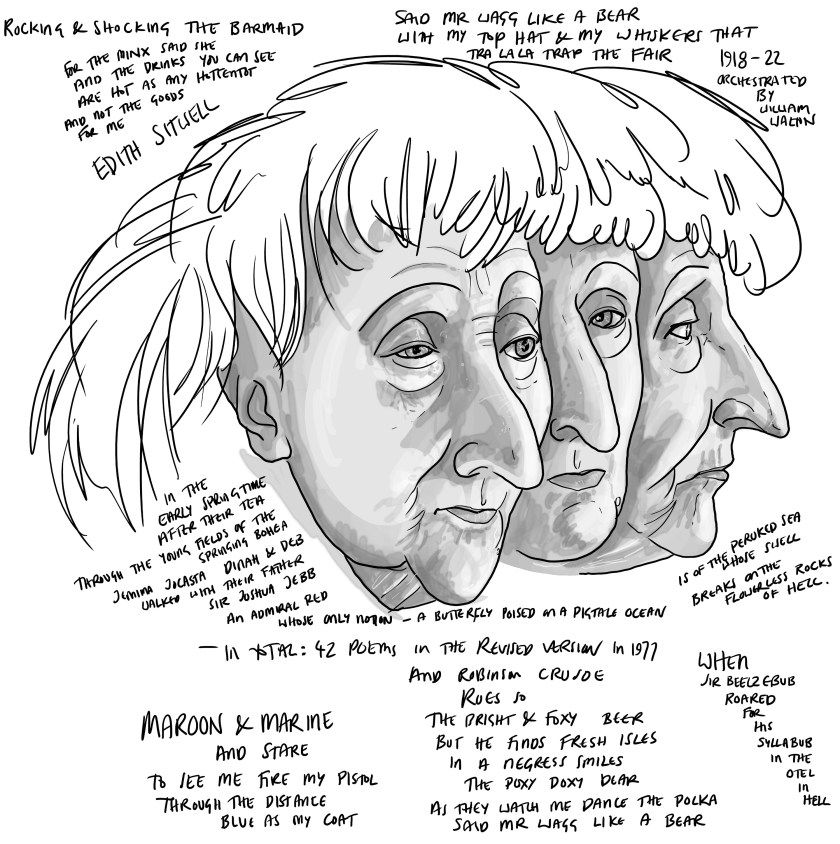
I did the 1951 version of Façade in a concert a few years ago and have always thought how well it would animate! The rapidly morphing images would lend themselves to gloriously anarchic animation. The concert version is much briefer than the revised 1977 version and Walton’s music is tremendous. It is, however, fiendishly difficult to remember all the words because the whole piece is predicated on nonsense. But great fun.
Below is my version of the Cecil Beaton portrait from late in her life. I suppose this was Beaton’s take on the famous triple portrait of King Charles. It was all done with her head poking out of bits of torn paper. Very interesting.
At the time, her personality was probably more important than her poetry, but I think if it is considered in the context of the modern rap movement, Façade becomes much more significant.

I saw Daniel Radcliffe rap the “Alphabet Aerobics”. Really very impressive.
Here is a link which I hope Youtube does not remove:
Meanwhile, I urge you to follow Miron Fyodorov, now known as “Oxxxymiron” whose work, though so far in Russian, is clearly clever and punchy. Heavily influenced by Grime, (and better than Guf) he is very keen on the Rap-fighting thing and has some bookings next year in Canada when he promises to do something in English. Meanwhile, he is writing his third album.
Here is a song from his second Album “Gorgorod” which tells a story through a series of rap pieces. This song was, I think, censored by the TV screening. I was in the audience (the show was the Russian equivalent to the Graham Norton show, or The late late show with James Corden in the US) and afterwards the host of the show, Ivan Urgant I think, gave me a signed T-shirt asking me publicly (to much mirth from the rest of the Russian-speaking audience) whether (a) I spoke any russian at all, and (b)if I understood what was going on. I confessed that I had not the slightest idea but that I was a dutiful member of the audience and I knew my job was to laugh and applaud. It was clear, anyway, that Miron was in complete control!

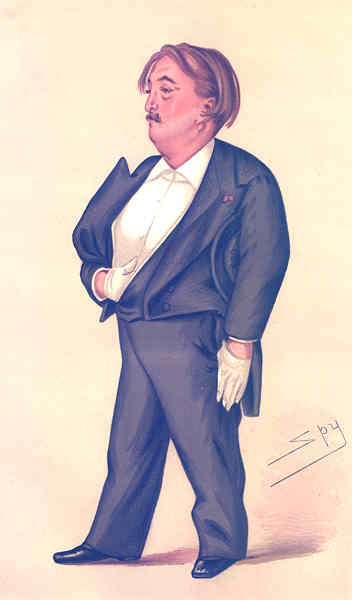
Above is a spy cartoon of Gustav Doré
meanwhile, here is the first proof of the judge in colour-
There are shadows to add.
Meanwhile, I was rebuked yesterday for writing a piece about woodprints and not drawing a picture of Gustav Doré, (32-83) the French master.
Doré is best known for his wood engravings, but he is also well-represented in his hometown of Strasbourg by huge biblical oil paintings. He was already in print by the age of 15for the periodical “Le Journal pour rire”.
Rather disturbingly, he was involved in the illustrations for a fairly abhorrent anti-semitic “Juif Errant”.
His printed work stretches from a 1854 edition of russian images to an 1884 edition of Edgar Allen Poe’s the Raven confirm him as one of the truly great European artists. I am particularly fond of the Paradise lost in 1866, Idylls of the King in 1875 and the Dante which he was working on from 1857 to 1867. In 1876, he did a book on London which has informed most of the films set in Victorian slums and was almost literally reproduced by John Box and Terence Marsh for Caron Reed’s version of “Oliver!”
Terence Marsh, who won an academy award for the Oliver designs, indeed, was also nominated for the designs of “Scrooge” a few years’ later so he had his fill of Victoriana. John Box was the art director on the Asquith production of The Importance of Being Earnest with Joan Greenwood and Edith Evans, but he was also production designer on Lawrence of Arabia and A passage to India (in 1984)
Here is my sketch of Monsieur Doré:

I have been revising a drawing of a house and garden.
Here is the progress 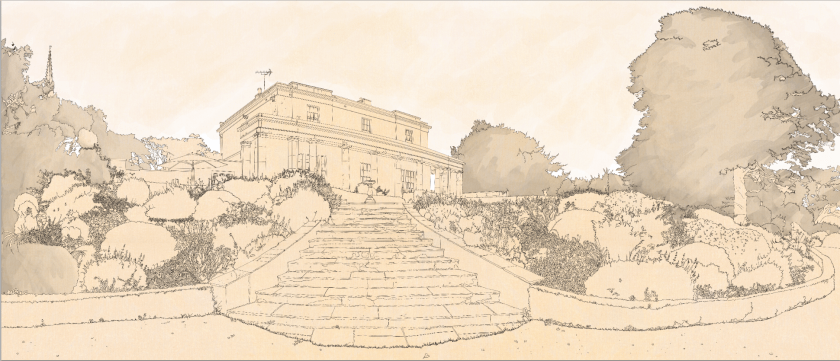
and the new version:

and with finally windows etc added:

Some other houses:
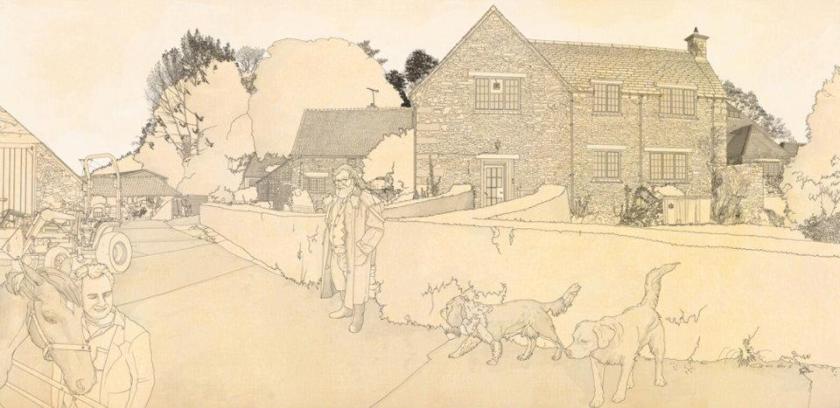
This was our house in Thorpe Mandeville
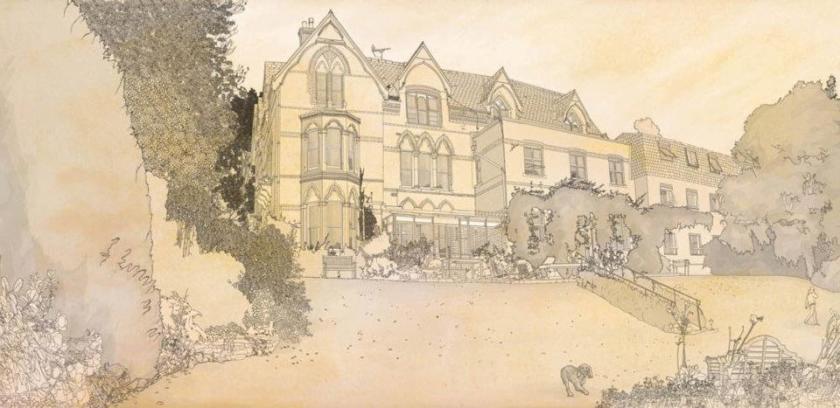
This is one of the school houses in Uppingham

This is a house designed by Voysey
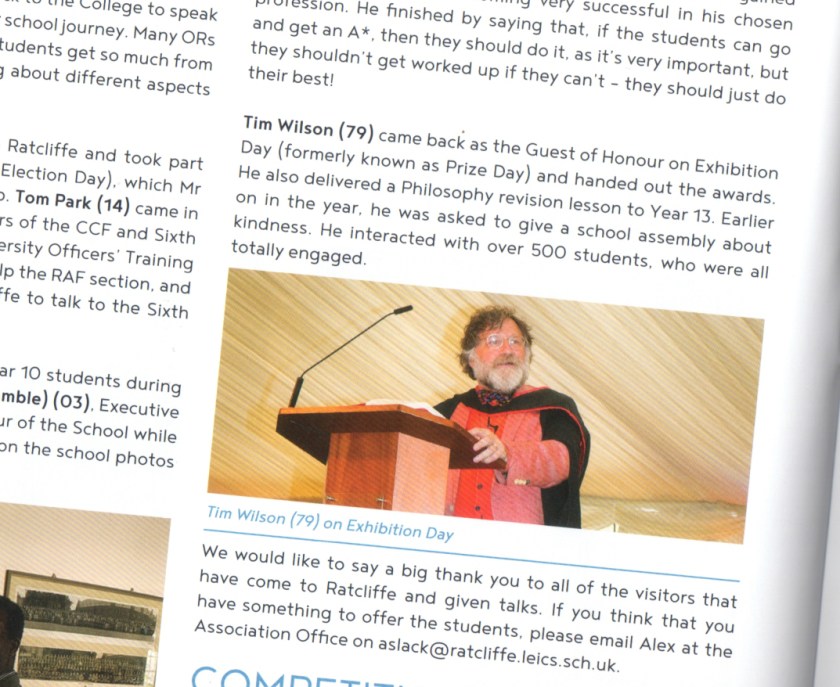
This term sees a new Headmaster at Ratcliffe. A few months’ ago I finished a talk with a formal farewell and thanks to Gareth Lloyd who has certainly done wonders for the school. A brand new Prep school was opened a while back by the Duke of Gloucester and a new sports track is on the way, both developed and built under his leadership. Meanwhile, a very healthy intake of both boarders and day-students is testimony to the hard work and vision that has coloured Gareth’s 6-year tenure. The new Headmaster, Jon Reddin, is well-known as the former vice-headmaster, and one of the tallest people I have ever met. I am sure he will do splendidly and I wish him and his family well in the coming years!
Here are some old images in celebration:

This is an image of the Pugin facade and below are some cards we did for the School, which I think are now available in the school shop:


Here is the new Prep school designed by a descendant of AW Pugin who designed the original school, Mount St Bernard’s Abbey down the road and my prep school below, Grace Dieu:


A half-finished picture of Grace Dieu. The new headmaster, Peter Fisher, is another dynamic headmaster!
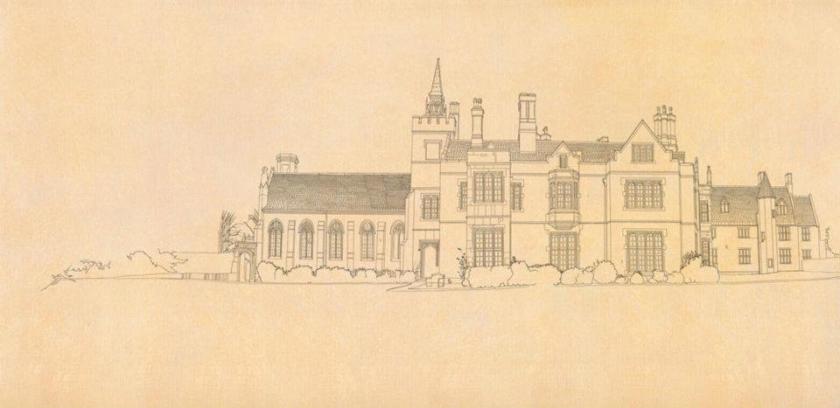
Finally, a picture of the cloisters, which are soon to be turned from a gravel football pitch to a contemplative open air space. Bravo!

 animate-tim.com