
Here is the first frame of animation for the matilda song:


Here is the first frame of animation for the matilda song:
I have written before about the work of Miqdaad Versi and I note that his actions are now reported to be more targeted and disciplined. He now also writes for the Guardian.
It is not that I want people to search for errors, but I would like journalists to be held to a standard of decency that sets the tone for any future or current debate. I went back and reread what I wrote earlier- mostly it was a groan about the gathering campaign of Mr Trump who tomorrow is inaugurated as 45th President of the US. Rather like Brexit, this is something we must now accept as reality. We cannot wring our hands and protest that we did not vote for this, want it, or indeed that we do not recognise the outcome. It is our job to make the best of a given result. That is the reality of politics.
More than that, the Trump Presidency has an impact well-beyond the borders of the US and he has a direct effect on many people therefore who were never given an opportunity to vote for him in the first place. The much-hyped concept of 51% voting for such and such is irrelevant actually. The only relevant fact is the reality we face, and we move forward in the knowledge that that is the reality we must address.
In contrast to the worried views of the “Spiked on line” people, and particularly the rather petulant Tom Slater (who thinks Versi is trying to “ring-fence Islam from criticism”), I think it is the quiet and careful actions of people like Mr Versi that will tone down the more extreme rhetoric that was used by Trump and his followers during the US election campaign. Let’s hope Trump’s more extreme remarks were the product of ignorance. Ignorance, as Plato says, can always lead to knowledge and knowledge is “the Good”.
To his credit, Mr Trump has mellowed of late and is clearly seeking and taking advice. Like Mr Reagan, Trump shows all the signs of being a good delegator, something we over here need to learn. Maybe it is time for a big businessman to take on the establishment. I loved the Peter Brooke’s cartoon a few days ago in the Times that celebrated Trump while also recording the end of the Barnum and Bailey/Ringling brothers’ circus. In fact, I increasingly love Peter Brookes! His observation demands scrutiny and his drawing alone merits some study. He has been on a bit of a roll recently while Riddell, in the Observer, whose work I think is a natural successor to Tenniel, has been a bit “same-y”.

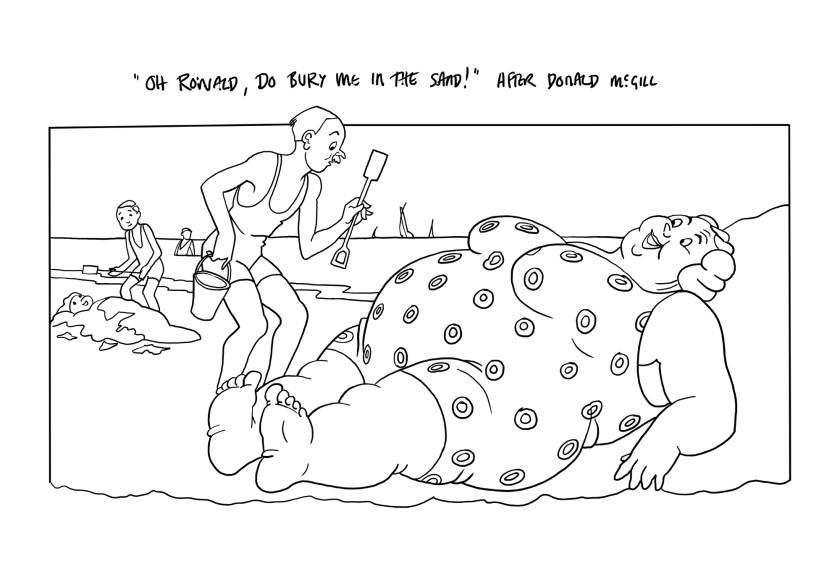 A sequence I am working on at the moment (Matilda by Harry Champion*) to complete the two music halls films draws inspiration form the work of Donald McGill.
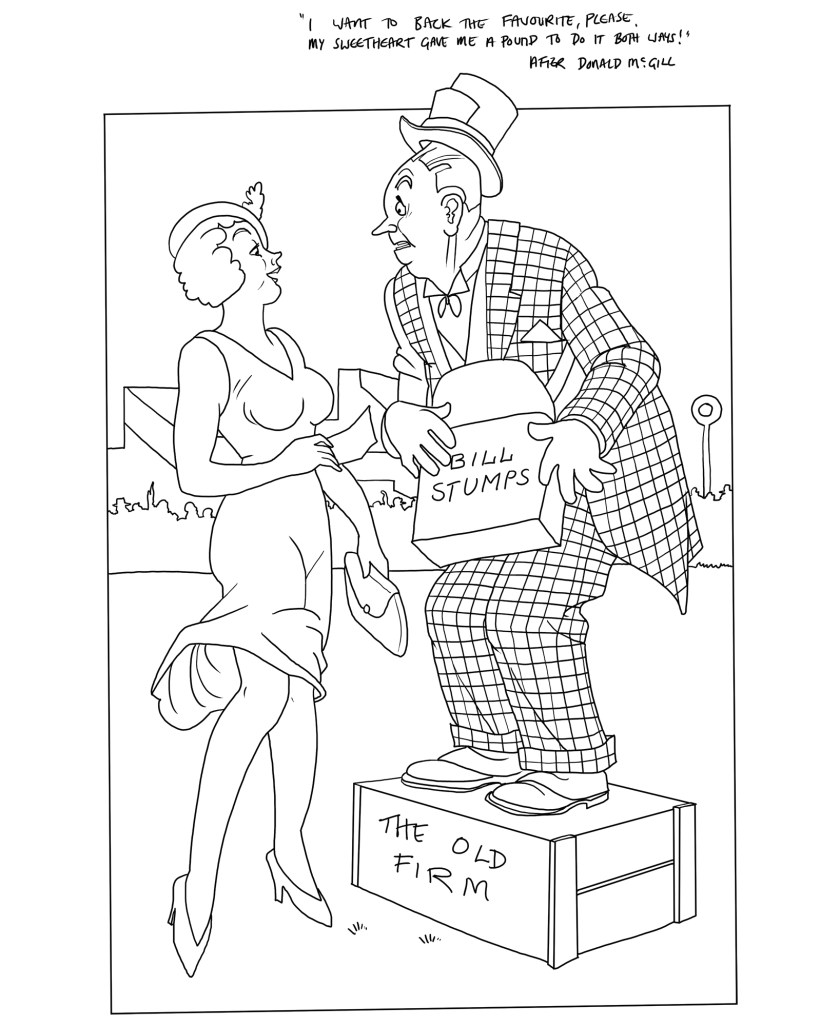
Just after the war, about 1300 subversive picture postcards, redolent in double-entendres, were seized by the police and a court case was held to judge whether these cards were undermining public morality. Oddly, it is exactly the same sort of humour that turns up on screen a few years’ later in the “carry on films”. They got away with it. The postcard industry was not so fortunate. The line taken by the postcard artists in court, however, was that the pictures were only offensive to those people corrupt enough to appreciate the risqué jokes. Quite a brilliant bit of legal subterfuge in itself.
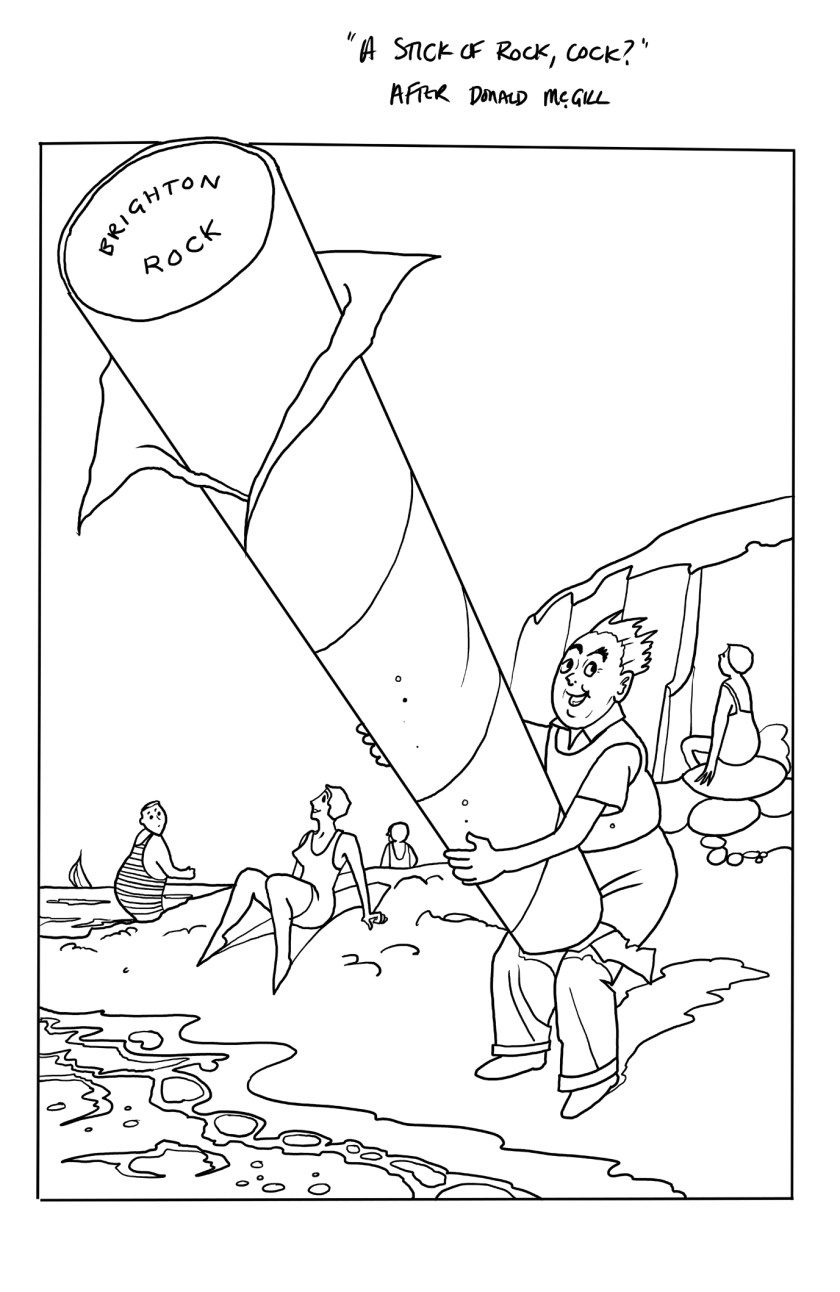
The king of the seaside postcard was Donald McGill. I have spent many months copying his images and my moleskin is stuffed with them! It is only when you look at what an artist does very carefully that you appreciate the cleverness of composition and the recurring features. Donald McGill is really a very good draughtsman! What I love perhaps more than the expressions which are excellent and well-observed are the ways he breaks the frame- constantly!
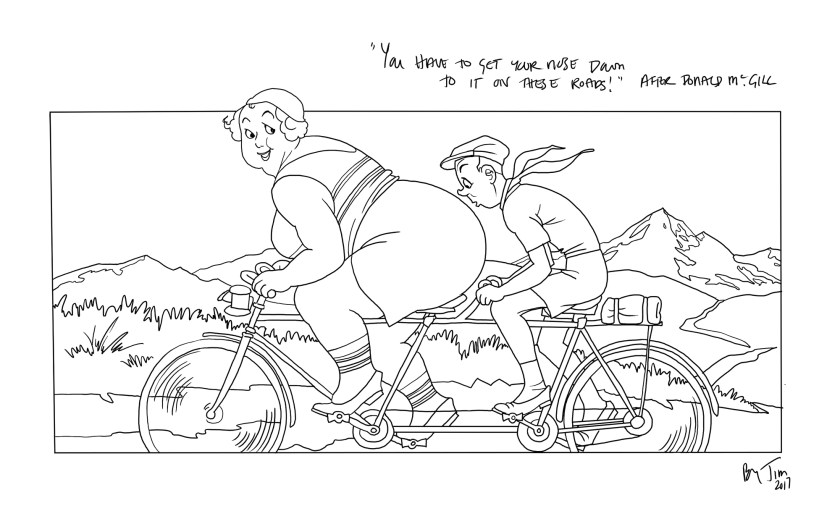
His images are just the flip-side of the Dandy and the Beano. The adult-version. His men are whimpy, his women rubenesque. Here are my copies of some pictures by other postcard illustrators – the first one is clearly Edwardian so there is some history to this…
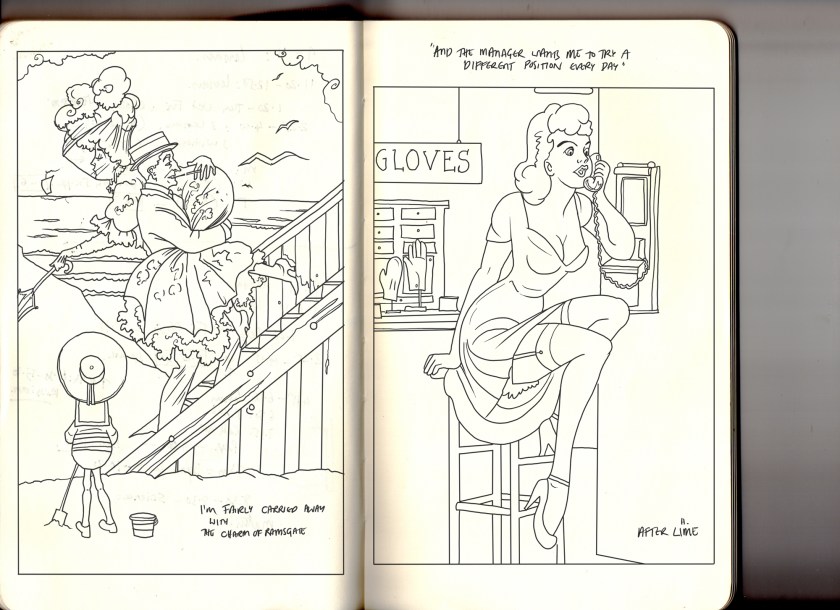

*Really interesting lyric which I have avoided:
“Matilda she went to a fancy dress ball and she played an original part.
She rubbed herself over with raspberry jam and she went as a raspberry tart.
I went up to hug her and give her a kiss. Well, the jam was all over my kite.
I know she’s a sticker, but lor’ what a licker! I shouted, “You’ve done it tonight.”
The kite in this case would be his belly as in the expression “stuff my kite”. The expression is also in the other song “Boiled beef and carrots”- ‘From morn till night, Blow out your kite on Boiled Beef and Carrots’
“Played an original part”, which I have retained, is a great line with the suggestion that Matilda was not only dressed as something unusual but that she was being a bit rude too.
In rhyming slang “a raspberry tart” is flatulence.
“discovered that I was a jay” – in 1880, this generally meant a fool and is retained in the US in the word “jaywalker”
“the dicky”- slang for shirt.
Michael Gove today penned a piece in the Times suggesting that he had access to Mrs May’s latest thoughts, indeed the very words she might utter in only a matter of days.Quite apart from the irritation of finding senior politicians jumping on the bandwagon of false news, his piece simply repeats arguments that were surely sorted out at about 8am on 24th June.
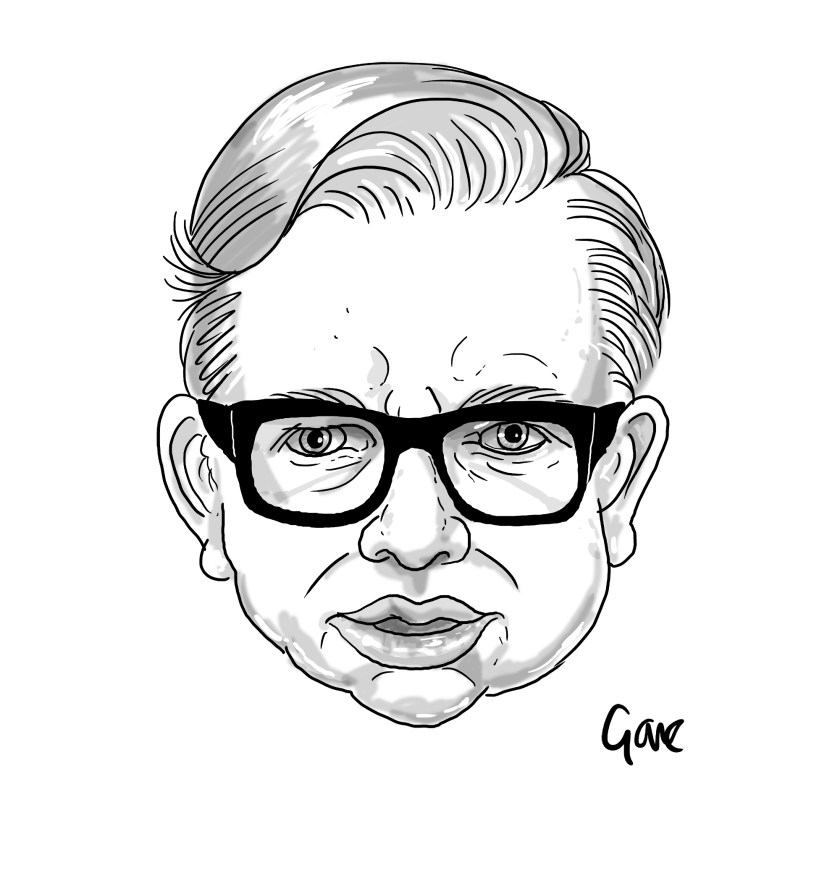
I think much of what he thinks the PM will say will remain wishful thinking, but it is still deeply mistaken and misleading.
I think Mr Gove’s greatest mistake lies in a misunderstanding of what it means to lead the country, something he aspired to do and that Mrs May is now doing. Mr Gove thinks that what matters is “the truth”, but truth is a relative and constantly changing concept. What matters instead is “responsibility”, or “trust”. I think this is a single concept though expressed in two words. For it is not possible to have one without the other. It is something Mr Gove failed to earn and, moreover, a concept that is much bigger than the referendum and certainly bigger than Brexit. It is about doing the right thing at the right time and with confidence. Today, when Brexit is presented, a number of politicians, and certainly Mr Gove, seem to abandon not only reality and rational thought but also a belief in the primacy of Parliament for naive demagogy as if they are still not sure they won, and have to rehash the same arguments over and over again.
Put bluntly, has Mr Corbyn not been a sufficient warning to you?
Mr Gove sets the tune of his piece by referring to Ronald Reagan and Mrs Thatcher. Reagan’s plan for the cold war- “Simple — we win; they lose.” But that is not quite how it panned out, was it! Let’s look back a little further:


While France and America embraced revolution, Britain quietly changed from one leader to another. The “glorious revolution” may not be quite all it was cracked up to be, but it demonstrates a way of behaving that Mr Gove absolutely forgets. Revolutions, if pursued relentlessly, are out for blood and that has not been the British way. We want to forge a quiet rethinking of the status quo, and if possible, seemlessly merge from one form of rule to another, maybe, if absolutely necessary with a mild embellishment to the union flag.
Mrs May is quite right in repeating her mantra that “Brexit means Brexit” just as she is quite right in being tight-lipped about exactly how that will play out. Even if she triggers the process in a month, we still must wait two years for that act to play out, and during that time, much of the Europe we know today will have changed beyond recognition. Catalonia lingers, Le Pen lies in the penumbra of perceptual power and Germany smoulders with discontent to say nothing of Greece, badgered and badgered until it is made to feel like a poodle puddled in the Aegean. The only thing that we can be certain about is the Responsibility Mrs May has been given as our leader and the trust we place in her.
What I find most disturbing is the claim that we know what “the electors wanted” when they voted for Brexit. The fact is, we can never know just as we can never know what they wanted when they voted for Mr Corbyn. All we have is the result which in and of itself says nothing about immigration, control of borders, the single market, hard or soft Brexit. It is simply a mandate for leaving the current arrangement, a recognition that the EU as it stands is failing. A referendum is not a result in itself – it needs interpreting and circumstances will change. That is inevitable.
Also, though I hesitate to point this out, the Brexit vote was far from uniform throughout the country and a clever Brexit will allow for, and placate the 48% who voted to retain our place in Europe.
But I hope we are fast approaching the day when we will stop hearing what Politicians think the electors voted for. No one really knows. Equally the obsession with anticipating the way we leave Europe needs to stop. We need to leave the negotiating team to do its job.
The obsession, drummed up in part by people like Mr Gove and Mr Farage, about how we leave in fact allows Brussels to avoid the full force of the blow of that Referendum decision. Indeed, this obsession gives a platform to Mr Junker, who rather than falling on his sword as one of the architects of modern Brussels, can join Gove and Farage and pontificate about HOW we should be going. What folly for Junker to be mocking Milord, when his own house is burning down.
Mr Gove gave a tv interview a few weeks ago and demonstrated what a thoughtful, centred man he really is. I do not understand, therefore, why he needs to play to the gallery like this when what we really need is his keen intellect and analytic support at the centre of Government. What Mrs May does not yet say is that any form of Brexit means a re-ordering of Europe because she knows the European project is bigger than the EU. Because the future of Europe and the role it will play beside us is as much our concern as the manner in which Britain will be defined two years’ hence.
John Donne writes,

No man is an island,
Entire of itself,
Every man is a piece of the continent,
A part of the main.
If a clod be washed away by the sea,
Europe is the less.
As well as if a promontory were.
As well as if a manor of thy friend’s
Or of thine own were:
Any man’s death diminishes me,
Because I am involved in mankind,
And therefore never send to know for whom the bell tolls;
It tolls for thee.

I know I am a few days late- every year on 3rd January, the Tolkein society meet to celebrate the great man’s birthday.This year, he would have been 125 years old. Older than Bilbo, then, who was Eleventy-One, 60 years after the beginning of the Hobbit. Bilbo sails west at the end of the Lord of the Rings at the age of 131. There are a few more years before that anniversary.
Three wizards occupied my childhood- Gandalf, Merlin and the wonderful Ged from Ursula Le Guin’s Earthsea trilogy (there was a fourth book added which I think is inferior). I remember being introduced to each vividly. A wonderfully kind lady on a farm nearby gave me my first edition of “the Sword in the Stone”. And it really was a first edition! At Grace Dieu, my prep school, I found “Lord of the Rings” on a shelf and devoured it, rereading and rereading it during rugby games. I trundled the book backwards and forwards on to the pitch, rain or shine, often in the snow. But Earthsea was given to me by the English master in the same school, a brilliant teacher called Mr Kingdom- one of the most inspired classroom readers, a delightful artist and simply a joy to be around. Just after we completed Common entrance, he routinely read the 4th form the whole of “39 steps”, recreating each scene and each character , anticipating by some 40 years the brilliant West end production that indeed my friend David Newman supervised and redirected in the Stanislavski theatre in Moscow a few years’ ago.
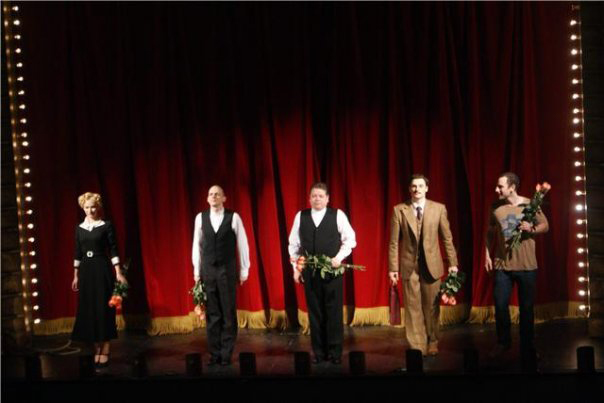
Earthsea dates from 1968 and, while of modest length, competes very well with Tolkein. It introduces the idea of a wizarding school and a nemesis in part linked to the hero, and able to subvert the will of others to do his bidding, turning them into the walking dead, the “gibbeth”, Ursula K Le Guin’s version of the Kabbalistic Dybbuk (Дибук or דִבּוּק) Is the gibbeth not a death-eater of sorts or a dementor? Indeed, in so many ways, Earthsea spawns Harry Potter. There is even a jumped up aristocratic student adversary, not called Malfoy but Jasper who taunts the young Ged into fighting a magic duel. Roke, the Hogwarts of its day is the safest place on earth. For the forbidden forest, read Immanent Grove, for familiar phoenix, read raven and for Hedwig the owl read the unnamed pet otak. the similarities are striking enough to lead to speculation about plagiarism, but frankly, given the setting of a wizarding boarding school, must of the rest follows naturally and at worst, Potter is a dumbed-down reworking of the same source material, the icelandic sagas and the Merlin stories of Arthur from which Tolkein also drew.
And while there are similarities, Ursula Le Guin always has the upper hand. Harry Ps flirtation with death as indeed Aragorn’s is fleeting really in comparison to the lengthy journeys through the land of death made by Ged. This is not about a magic resurrection, but about a mission – if there is a parallel here, it is in the Aeneid, Gilgamesh, Dante or Pullmann.
More than that, Ursula Le Guin is very much aware of following Tolkein. She writes a piece about the “Rhythmic patterns in Lord of the Rings” and looks at the “rapid reversals: darkness, light… downhill/ uphill…the fact is, we walk from the shire to mount doom with Frodo and sam. One two, left right on foot all the way.” What a brilliant observation and how true. I do not hear JKR talking about her indebtedness or admiration for either Tolkein or Le Guin. It might be interesting to know what she thinks about them and slightly less about the world she created herself. That said, I LOVED the film of “Fantastic beasts” in a way that I did not really love the previous films or stories. Maybe it was Eddie Redmayne?
What is wonderful about Ged, though and quite different to all the other wizards, including oddly Harry P, is that Ged matures and grows through the action of the books. He is tested, fails and overcomes the odds to make it to the top of the wizarding confraternity at Roke. Ged is Dumbledore with backstory. We care about Ged because we can identify with his failings in a way that we cannot care for Merlin or Gandalf or indeed Harry P. We can only sit back and admire their wondrous deeds.
I read the second book in the trilogy first, shortly after it was published in 1971 “the Tombs of Atuan” where we meet the counterpart to Ged, a woman raised to be the priestess in a dying world, honouring the fearsome shadow gods in a pitch-black underground labyrinth. No wonder that the few attempts to turn this into a film have failed.
Earthsea addresses fundamental questions. “What is evil?” someone asks. And Ged’s master Ogion says in Patristic tone, “To hear, one must be silent.” (or is that the Desert Fathers?) Magic is about preserving the delicate balance in nature so “rain on Roke may be drouth in Osskil, and a calm in the East reach may be storm and ruin in the West, unless you know what you are about.” Most of all, I love the idea that power over something lies in correctly identifying its true name. This is touched on in Tolkein when Gandalf is struggling to open the door to the Misty Mountains, but it is embroidered throughout the Earthsea books, from the identity of the shadow to the name of the dragon of Pendor. Language is magic. Words are a force in themselves because they are an attempt to identify and empower the things around us.
There was an article in The Telegraph a few days’ ago about Ian Knowles who runs the two-year old icon-teaching centre in the West Bank. His work is on the israeli wall that divides the land and also in cathedrals and churches around the globe. The West bank centre began in a Coptic Church, is now housed in the Bethlehem university near the Church of the Nativity and is funded almost completely by private donations.
As I understand it, the Bethlehem school was an outreach programme from the British Association of Iconographers, for the most part a Catholic-inspired organisation centred around the benedictine Abbey of Our Lady of Peace in Bedfordshire.
Some years ago, I was taught how to gild and my gilder’s cushion is to hand even as I am typing in my office this evening! Gold is an essential part of the iconographer’s trade, but I am afraid that I have taken the Icon form cautiously into the digital realm: I explained many years ago to Metropolitan Kallistos that I had a plan to animate icons in some way and he was rightly suspicious. He did not completely dismiss my plans but -“I do not think I could pray to a cartoon”, he memorably said. I have not given up this idea, however, though I am aware of the time it takes to realise the detail of an Icon in a new medium, quite apart from the technical issues of trying to move in an inverted perspective. For now, I see my work as an academic exercise and I am currently writing a short course which I believe I will deliver at the Moscow State University sometime later this year. I will use animation simply to define the differences in posture and the significance of the arrangement of characters in traditional iconography. I will also, I hope be able to demonstrate on screen exactly what inverse perspective means and what it does to objects like tables and chairs. While Icons are religious artifacts, they are also an art form telling very specific stories with layered meanings. I see the Icon as the perfect combination of art and religion, so perfect indeed that even with the advances of the Renaissance, and the influence of Western art on both Greek and Russian culture in the 19th Century, the revival of the traditional icon by Photios Kontoglou in the 1950s continues to be a powerful force across the Orthodox world and beyond. It is now not uncommon today, for example, to see Icons in both Catholic and Anglican churches.
On 22nd January according to the Greek Calendar, and on 26th January (transferred from 24th) in the Catholic Church, is the feast of St Timothy, my patron saint.

I am not a natural rap fan, but I am always impressed by people who do it with intelligence. Words are words after all and there is a history of rap arguably as old as the G&S nightmare song in Iolanthe, but certainly going back to Edith Sitwell and William Walton’s “Façade”, a series of sound poems or Klangdichtung. Sitwell simply called them an “entertainment”. This nonsense incantation is the stuff of magic and religion. With my own interest in Edward Lear, it is not perhaps surprising that I should be a fan of Façade!
Sitwell first performed Façade standing behind a painted curtain and speaking through a papier-mâché megaphone, the “Sengerphone”. Noel Coward hated it.
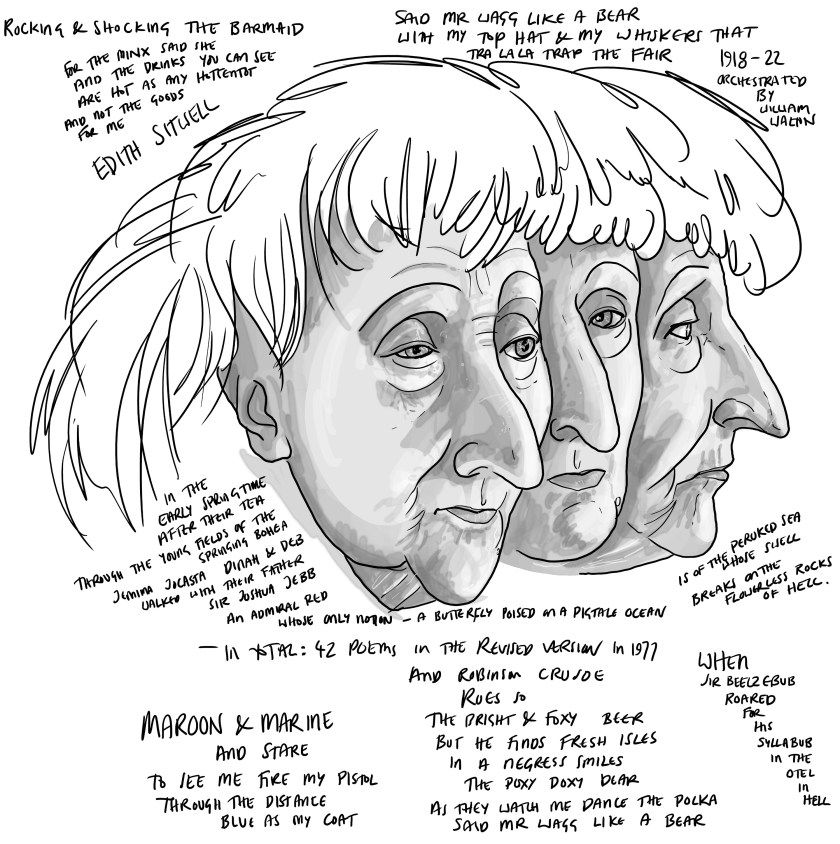
I did the 1951 version of Façade in a concert a few years ago and have always thought how well it would animate! The rapidly morphing images would lend themselves to gloriously anarchic animation. The concert version is much briefer than the revised 1977 version and Walton’s music is tremendous. It is, however, fiendishly difficult to remember all the words because the whole piece is predicated on nonsense. But great fun.
Below is my version of the Cecil Beaton portrait from late in her life. I suppose this was Beaton’s take on the famous triple portrait of King Charles. It was all done with her head poking out of bits of torn paper. Very interesting.
At the time, her personality was probably more important than her poetry, but I think if it is considered in the context of the modern rap movement, Façade becomes much more significant.

I saw Daniel Radcliffe rap the “Alphabet Aerobics”. Really very impressive.
Here is a link which I hope Youtube does not remove:
Meanwhile, I urge you to follow Miron Fyodorov, now known as “Oxxxymiron” whose work, though so far in Russian, is clearly clever and punchy. Heavily influenced by Grime, (and better than Guf) he is very keen on the Rap-fighting thing and has some bookings next year in Canada when he promises to do something in English. Meanwhile, he is writing his third album.
Here is a song from his second Album “Gorgorod” which tells a story through a series of rap pieces. This song was, I think, censored by the TV screening. I was in the audience (the show was the Russian equivalent to the Graham Norton show, or The late late show with James Corden in the US) and afterwards the host of the show, Ivan Urgant I think, gave me a signed T-shirt asking me publicly (to much mirth from the rest of the Russian-speaking audience) whether (a) I spoke any russian at all, and (b)if I understood what was going on. I confessed that I had not the slightest idea but that I was a dutiful member of the audience and I knew my job was to laugh and applaud. It was clear, anyway, that Miron was in complete control!

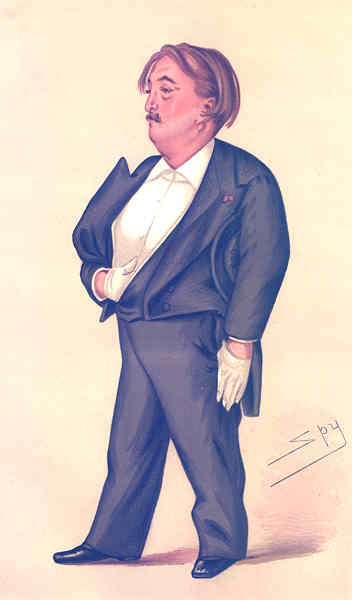
Above is a spy cartoon of Gustav Doré
meanwhile, here is the first proof of the judge in colour-
There are shadows to add.
Meanwhile, I was rebuked yesterday for writing a piece about woodprints and not drawing a picture of Gustav Doré, (32-83) the French master.
Doré is best known for his wood engravings, but he is also well-represented in his hometown of Strasbourg by huge biblical oil paintings. He was already in print by the age of 15for the periodical “Le Journal pour rire”.
Rather disturbingly, he was involved in the illustrations for a fairly abhorrent anti-semitic “Juif Errant”.
His printed work stretches from a 1854 edition of russian images to an 1884 edition of Edgar Allen Poe’s the Raven confirm him as one of the truly great European artists. I am particularly fond of the Paradise lost in 1866, Idylls of the King in 1875 and the Dante which he was working on from 1857 to 1867. In 1876, he did a book on London which has informed most of the films set in Victorian slums and was almost literally reproduced by John Box and Terence Marsh for Caron Reed’s version of “Oliver!”
Terence Marsh, who won an academy award for the Oliver designs, indeed, was also nominated for the designs of “Scrooge” a few years’ later so he had his fill of Victoriana. John Box was the art director on the Asquith production of The Importance of Being Earnest with Joan Greenwood and Edith Evans, but he was also production designer on Lawrence of Arabia and A passage to India (in 1984)
Here is my sketch of Monsieur Doré:

I have been revising a drawing of a house and garden.
Here is the progress 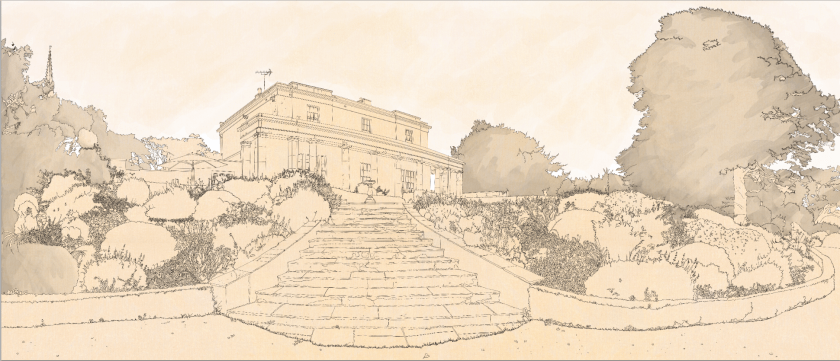
and the new version:

and with finally windows etc added:

Some other houses:
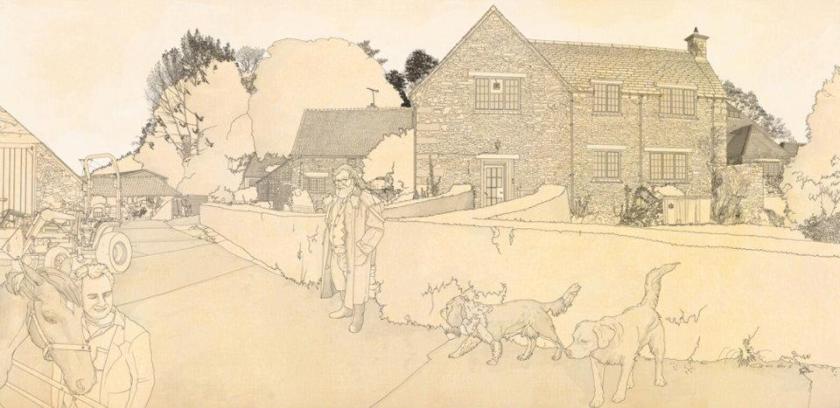
This was our house in Thorpe Mandeville
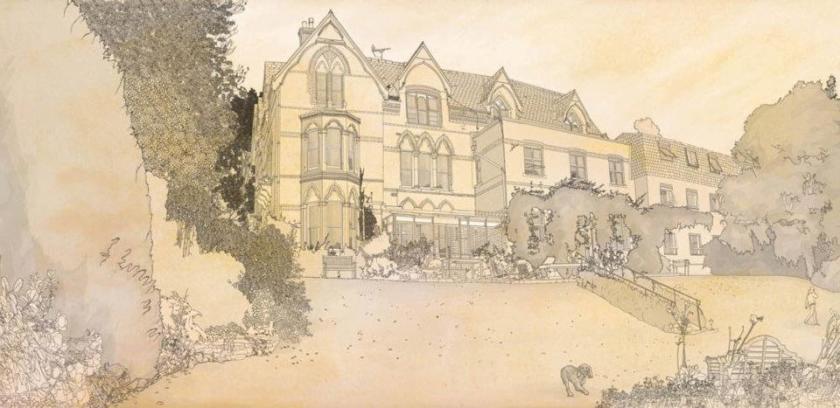
This is one of the school houses in Uppingham

This is a house designed by Voysey
This term sees a new Headmaster at Ratcliffe. A few months’ ago I finished a talk with a formal farewell and thanks to Gareth Lloyd who has certainly done wonders for the school. A brand new Prep school was opened a while back by the Duke of Gloucester and a new sports track is on the way, both developed and built under his leadership. Meanwhile, a very healthy intake of both boarders and day-students is testimony to the hard work and vision that has coloured Gareth’s 6-year tenure. The new Headmaster, Jon Reddin, is well-known as the former vice-headmaster, and one of the tallest people I have ever met. I am sure he will do splendidly and I wish him and his family well in the coming years!
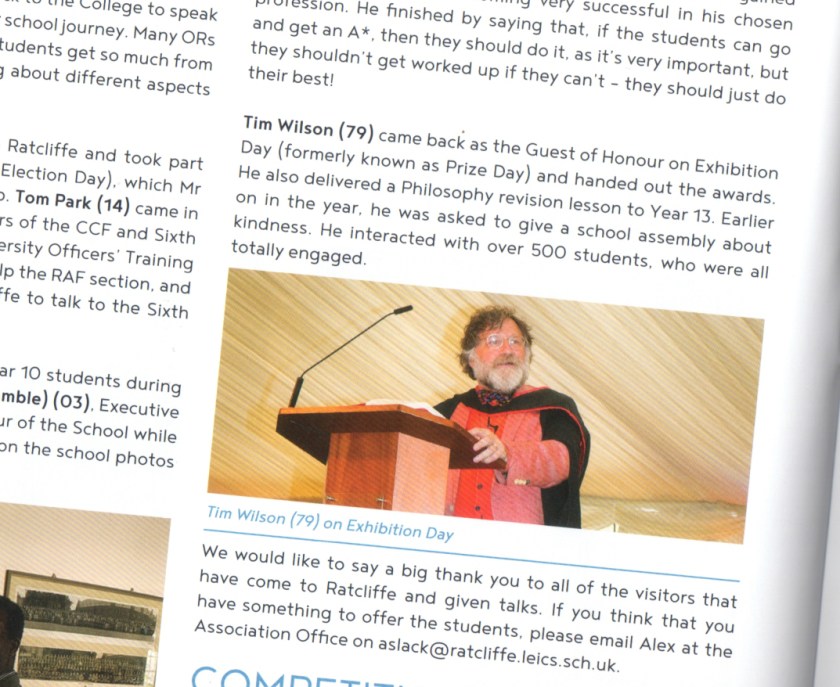
Here are some old images in celebration:

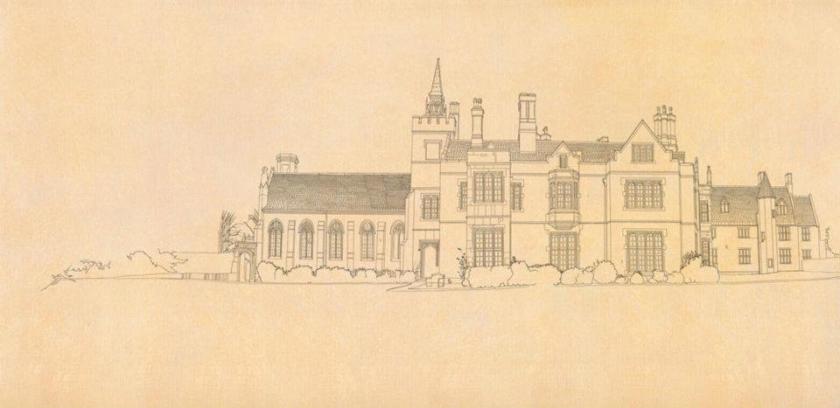
This is an image of the Pugin facade and below are some cards we did for the School, which I think are now available in the school shop:


Here is the new Prep school designed by a descendant of AW Pugin who designed the original school, Mount St Bernard’s Abbey down the road and my prep school below, Grace Dieu:


A half-finished picture of Grace Dieu. The new headmaster, Peter Fisher, is another dynamic headmaster!
Finally, a picture of the cloisters, which are soon to be turned from a gravel football pitch to a contemplative open air space. Bravo!

 animate-tim.com