Theology of the Icon

The Icon is a major feature in the Orthodox Church. Unlike religious images and statues in Catholicism, however, the Greek Icon has a position in liturgy and doctrine that is cemented by the 7th Ecumenical Council in 787 and which goes beyond the purely decorative and helpful. In this way, however, any Icon, has a position in the liturgy that is paralleled by the Catholic crucifix (with the depiction of the body of Christ) – a Liturgy without Icons is no liturgy just as a Mass  (as stated in the Roman Missal, no 308) celebrated without a Crucifix is regarded as illicit. Of course, both Catholics and Orthodox would wax lyrical about the efficacy of the sacrament with or without the attendant iconography, and both, I hope, would warn against applying the canons too strictly.

The Icon has a bizarre history and seems to defy the ruling in the 10 commandments, “You shall not make for yourself an image in the form of anything in heaven above or on the earth beneath or in the waters below. You shall not bow down to them or worship them; for I, the Lord your God, am a jealous God” (Ex. 20:4-5), but this ruling say the Fathers of the Church is overturned by the fact that The New Testament celebrates God made man and the Invisible Godhead is manifest in the true Icon of his Son, Christ – “Anyone who has seen me has seen the Father”.

timothy-.jpg

The first sunday of Lent in the Orthodox calendar celebrates the Triumph of Orthodoxy. St John Damascene demonstrated that the Icon was the celebration of the Theosis, the divinization of humanity and the Icons in the church act as windows through which the heavenly Church is brought into direct contact with the Church on earth. “The icon” says Archimandrite Zenon, “does not represent anything, it rather reveals something.” St John says the Icon particularly represents what Orthodoxy is about: “If one of the heathens comes to you saying: show me your faith… you will take him to church and put him before all kinds of holy images.” The veneration of Icons is simply a greeting made by the worldly Church with the Church in Heaven and in the words of St Basil the Great, “the honour paid to the image passes on to the prototype”. Outside the Church and the liturgy, the Icon, always an image of great beauty and often valuable in its own right, is in danger of losing its theological meaning and of course it could degenerate, simply, into a form of Ecclesiastical comic strip. (much of what I am writing about the care of religious art could equally apply to the Tibetan Thangka Paintings and frankly could be adapted to the care of the Torah scrolls and the Koran)

baptist icon.jpg

For the Catholic church and many Anglicans, Religious art is a Gospel for the illiterate, as defined by Gregory the Great, “Images are used in churches so that the illiterate could at least look at the walls to read what they are unable to read in books.” and Damascene goes along with this understanding, “The image is a memorial, just what words are to a listening ear. What a book is to the literate, an image is to the illiterate. The image speaks to sight as words to hearing; through the mind we enter into union with it” :he is joined by Theodore the Studite and the canons of the 7th Ecumenical council in identifying the Icon as a form of teaching: “What a word communicates through hearing is what art shows silently through an image”.

St John of Damascus goes a bit further and turns the 2nd commandment round, “It is obvious that at that time [before Christ] you could not make an image of the invisible God, but when you see the Formless One become man for your sake, then you will make images of Him in His human form. When you contemplate God becoming man, then you can depict Him clothed in human form. When the invisible One becomes visible to us, you may then draw His likeness…Paint everything with words and colours both in books and on boards”. In other words, the Icon becomes the way to demonstrate the revelation of the New Testament and the Icon represents a person in a transfigured state.
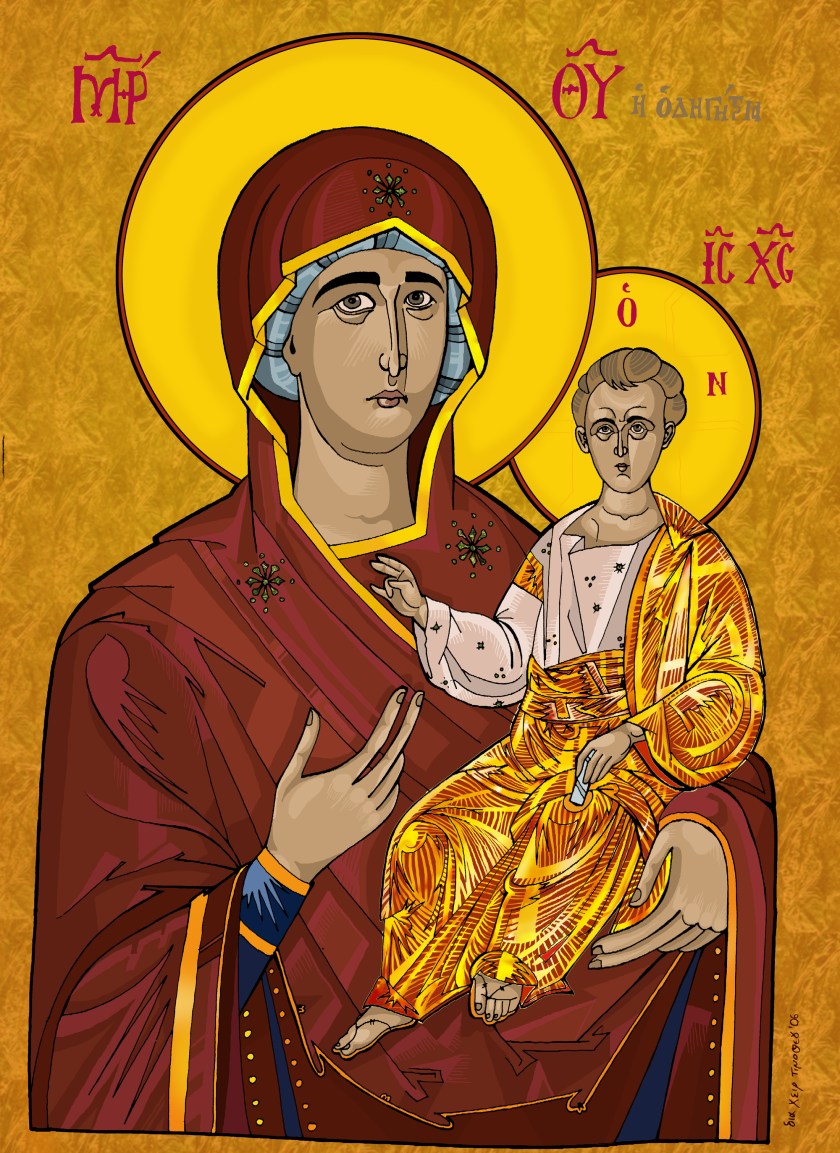
virgin 2 2003c

There are many conventions- only those not venerated, for instance are depicted in profile, the idea of inverted perspective and the light of Mount Tabor, the fact that the Virgin is always pointing to her son, and so on. I have a bit of an issue with one aspect of icongraphy that seems to be gaining ground- there is a tendency to talk about “writing” rather than “painting” an Icon. I think this is a bit precious and as far as I can see, the two words in Greek and Russian, γράφειν and писать, are both ambiguous and can mean both “write” and “paint”, (the russian word is more likely to mean “paint” as a technical term and tends only to be used in the sense of “write” in modern Russian but, if the stress is misplaced, it can also have a slightly more vulgar meaning  redolent of the astonishingly crass Councillor- now thankfully suspended, Dominic Peacock)

dominic Peacock

We should use English in a more direct way. But in a noisy world, the Icon remains a silent testament to a different kind of life. That must be valuable whether we have a belief or not. A celebration of the beautiful.

 

Orthodox Council in Crete

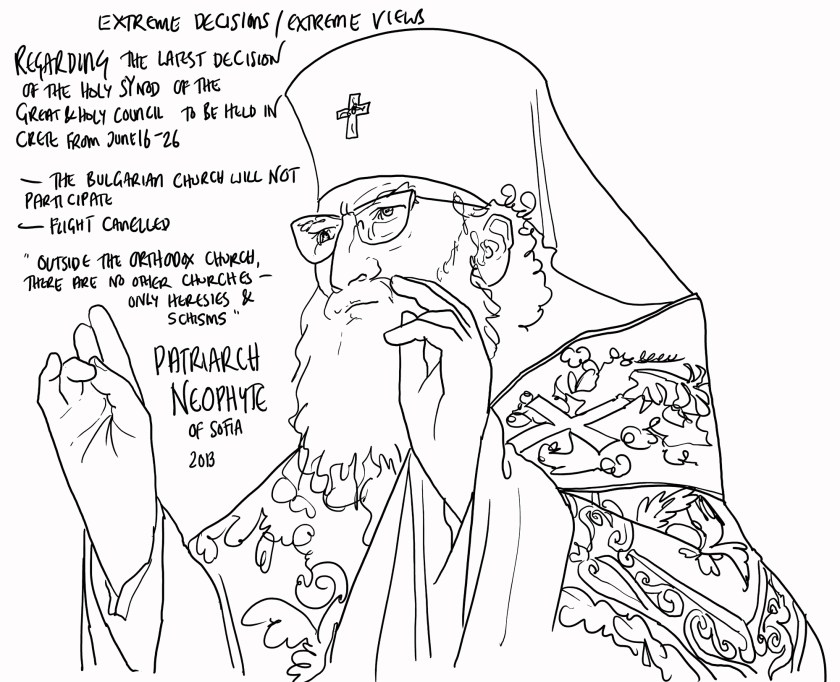
While Britain focuses on the EU referendum, a meeting is taking place (or not) in Kolymbari, Crete that has taken about 1000 years to negotiate and this specific effort dates back to 1901. Far from pursuing Church unity between Rome and Constantinople, it is fairly evident that unity across the Orthodox Church of 14 autocephalous Churches can be fairly fragile itself.

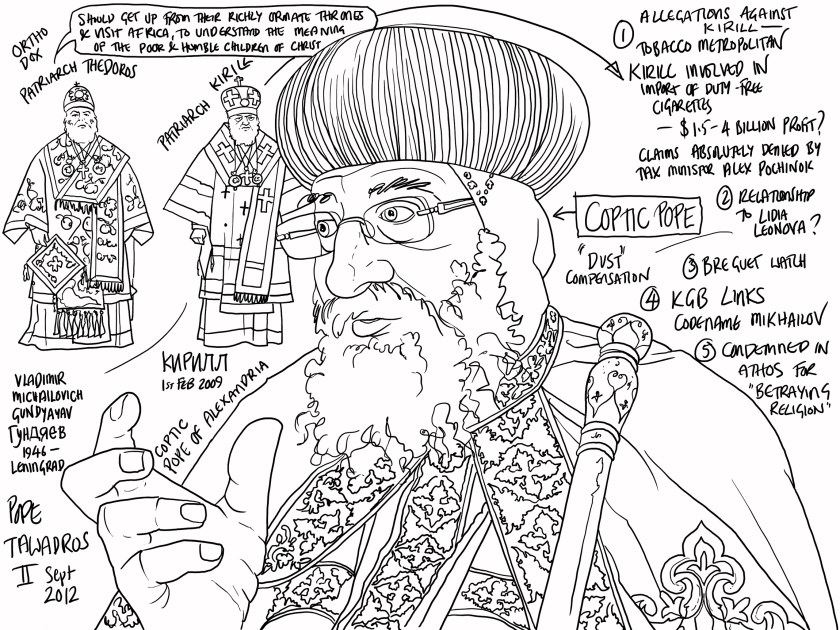
theodoros

Yesterday, Theodoros II urged the squabbling Bishops, led by the Bulgarians, to set aside differences and attend the council. The Serbians responded by saying they would attend, but they might not stay. The Russians remain determined to boycott the event.

As I see it the reasons for the boycott are fairly spurious- issues about primacy of honour in the conference itself and in any pronouncements thereafter issued, as well as a general prickliness about orthodox links with other churches, particularly Rome.

neophyte


The issues causing problems are really an excuse to promote the power of Moscow and the objections put forward by the smaller Churches like Georgia seem to have been orchestrated to make the point. While the Antiochene Church may well have a valid dispute with Jerusalem over control of parishes in Qatar (they should both be focused on Syria frankly), issues like “Church unity”, and intermarriage had already sparked concerns among the conservatives in Moscow. Kirill was also, I gather, worried about the prominence given to Bartholemew in seating arrangements at the council. This analysis tends to suggest that Moscow is absolutely the villain of the piece but there is a long history of Greece exerting control (most of the hierarchy throughout the middle east is bizarrely Greek, and has been so for many years). Squeals of theological protest from Athos and from what is mostly a group of ultra-conservative converts, have kicked up a fuss. Georgia, meanwhile, which worries that documents dealing with inter-marriage are too progressive and might cement in practice what has  so far been a “don’t tell” policy of tolerance, and Bulgaria’s decisive withdrawal gave an excuse for Moscow to withdraw too. How much their withdrawals were orchestrated by Kirill will remain to be seen.

Behind this jockeying for power is a nasty undercurrent. If, following rules laid down by the Turkish government which stipulate the Patriarch must be a turkish citizen, Bartholemew is to be one of the last Ecumenical patriarchs of Constantinople (with a flock of barely 3000 believers), the Moscow Patriarch clearly has its eye on the job.

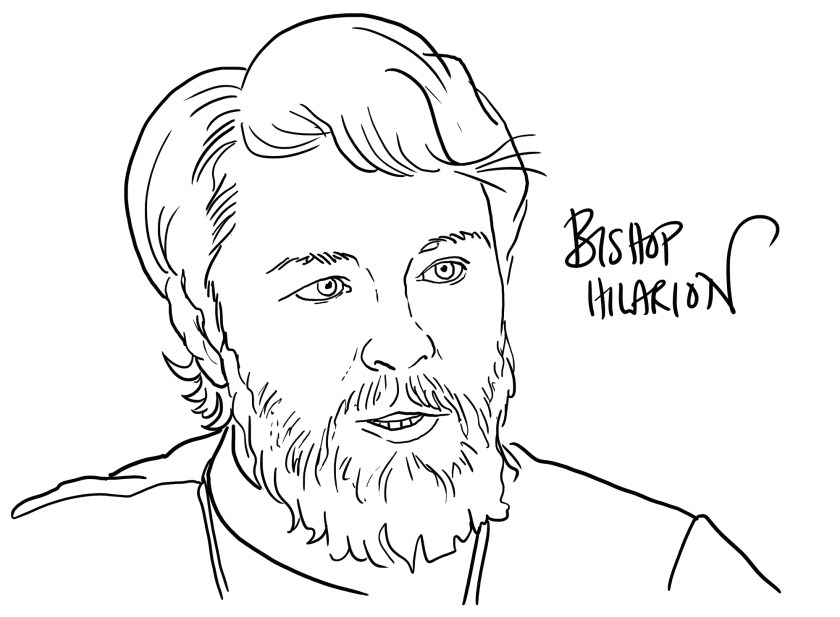
hilarion(Either Bishop Hilarion fails to do his job or is not allowed to do so. I hope the latter is the case because I like him!)
15th June 2016

C O M M U N I Q U E

In brotherly love, while with responsibility and hopes preparing for the participation in the Holy and Great Council of the Orthodox Church, which, God willing, is to be held at the Orthodox Academy at Crete around Pentecost, from June 17 to 26, 2016, the Holy Synod of Bishops in its broader composition at its session held at the Serbian Patriarchate in Belgrade, on June 15, 2016, regarding the situation created after the ordinary convocation of the Holy Assembly of Bishops of the Serbian Orthodox Church, takes the following decision:

First of all, having in mind the importance and significance of the Council, our Church wants, in a spirit of ecclesial upbuilding, to contribute to this Holy and Great Council fulfilling the criteria and the measure of true Councils in the history of the Orthodox Church, thereby justifying its title.

On the other hand, our Church requests that problems and matters not only of the Serbian Orthodox Church, but also of the other most Holy Churches that cancelled their participation in the Council, be considered at the Council.

With this aim in mind, the Holy and Great Council should last as long as these questions are to be considered, and must not be hostage to previously layed-out and accepted rules. Exclusively with the full consensus can the Council be considered as a Holy and Great Council.

At last, our Church insists that the gathering on the island of Crete be the beginning of the Conciliar process, that the matters in question should be solved during its working process, but in the spirit of the conciliar tradition of the Church of Christ.

In the case that the Churches present at the Council, with the Ecumenical Patriarchate at its head, persist in the position that the absent Churches boycott the work of the Council without any real reason, and in the case that the already present Churches refuse to take into consideration all the matters in question, problems and disagreements, the representatives of the Serbian Orthodox Church at the Council will be, regretfully, forced to leave the sessions of the Council and in that way join the Churches that are already absent.

This is by no means a threat or ransom, but a consequent implementation of the position and decisions of the Holy Assembly of Bishops of the Serbian Orthodox Church held in May 2016.

In the spirit of our ecclesial and pastoral responsibility, we present these positions hoping in the illuminating action of the All-Holy Spirit.

Archbishop of Pec, Metropolitan of Belgrade – Karlovci
and Serbian Patriarch

President of the Holy Assembly of Bishops
sign.   I R I N E J

coptic.jpgThis all seems a bit unfortunate. Bulgaria is simply following the lead of Patriach Kirill in Moscow, whose background is almost as dodgy as the late Christodoulos of Athens. Neveretheless, I hold out some hope that Bishop Hilarion, who was at Oxford, will hold sway over the Muscovites and they will finally come round to sense. At the moment, he is urging postponement but as another member of the council pointed out, there is not really anyone with the authority to call off what was agreed by “all churches” in January. “It would be autocratic and papal for him (the ecumenical Patriarch, Bartholomew) to change that. No one, including the Ecumenical Patriarch, has right to override that decision.

“There have been councils in past attended by very few bishops or churches, because of various circumstances,”Chryssavgis said. “This council will be the largest, most representative council in the history of the Orthodox Church.”

“In that respect,”Chryssavgis said, “it truly is a ‘great’ council, greater than any individual synod of one of the sister churches.”

I note that one of the signatories to a letter urging union and specifically “To postpone the Council once again,” they tell participants, “is to fail to live up to the principle of conciliarity on a global level.” is Dr Smilen Markov, Sofia University (Bulgarian Orthodox Church).“It is a great council, a pan-Orthodox council whose decisions are binding for the Orthodox Church,” said Deacon Chryssavgis, theological adviser to Patriarch Bartholomew.

An analysis in Greek (but with english subtitles). I am indebted to Fr Nikolas Young for pointing to this!

kallistos.jpg

Metropolitan Kallistos of Diokleia speaks  about the coming Holy and Great Council here,

Some Gilbert and Sullivan

I am about to compère a concert of G&S  favourites. I was writing some programme notes and started to draw- the first three pictures are my copies of original photos and the two pictures that follow are a quick attempt to conjure up the look of Yum Yum and Mabel. Years ago, I designed a production of both the Mikado in the Playhouse in Oxford and then later a production of Pirates.

WH Smith was the original of Sir Joseph Porter whatever Gilbert might have said to Sullivan. Smith knew it and so did Disraeli who thereafter called him “Pinafore Smith”

and here are some photographs from the production of the Mikado which goes back to the early 1980s – I found a photo of the rather grand front drop but have somehow misplaced it.


Swedish gripe


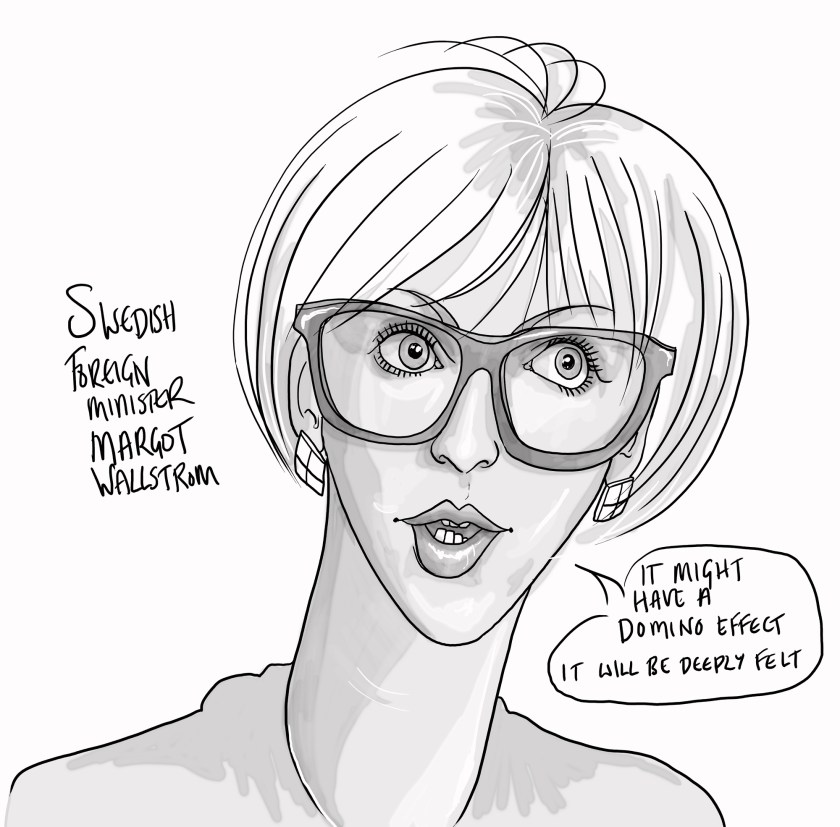
The Swedish group Abba have just performed again for the first time in 30 years, and today the Swedish Foreign Minister, wearing glasses no doubt to give an air of authority to her statement, added her own voice to the Referendum debate. Maybe she is the first of many such interventions. But it is all a bit late. The time to have pleaded about the “domino effect” was when David Cameron was jetting around the capitals of Europe trying to secure a better deal. But the effective dictatorship of Merkel held the day and we entered the Referendum at a disadvantage.

margot

Now, Ms Wallstrom whines, “everyone might want one”. Absolutely. And what is wrong with that? A series of referenda to determine the future of the Continent- democracy in action might actually re-invigotate this EU project. Because Europe is failing because it has been hijacked by largely unaccountable political ideologists who forget that the two primary functions of the EU are to bolster trade and preserve unity. Instead, a number of political obsessions have been allowed to take over- it was politics, in other words, not economics that dictated the spread of the EURO and, similarly, the punishment of Greece. But it is the creed of ever closer union that has most seriously damaged the overall project.

While I think her intervention is late and slightly patronising, I am afraid she is right (for once- because she was wrong about the arms deal with Saudi Arabia and that one blew up rather spectacularly in her face), but what she says in itself is not a good enough reason for us to vote to remain in the EU. The only reason to vote against BREXIT is to sort out the mess Europe has got into (and it is people like Wallstrom whose background in the EU Commission was put to the test and found wanting in her spat with Riyadh). We cannot afford to have this EU monster of such mindlessness and arrogance growing on our doorstep.

If we left Europe and it collapsed in our wake, the pressing political need to set up a new “EU” would be paramount for the very reasons the EU was established in the first place to provide trade, unity and security. Better, then, to repair the old one, waste less time and money and cement our common alliances. The measure of our success will be not only the prosperity of Greece but also our own security.

Ubiquitous Mann

A few weeks’ ago, I wrote about the appalling Ken Livingstone’s rewrite of history and the failure of the BBC to correct the faulty facts. The BBC is unrepentant but Livingstone looks set to explore the wilderness at last. The man behind the exposure was John Mann, who called Livingstone a “nazi apologist”, and who had also attacked Livingstone earlier as a “bigot” when the ex-Mayor had pointed out that he thought the shadow Defence Minister Kevan Jones might “need psychiatric help”. This is what Livingstone said, “I think he might need some psychiatric help. He’s obviously very depressed and disturbed … He should pop off and see his GP before he makes these offensive comments.” It is very much a Livingstone put-down. Livingstone suggested that his spat with Mann, however, went back to his failure to campaign for Mann in Oldham during the general election. Another typical swipe. But well done, Mann!

It all seems a bit personal, of course. When the two of them were on the radio, Livingstone said, “You’re on the radio and TV all the time, criticising what this party leadership is doing. All the time.” mm. It is an Edward Lear instance of the pot bashing the kettle.

And in response, Mann said this,

“You are a bully attacking Kevan Jones. Your language is appalling. You’re a bigot. You’ve failed to apologise … Even today, you’re failing to do so.” whereupon David Mellor butted in and added, “Can listeners kindly be reminded that these are two members of the Labour party who’ve been discussing their love for one another.”

However, Livingstone has a point. Whenever he knocks him down, Mr Mann keeps popping up like some sort of puppet- but the issues are so much bigger than a punch and judy booth.

john Mann

I think Mann looks alot like Neil Morrissey of “Men Behaving Badly” fame.

Mr Mann is also the MP who blew the whistle on abuse in Westminster, amid lurid tales of child strangulation in the 1980s. This, in turn, led to the hounding of Leon Brittan and Edward Heath. Unfortunate: stories have been leaking for years about the former PM but I think the idea that such an introverted man was involved in any groups is absurd, lurid and foundless. De Mortuis nil nisi bonum. Today, Mr Mann has announced that he is voting against his party for Brexit. I suppose that says rather more about Mr Corbyn’s lacklustre leadership than it says about Mr Mann’s ability to grab headlines.

It pains me to say

Much of what Farage says here is right, particularly about his reservations and warnings about the Euro- “through massive ambition and hubris, you ploughed on.”

I was in Greece in the run-up to the Millenium and the Euro project there was clearly a disaster hidden beneath a carpet of half-truths. But while Farage thinks we should walk away now the damage has been done, I think we should hang around and clear up the mess.

So much of what Farage says is reasonable, and of course brilliantly done- from a rhetorical point of view, he is a master of the verbal put-down and the jocular aside. But then he does a typically Farage thing and says he is walking out, never to return. But we know Farage from last year, when his resignation then turned out to be just a two week holiday following his unplanned defeat in the elections. Time to lick his wounds perhaps but not time enough to reflect on what the electorate had told him.

While I accept his comments about the hubris of those who drove the Euro, and while I share his concerns about the EU and its future, I hasten to add I have drawn different conclusions, partly because of his failure to eradicate racism in his own party, his endorsement of views that might well be taken to be racist, and his inability to control the thugs in his own backyard.

UKIP is the only party in the UK to embrace a libertarian view, and that is attractive, – more than that, there are excellent people in the party (not least Douglas Carswell, but I hope the option remains for him to return to the fold) – but it is too wide a church and the BPMers who infiltrated its ranks have been both tolerated and advanced to the detriment of others. (What was Sajjid Karim thinking of when he talked about “dealing” with Farage- I hope he was not suggesting violence and I am sure he was not- but no doubt that’s the way Farage would interpret it! We do not want to encourage the thuggery surely!)  If Farage is walking out of the EU, then, thank God, but recent history suggests he is not to be trusted to follow-through with this!

farage


Dr Sarah

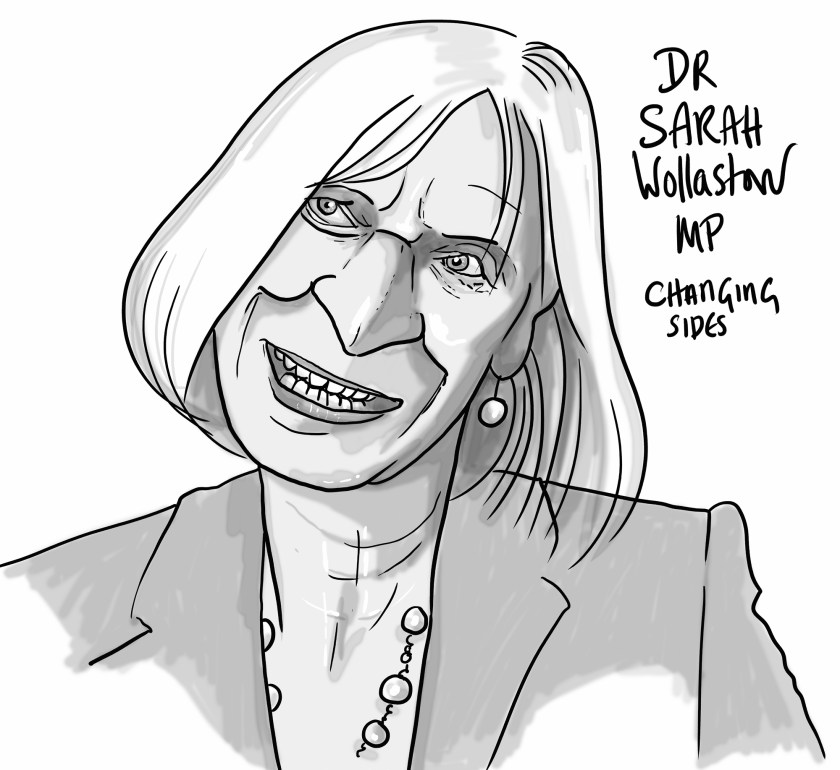
sarah wollaston


Yesterday, Dr Wollaston changed sides. I quite admire people who change their opinions especially in the middle of a race. It is rather noble, I think, to defy the school 400m, turn tail and run backwards to the starting point. It requires guts and self-judgement as well as a fair degree of élan to pull off this sort of manoeuvre successfully.

It is also something that, quite frankly, you can only do once. (I did it so that is the end of that)

In this case, I think Dr Wollaston has actually drawn attention to a disturbing trend in the Referendum campaign. She said that she was not comfortable with the claims being made about the potential money, potentially £350 million a week, available to spend on the NHS (and the simple fact is that she is right). This is what she has said,

“For someone like me who has long campaigned for open and honest data in public life I could not have set foot on a battle bus that has at the heart of its campaign a figure that I know to be untrue.

“If you’re in a position where you can’t hand out a Vote Leave leaflet, you can’t be campaigning for that organisation.”

This is all well and true, however, and I have been saying this for a while, but the problem here is that the claims made about the £350 million were being made quite a few weeks’ ago, so her sudden defection seems a bit tardy. Was it that she did not think the claim mattered as long as it was not plastered over her own bus? The timing of her move is just not quite right.

Dr Wollaston is quite good with warnings – she warned us before the General election about the need for a £15 billion spend on the NHS to avoid the whole system imploding during the present parliament. So prophetic and right again, but late, and she is doing the same here.

We also heard about fraud (£670 million lost last year with 9000,000 Euros lost to dishonest EU staff!) but the figures were drawn from Olaf, the EU fraud office, which presumably is in the process of catching the fraudsters and putting the money back where it belongs.

boris

Boris has made the £350 million claim fairly often-“We send the EU £350 million a week – let’s fund our NHS instead.” -that is 350 million a week going to Brussels (17.8 billion a year), but with the rebate (1984) the actual figure is closer to £240 million and the rebate takes place before any money is sent to the EU so the claims made about Britain sending £350 million a week to Europe are blatantly false.

More than that, the £240 million odd that is sent to Brussels does not include the money spent by the EU on UK projects. Scientific research (in 2013 was £1,4 billion a year), education and the arts all benefit from EU investment and bring the overall net fee to around £130 million a week- still arguably alot of money, but significantly less than the claims made by Boris.

The letter

The UK Statistics Authority wrote rather apologetically to explain to the leave campaign that their figure was wrong, but still the sum is peddled out…

But there are other more serious errors. The first is the simple fact that even if we save £350 million every week, there is no guarantee it will be used in the NHS or can be ring-fenced at all. If a “Leave” result causes the economy to tumble as some predict it will, then much of that savings will be lost anyway and the reality of the post-Brexit negotiations certainly does not guarantee any substantial savings if we follow Norway . So the simple fact remains- if I do not spend money as it is currently spent, that does not automatically mean I have saved it- It may mean I no longer have the money to spend at all.

The Philosophical problem

There are good reasons for voting “Leave”- supporting our declining fishing industry is one of them, and I contributed advertising to that end.

I still think this is an important cause, but on reflection, I am not sure it is enough to see us quit the EU. That alone is not enough- a big negative gesture will not bring about anything positive. Again, back to the Wollaston issue- saving £350 million does not mean we can or would automatically use that money on the NHS.

Here is the mistake of the BREXIT campaign in this instance and it is a serious one: not doing something bad does not mean we are automatically committed to doing something good.

And back to Statistics

But the Remain side has been equally plagued by dodgy statistics, so once again Dr Wollaston’s desire for honesty is compromised. The Osborne claim that families would be £4300 worse off after Leave is again fairly spurious and based on a misreading of Treasury data. Jacob Rees Mogg is someone I respect a great deal and this is his conclusion-

“I care nothing about the bus. I am not concerned about charabancs. That is not at the heart of the debate.

“I have always used the net figure. What is far more shocking is that the Chancellor has been using a figure he knew would be misleading.” Mr Rees-Mogg is in the Brexit camp.

Trump needs a trim

We live in a world dominated by peculiarly dull politicians, so it ought to make sense that those with a little eccentricity get support. Trump, sadly goes too far. He is an engaging speaker but he is not a politician: he is more of a fairground bouncer, a barnum and bailey carousel barker, but the joke has worn thin as I suggest has his hair, and it is time to call time on this playground parody. He needs a trim.

I have issues with The new Mayor, Khan, but I like the way he has responded to Trump’s offer that Khan might be the new Jesse Owens, the single blessed exception to his pernicious anti-Muslim rule. Khan knows the concession validates the underlying rule -and we can never dignify the ravings of a man hiding beneath a bird’s nest. Heaven forbid that he might win- that would be one weird cuckoo taking over the Whitehouse!

trumping

Hair and history

History has often savaged political leaders blessed with a luxuriant mane. Heseltine, Foot and Alexander the Great all tripped up and lost the game when they seemed to be winning, and Boris’s mop may well prove to be his downfall too. The spectre of Samson looms large but we cannot go too far with this imagery because it was undue criticism of Trudeau’s hair that gave him some sort of advantage and La Clinton’s hair barely merits a mention these days which may well usher her back into the Whitehouse.

At the beginning of the current US campaign, the Obama team tried to rubbish Trump’s hair with claims that it was all fake. There has been talk about Trump’s use of an ointment called Rogaine (he handed it out to one of his employees apparently who was suffering hair loss), of his having had a surgical flap (a form of hair transplant) and grafts like some sort of cranial rose. But surely we are beyond that now- can floppy hair ever explain his rudeness, racism and bigotry? can so many wives and girlfriends be combed away so easily? I am with Cameron and Khan in sniffing at his bonce. Can these teflon locks really explain why Trump gets away with the worst excesses of follicular audacity? Is it hair, or does Trump conceal some sort of blond rodent presumably whispering inanities into his hidden ear – a bit like the rat in “Ratatoille” – is he in short, the Davy crocket of the 21st century-  It may not be a hairpiece- it may be an earpiece, or maybe Trump believes it is the word of God. Moses had long hair too, remember?

And is that Trumping racoon dangerous?

The answer regrettably is yes, and if Trump says we need to get out of Europe, there can be only one sane response. We need to stay, but we need to make sure we’ve got a sturdy pair of scissors to hand for all the trimming we will need to do. We have to remember the History of Europe- but we have to be mindful of recent scissoring too. Can we ever forget the haircuts given to Greece? Unless Mrs Merkel wants to present herself as a modern-day Dalilah, a trip to the barber should be a joy, not a punishment.

louis XVI

Roman soldiers had short hair- probably a reason why St Paul promoted haircuts in the New Testament, though, of course, the rabbis might tell a different story- and certainly in Hassidic Judaism, it would be the women (the wig wearers) who shave their hair while the men still grow it in elegant tassles, as indeed do Orthodox monks (the man bun is not just for John Snow). British history, meanwhile, pitches the long-haired Royalists against the sturdy Roundheads, suggesting that short hair means business (Nicola Sturgeon?). But short hair historically has also been associated with slavery and long hair has been tied up with liberation and the urge to rebel (remember the musical “Hair”?).

Moving from politics, there have been some notable long haired men, often scientists- Robert Boyle (as in Boyle’s law), Dmitri Mendeleev, the periodic table man, Carl Linnaeus (the “Gorilla Gorilla” man from Biology), Da Vinci, Ben Franklin, Albert Einstein of course and Isaac Newton, but also artists like Jim Morrison, Bob Marley, Brad Pitt, Johnny Depp, Oscar Wilde, Franz Liszt, Leif Segerstam (who puts me to shame) Stokowski, Jesus, Brian May and so on. But then there is Richard Branson, and immediately we start to think again of Mr Trump and of the desperate need for both a decisive tonsure and a monastic vow of silence.

Whatever nonsense might be in his head, whatever words he utters, the curse of Trump’s excessive hair never really goes away. It has becoming an icon of insanity, whether ours or his I suppose will be decided at the Presidential election.

branson.

Her majesty’s leak

Every other day there seems to be a story emerging from the Palace – private views on Europe, on China and now on Nigeria. Surely there should be a review of the Palace plumbing because this is becoming absurd. It is almost as if there is a secret organisation determined to undermine the dignity of our monarch!

buhari.jpgStill, what Cameron said seems fairly legitimate: Nigeria is demonstrably corrupt. However, what has happened is a home goal because President Buhari’s brilliant, evasive and commendably concise response has had the effect of turning attention from his country’s dodgy dealings to questions about the lingering impact of Empire and the slow progress of restoring money after it is confiscated by the British legal system. More than that, Buhari readily admits his country is certainly corrupt- or rather, as a representative of the new Nigerian Administration, he says this is something he has discovered himself. “He was telling the truth. He was talking about what he knew.” The previous government had stolen an estimated £10 billion through arms trafficking. Buhari is determined to tackle corruption which he calls a “hydra-headed monster”.

I think this requires some comment:

The most obvious assets still held in the UK belonged to Diepreye Alamieyeseifha, who, rather like a recent ISIS fighter, fled in a yashmack, to avoid trial, though his accounts were frozen and assets held. The ISIS man was captured near Cairo, looking rather silly in a skirt. There was also Abdul Aziz Ghazi who rather hypocritically ordered his followers to fight to the death and then crept out of Masjid en travesti. Of course, the desire to cross-dress as part of the escape plan, while it seems to belong to “Carry on” films, “Dad’s army” and “Allo Allo” or, more seriously in films like “Triple Echo”, actually has a very long pedigree. I gather that Ehud Barak dressed up as a woman in a covert operation against the PLO in 1973- that must have been a sight to see, but Amin el-Husseini escaped the British in Palestine in 1937, sliding down a rope from temple mount, and romping off to Lebanon where he started a pro-Nazi cell. Neuri al Said tried the same thing in Iraq in 1958 but was given away by his shoes, and shot. Ignominious end. There was also Mullah Mahmood in Afghanistan and Yassin Omar from the UK, the latter also carrying a brown handbag, so going for accessories as well. Bonnie Prince Charlie did it after the battle of Culloden and of course Achilles did it to prevent his being conscripted into the Trojan war.

Oddly, while alot of attention has been given to France’s decision to ban the veil in public, the Ottomans dealt with this issue in the late 19th century, banning the Burqa (the extreme form of veiling) after a man disguised in a burqa attempted a robbery in 1892.

War-time cross-dressing is better served by women dressing as men, of course, and “the trouser-part”or breeches role, like Cherubino, seems altogether more gallant. From Epipole, to Joan of Arc, Phoebe Hassel and Zoya Smirnow. Though probably the best example today would be Eowyn the white lady of Rohan.

As for literature and theatre- the place is littered with cross-dressers. Indeed, until Rudolph Nureyev butched up male dance in the early 1960’s, ballet had a reputation for fey men- and with good reason – the male role in Coppelia, for example, was actually created by a woman, Eugenie Fiocre, and of course it was only recently that Peter Pan (my own production in Oxford was among the first examples, incidentally) was played by a man. Pantomime continues the music halls’ obsession with cross dressing.

But back to Diepreye Solomon Peter Alamieyeseifha who was the governor of the oil-rich Bayelsa State, and who was accused in London of money laundering in 2005. He was found with nearly £2.5 million and property in excess of £10 million. He jumped bail disguised as a woman and was then sentenced in Nigeria to be later pardoned by Goodluck Jonathan. He died in 2015.

He had to dress like a woman

All these men in frocks! It was Nietzsche who popularised “the Bacchae” and what a play that is! The main character even does a Pantomime turn on stage as he is persuaded by the (disguised) god to try on women’s clothing – “Go on, it suits you. Sir!” and then his head is ripped off by his crazy mother, Queen Argave. the reason for all this? Dionysos demands respect: “Can you, a mortal human, dare to fight a god?” (πρὸς θεὸν γὰρ ὢν ἀνὴρ ἐς μάχην ἐλθεῖν ἐτόλμησε.) This is one side of the equation and the other is the fight many LGBT campaigners have waged so that they can be taken seriously. This is to say nothing about the prohibition in Islam, but then, as we know, terrorists read the sacred texts very selectively when they want to:

عن ابن عباس رضي الله عنهما قال: لعن رسول الله صلى الله عليه و سلم المتشبهين من الرجال بالنساء، والمتشبهات من النساء بالرجال. صحيح البخاري.

This is what President Buhari said, “He (Alamieyeseigha) had to dress like a woman to leave Britain and leave behind his bank account and fixed assets which Britain was prepared to hand over to us. This is what we are asking for. What would I do with an apology? I need something tangible…Our experience has been that repatriation of corrupt proceeds is very tedious, time consuming, costly.” He also thanked Britain for helping in the impeachment process of Alamieyeseifha. But Alamieyeseifha was really just the tip of the iceberg, with Sani Abacha apparently looting more than $5 billion while in power, and huge amounts of oil stolen more recently according to a 2013 report.

The foreign secretary has added,

“The Prime Minister was merely stating a fact. These are both countries (Afghanistan and Nigeria) with serious corruption problems and the leaders of both those countries know they have those problems and are determined to deal with them.”


Andrew Marr

AndrewMarr.jpg


I was horrified by the story that Andrew Marr had been abused in the Daily Mail. Quentin Letts should have known better and it should not have been down to Roy Greenslade to get him to apologise, but that is the world we are living in. We are back to the same discussion we have had before (Jonathan Ross, for instance)- when is a joke no longer funny?

There have been many times when I have drawn something I later decided was too direct or simply did not work. Trying to be topical and humorous can often get us all into trouble, but there are some lines we should never cross. Racism is of course an absolute, but I think also we have to salute those people who are brave enough to stand up in public – Marr is particularly brave, to come back to prime time TV after suffering a stroke. He shows that this is possible. But that wider thought about public life is what makes me pause to admire even those public figures with whom I disagree- I am delighted Sadiq Khan, for example is now the first Muslim Mayor of London: it sends out a tremendous message, though I disapprove of many things Khan and his supporters have said and done (as I hope is clear from previous blogs). Nigel Farage might espouse views I dislike and behave in an appalling way (he still owes me a letter incidentally) but he must be saluted as one of the three great orators in the UK today (the other two are Nicola Sturgeon and Boris Johnson).

Here is the best Farage speech: brilliant, cruel, and probably not something I would say (I balk at the reference to Belgium, for instance) but certainly not poking fun at someone with a disability:

Jeremy Corbyn may not be a man who leads from the front, but I recall on the Andrew Marr show, what a convincing and positive performance he gave. I salute that too, while at the same time bemoaning his inability to control his own cabinet and form a decisive and genuinely loyal opposition. In the absence of real political leadership, we in the conservative party have begun to form our own loyal opposition on our own backbenches! Not good for the Conservatives, not good for Labour and certainly not good for our wider parliamentary democracy.

But praise where praise is due, and frankly, I cannot find a word to say against Andrew Marr. It is fairly shameful that the Daily Mail peddles this sort of filth.