Necati’s case update

The incompatibility of the definition of torture in Greece with international law

This is what was written by Nikolaos Sitaropoulos:
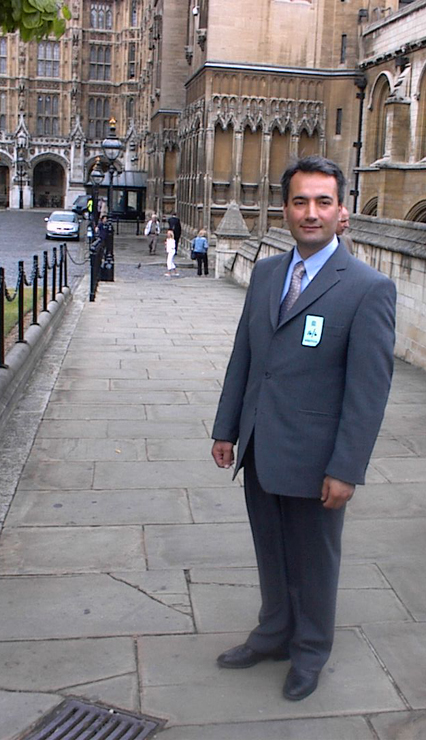
Necati_at_westminster.jpegIn the course of its visits since 1993 and reports on Greece the European Committee for the Prevention of Torture (CPT) has recorded numerous cases of torture and other forms of ill-treatment. In its 2015 visit report on Greece, CPT noted that infliction of ill-treatment by law enforcement agents, particularly against foreign nationals, including for the purpose of obtaining confessions, continues to be a frequent practice. As noted in an earlier post, ill-treatment in Greece has in fact acquired an institutionalised form. For this, CPT considered essential for the Greek authorities to promote a “culture change where it is regarded as unprofessional to resort to ill-treatment”.

The latest report by CPT made also clear that one of the major reasons for this state of affairs is impunity due to lack of convictions. One of the major reasons for this is the problematic definition of torture in Greek law. This definition was introduced into the criminal code (Article 137A§2) in 1984 by Law 1500, although introduction of statutory legislation was prescribed already by Article 7§2 of the 1975 Greek Constitution. Torture is defined in Article 137A§2 primarily as the “planned” (μεθοδευμένη) infliction by a state official on a person of severe physical, and other similar forms of, pain. Under the established Greek case law and doctrine in order for the infliction of pain to be considered as “planned” it must be repeated and have a certain duration.

Domestic Greek law and practice on torture is clearly at variance with international human rights law standards. This was highlighted by the European Court of Human Rights (“the Strasbourg Court” or “the Court”) in 2012 in Zontul c. Grèce, a case concerning a Turkish asylum seeker who in 2001, while in detention on Crete, was raped with a truncheon by a coast guard officer. The naval tribunals, both in first instance and on appeal, did not qualify the applicant’s rape with a truncheon as torture but as an affront to the victim’s sexual dignity, an offence that, under Article 137A§3 of the criminal code, is sanctioned with imprisonment of at least three years (while torture is a felony and punished with at least five years’ imprisonment). In Zontul the actual penalties that were finally imposed on the main perpetrator and his accomplice were six and five months’ imprisonment, which were suspended and commuted to fines. The Strasbourg Court found a violation of Article 3 (prohibition of torture) ECHR noting, inter alia, that a detainee’s rape by a state agent has been considered as torture in its own case law as well as by other international courts, such as the International Criminal Tribunal for the former Yugoslavia.

Indeed, the conditioning of torture upon the existence of a “planned” infliction of severe pain raises serious issues of compatibility of the Greek criminal law with international human rights law. Firstly, it finds no ground in ECHR and the Strasbourg Court’s case law. In 2010 in Gäfgen v. Germany, the Grand Chamber of the Court noted that in determining whether ill-treatment can be classified as torture, consideration must be given to the distinction  between this notion and that of inhuman or degrading treatment. The Court added that  it appears that it was the intention that ECHR should, through this distinction, attach a special stigma to deliberate inhuman treatment causing very serious and cruel suffering. Apart from the severity of the treatment, there is a purposive element to torture. To support this the Court noted, as primary treaty-reference, the 1984 Convention against Torture (CAT), where (Article 1) torture is defined in terms of the intentional infliction of severe pain or suffering with the aim, inter alia, of obtaining information, inflicting punishment or intimidating.

As noted by the Strasbourg Court in Zontul (para. 47) in fact the draft text of CAT provided the model for defining torture in Law 1500/1984 that introduced the definition of torture into the criminal code. In addition, Greece by Law 1782/1988 ratified CAT, without any substantive reservations to the text of that treaty. Actually Law 1782/1988 constitutes a literal transposition into Greek law of CAT, including the definition of torture contained in Article 1 CAT. In view of the above it is hard to understand the deviation of the criminal code definition from international standards that appeared to guide the Greek law makers in 1984. The only logical explanation may be a wrong translation into Greek of the wording of Article 1 CAT.

In addition, the word “planned” is a vague term from a legal point of view that may ignite various interpretations. By its 2012 concluding observations, the UN Committee against Torture called on Greece to amend the torture definition in the criminal code so that it is “in strict conformity with and covers all the elements” provided for by Article 1 CAT and meets “the need for clarity and predictability in criminal law”.

The current wording of the Greek criminal code, and its application by the Greek courts, is clearly at variance with both CAT and ECHR and needs to be amended. Under Article 28§1 of the Greek Constitution, CAT and ECHR upon their ratification became an integral part of domestic law and prevail over any contrary provision of domestic law. As noted by A.A. Fatouros, when debating the above provision in 1975 in parliament, there was an overall agreement among the law makers that the Greek Constitution by Article 28§1 gives enhanced formal validity to both customary and conventional international law so that they prevail over both prior and subsequent statutory legislation. In fact the then Minister of Justice stated that the Greek government accepted the increased validity of treaties par excellence.

The execution by Greece of Zontul is still subject to supervision, under Article 46 ECHR, by the Council of Europe Committee of Ministers (CM), along with ten more cases (Makaratzis group of cases) against Greece concerning, inter alia, excessive use of force, ill-treatment by law enforcement officials and lack of effective investigations. The CM supervision has so far focused on the need for Greece to establish an effective administrative complaint mechanism for such cases. A mechanism provided for by Law 3938/2011 never became operational. Law 4443/2016, published on 9 December 2016, defined the Greek Ombudsman as the new national complaint mechanism covering all law enforcement and detention facility agents. The Ombudsman was given the competence for collecting, registering and investigating (also ex officio) individual complaints, and was accorded the power of issuing a report with non-binding recommendations addressed to the disciplinary bodies of the law enforcement authorities concerned.

Although this is a positive step, concern about the effectiveness of this new mechanism has been voiced by the Council of Europe Commissioner for Human Rights in a letter on the draft law which he addressed to the Greek government in July 2016. The primary reason for this concern is the non-binding force of the Ombudsman’s recommendations. However, even if the new complaint mechanism had been provided with stronger safeguards of effectiveness it would not have been in a position, on its own, to provide redress to victims of torture without an amendment of the criminal code or a change of the established domestic case law.

As stressed by the Strasbourg Court (see e.g. Zontul; Gäfgen) in cases of a person’s ill-treatment while in detention, or wilful ill-treatment contrary to Article 3 ECHR, adequate means of remedy is the one provided by criminal law. In order for an investigation to be effective in practice the state should enact criminal law provisions penalising practices that are contrary to Article 3. The Court in Zontul made it clear that the current Greek criminal code and case law do not fulfil this vital requirement. The best solution and way forward would be an amendment of Article 137A§2 of the criminal code so that it is fully aligned with the standards contained in ECHR and CAT.

Published at: http://verfassungsblog.de/the-incompatibility-of-the-definition-of-torture-in-greece-with-international-law/

Maybe clause six but never clause eight!

There is a thing going round Westminster today called “the wrecking amendment” and it wrecks in two ways. Firstly, if it goes through, it will seriously damage the chances of triggering article 50 (which may well be the intention) and secondly, it assumes a power to which Parliament has no right. The “wrecking” amendment is not clause 6 which rightly, in my opinion, states that EU nationals living in the UK should be guaranteed the right to live here. The labour amendment, however, suggests (I think wrongly) that this right should be guaranteed on the date that Article 50 is triggered.

Instead, I think these rights should be unilaterally accepted before we even enter into negotiations. This approach represents a mark of good-will, a moral standard and a commitment to the wider concept of European integration that I trust the referendum will never scupper. Indeed, despite news today that Mr Farage’s marriage is on the rocks, he led the way in marrying a German national, setting out in quite domestic terms, a commitment to European identity that seemed at odds with his vigorous campaign against the power of Brussels. Of course, I do not share most of Mr Farage’s views, assumptions or political ambitions, but I know that on a personal level he has proven to be a good man and he remains one of the best speakers in the UK. Indeed, I have heard him praised by members of our own Conservative cabinet, who point to his personal discretion and his sense of honour. this is to say nothing about my reservations about his brand of demagogy and his confusion of democracy and populism but when Mr Farage finally retires and where, we will be the poorer for it when he is fully eclipsed by the dreadful people currently taking on the leadership of UKIP.

And here is the core of the “wrecking amendment” because it is put forward by people who think a statement is more important than a credible achievement. King Canute was a twit. He was in his own way quite as mad as King Lear raging against the elements on the moor. Words are just words if they can never be translated into actions, but more than that, words are a record of what we should do, and they can cripple progress if they are actually proven to be meaningless. I salute clause 6 with reservations, but I hope clause 8 will be fully rejected as the absurdity and arrogance that it represents. It is silly to bind the EU to accept both article 50 and clause 8! It makes the whole thing a joke and that is how it will be seen. More than that, I do not really think it will not wreck the Brexit plan. It simply makes us look unrealistic.It puts us in the same boat as Varoufakis- teasing an entire contin ent with some sort of limp gamesmanship. It did notwork for Varoufakis. I cannot see it working for us.

yiannis

Clause 6 should be a moral statement, and nothing at all to do with the Brexit treaty negotiations. It should be a Statement of our National Integrity. To place clause 6 in the context of article 50, or to balance clause 6 with clause 8 is no more than Mrs May is already planning- to negotiate a frankly demeaning tit for tat deal on the care of our respective nationals living abroad. What folly!

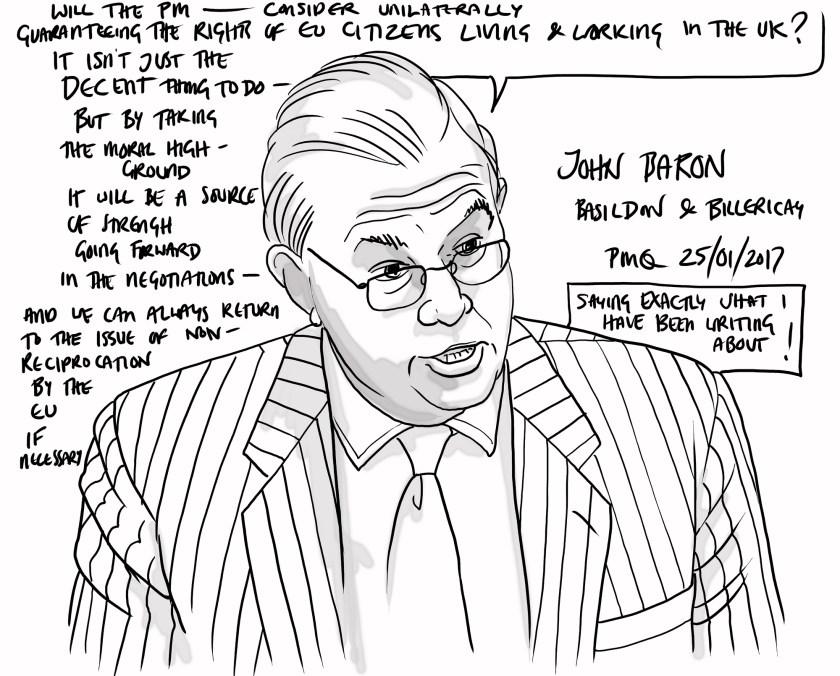
The matter of EU Citizens in the UK

I am delighted that this issue is receiving more and more attention and support. I hope the Prime Minister will take note and act appropriately. If Mr Junker and his cohorts wish to bargain with people’s lives in this way, we in the UK should make it clear that there is a moral high ground and we have taken it. I am astonished m. Junker did not seize such ground himself but I am deeply disheartened that Mrs May has, even now, left it so long.

We need to reassure EU citizens resident here at the time of the Referendum that, whatever the outcome of future negotiations with the EU, we acknowledge and confirm that their faith in Britain was not and will not be misplaced.

Here are my scribbles during the lunchtime news a few minutes ago. I am afraid I am so busy with Edward Lear, he has crept into this page anyway… Apologies.

david-davis-brexit-by-tim

Despicable?

Today Gina Miller who led the Supreme court move a few weeks’ ago is on TV again saying that Politicians of various hues have exacerbated the problems of brexit, mostly by demeaning her “legitimate concerns” about the way Brexit is triggered.

gina miller.jpg

In fact, she has been proven correct. At least legally as justices have ruled that article 50 of the Lisbon treaty cannot be invoked without the approval of Parliament as a whole. No doubt the Government has allowed for this ruling so nothing will be delayed in the Government’s overall plan.

However, I have never quite understood the nature of the national debate that has taken place since the Referendum. If the Referendum was actually so decisive, I do not understand why politicians of almost every background have been so feverish to rehearse again and again the varied reasons for leaving the EU. It is actually as if even the winning side cannot quite believe what happened or why.

The actual debate that should have been happening over the last few months has been ignored so I want to spell it out. 48% voted against Brexit on 23rd June. (out of 30 million voters or 71.8% turnout). This was exactly the percentage breakdown in the referendum held in Greenland that led to their exit from the EU in 1982. In England and Northern Ireland, the leave vote was less marginal, with 53.4% and 55% respectively voting for Brexit, though in contrast Scotland voted decisively to remain by 62%- not a marginal decision at all and something that should be respected. But I am confident that among that 48%, there was a high proportion of voters who, like myself, feel that the EU as it currently stands is in serious need of overhaul and that Brexit was only one of a number of fixes that we can all agree is needed. Indeed, I have not spoken to anyone in the UK or in mainland Europe who “hand on heart” thinks the EU is currently doing the best job it can.

Rather than bullying those who lost the Referendum and branding them “remoaners” or whatever, we should have spent the last few months enlisting their support, and persuading those who like Mrs May voted to remain that their views would still be represented in the triggering of Article 50. Article 50 is not an either/or scenario. It is one solution to a problem that an overwhelming majority of people in Britain and abroad have identified for years. It is just one solution of many and it is the solution we voted for in the summer. There is no need to gloat or to silence those who did not agree with Brexit. Instead, clever politicians would take these people along with the popular mood.

As for the fate of EU citizens currently resident here- (currently increasing at a rate of 184000 a year) if the negotiations linger on for maybe two years after the allotted negotiation period, by no means an impossibility, so five years from the referendum date itself, then anyone who was legitimately here in June will have a right to full residence anyway. There is a simple solution!

But instead of looking for solutions and fostering collaboration, we have been encouraged into a disturbing climate of “them and “us”. We can do better than that!

There is still time to change!


“Britain’s punishment”

“Britain must not get a better deal than the members who stay fully committed – otherwise this is not punishment.

What an extraordinary comment by Sylvie Goulard MEP who acts like some sort of haughty Au Pair, trying hard to play “Nanny”. She goes on to suggest that when we leave the EU, we must also shoulder a leaving bill of between £42 and £50 billion. It is outrageous to be charged for leaving the shop.

It is more outrageous to be told this by the Au Pair.

In Moscow, I found it hard when I went into a department store that I was obliged to go through the whole shopping-centre rather than simply exit by the door I had mistakenly entered. It is like being steered through duty free, or window-shopping in Amsterdam in the hope we will be tempted by something. But this is worse. And more than that, it is shameless when a gathering clan of European politicians are openly talking of “punishment”.

The “punishment” is already in the wording of the Referendum- we are to “leave” the EU club. I think that is punishment enough! But this ridiculous lady thinks we should have additional punishment as well, and that any payments that are demanded of us must also be couched in the language of punishment? It beggars belief!

If she wants to fleece a customer who says he will not return, at least try to do it with finesse. To bar the door and demand a ransom for leaving. That is frankly communist! It is the stuff of the old USSR!

For me, only one thing matters now- far more than posturing about what sort of “Brexit” we would prefer- that we behave decently and promptly to the EU citizens resident here, no matter what the EU politicians propose, and if this is a demonstration of their bilious response, we need to set the moral compass well and truly in advance. Let us not sink to this vicious nasty spiteful tit for tat. This is not a game anyone will leave with dignity. We must rise above it.

We have had a bad start, let’s be honest. And it will not get better if Brexit talks stall in the face of imminent French and German elections. We need to deal with our issues of regulating the British market to take over from what the EU market was once doing- and we need to do that quickly no matter what sort of Brexit we ultimately agree politically. We need to co-operation of both France and Germany to do this, but instead we are triggering article 50 when both these two countries could not be more distracted! What folly!

Yet that folly is not what Madam Goulard criticises. In fact, almost no one recognises this particular folly! Instead, the post-referendum language that both sides have continued to wield is of hostility and threats, a giant game of chicken that oddly people in parliament believe might have a set of rules. There are no rules or certainly none that favour us. And more than that, if just one of the 27 states objects to any deal we arrange, maybe because they do not, or rarely trade with us anyway, they have the power to veto the whole process. This is not a game of cat and mouse- this is about a rat in the lion’s den and the rat is trying vainly to dictate terms.

Yet…the EU is, without doubt, also behaving very badly.

I have said before that the EU should be ashamed of the Referendum vote- that it was reason enough to expect Mr Junker to resign. He failed to provide Cameron with enough leverage to take into the Referendum anyway. Yet he remains.

But there is much more to madam Goulard’s pronouncements that meets the eye. This is a woman who is keen on the ever-closer integration of Europe (she is already president of Mouvement Européen-France), was advisor to Romano Prodi when he was President, who wants, indeed, to be President herself of that EU, who is confident enough to write not only in French but also for the FT in English. This is an ambitious lady.

It is worth looking at m Goulard’s approach to other difficult EU states-

About Greece, she repeats the integrationist line: “I believe in the team game. We should not even consider the case of losing a member state. It is not in the interest of the Greeks. It is not in the interest of the eurozone. But this requires effort from both sides. The Greek government should admit that any decision taken must be passed in the Greek parliament as well as the German and the French parliaments. Perhaps Europe should make some more positive steps. Both sides should agree that their future is common and be prepared to correct past mistakes.” She has pushed for greater transparency in negotiations, seemingly a good thing, but when all is said and done, even her recommendations and good will come with an acidic put-down.

Vague

She wrote about and took a major role in reversing the Greek Referendum (and arguably Grexit would have been better for Greece and almost certainly for Europe): “Sur le fond, Tsipras est resté très vague”, she said and indeed, let’s admit it privately, he really was, but it is not something we should ever say in public, surely! What condescension! Quelle folie! Tant d’agressions! But while Tsipras could be bullied into remaining in the EU, Mrs May, who frankly has been even vaguer (-extrêmement vague) at least until yesterday, has made it clear she is off and that no deal is better than a bad deal. It is not that surprising that Madam Goulard has, therefore, hit the presses today. What a thoroughly disagreeable woman she is.

sylvie goulard by TIM.jpg

Mr Versi’s revisions

I have written before about the work of Miqdaad Versi and I note that his actions are now reported to be more targeted and disciplined. He now also writes for the Guardian.

It is not that I want people to search for errors, but I would like journalists to be held to a standard of decency that sets the tone for any future or current debate. I went back and reread what I wrote earlier- mostly it was a groan about the gathering campaign of Mr Trump who tomorrow is inaugurated as 45th President of the US. Rather like Brexit, this is something we must now accept as reality. We cannot wring our hands and protest that we did not vote for this, want it, or indeed that we do not recognise the outcome. It is our job to make the best of a given result. That is the reality of politics.

More than that, the Trump Presidency has an impact well-beyond the borders of the US and he has a direct effect on many people therefore who were never given an opportunity to vote for him in the first place. The much-hyped concept of 51% voting for such and such is irrelevant actually. The only relevant fact is the reality we face, and we move forward in the knowledge that that is the reality we must address.

In contrast to the worried views of the “Spiked on line” people, and particularly the rather petulant Tom Slater (who thinks Versi is trying to “ring-fence Islam from criticism”), I think it is the quiet and careful actions of people like Mr Versi that will tone down the more extreme rhetoric that was used by Trump and his followers during the US election campaign. Let’s hope Trump’s more extreme remarks were the product of ignorance. Ignorance, as Plato says, can always lead to knowledge and knowledge is “the Good”.

To his credit, Mr Trump has mellowed of late and is clearly seeking and taking advice. Like Mr Reagan, Trump shows all the signs of being a good delegator, something we over here need to learn. Maybe it is time for a big businessman to take on the establishment. I loved the Peter Brooke’s cartoon a few days ago in the Times that celebrated Trump while also recording the end of the Barnum and Bailey/Ringling brothers’ circus. In fact, I increasingly love Peter Brookes! His observation demands scrutiny and his drawing alone merits some study. He has been on a bit of a roll recently while Riddell, in the Observer, whose work I think is a natural successor to Tenniel, has been a bit “same-y”.

moleskin-versi-by-tim-may-and-trump

The Immanent Gove

Michael Gove today penned a piece in the Times suggesting that he had access to Mrs May’s latest thoughts, indeed the very words she might utter in only a matter of days.Quite apart from the irritation of finding senior politicians jumping on the bandwagon of false news, his piece simply repeats arguments that were surely sorted out at about 8am on 24th June.

gove

I think much of what he thinks the PM will say will remain wishful thinking, but it is still deeply mistaken and misleading.

I think Mr Gove’s greatest mistake lies in a misunderstanding of what it means to lead the country, something he aspired to do and that Mrs May is now doing. Mr Gove thinks that what matters is “the truth”, but truth is a relative and constantly changing concept. What matters instead is “responsibility”, or “trust”. I think this is a single concept though expressed in two words. For it is not possible to have one without the other. It is something Mr Gove failed to earn and, moreover, a concept that is much bigger than the referendum and certainly bigger than Brexit. It is about doing the right thing at the right time and with confidence. Today, when Brexit is presented, a number of politicians, and certainly Mr Gove, seem to abandon not only reality and rational thought but also a belief in the primacy of Parliament for naive demagogy as if they are still not sure they won, and have to rehash the same arguments over and over again.

Put bluntly, has Mr Corbyn not been a sufficient warning to you?

Mr Gove sets the tune of his piece by referring to Ronald Reagan and Mrs Thatcher. Reagan’s plan for the cold war- “Simple — we win; they lose.” But that is not quite how it panned out, was it! Let’s look back a little further:

While France and America embraced revolution, Britain quietly changed from one leader to another. The “glorious revolution” may not be quite all it was cracked up to be, but it demonstrates a way of behaving that Mr Gove absolutely forgets. Revolutions, if pursued relentlessly, are out for blood and that has not been the British way. We want to forge a quiet rethinking of the status quo, and if possible, seemlessly merge from one form of rule to another, maybe, if absolutely necessary with a mild embellishment to the union flag.

Mrs May is quite right in repeating her mantra that “Brexit means Brexit” just as she is quite right in being tight-lipped about exactly how that will play out. Even if she triggers the process in a month, we still must wait two years for that act to play out, and during that time, much of the Europe we know today will have changed beyond recognition. Catalonia lingers, Le Pen lies in the penumbra of perceptual power and Germany smoulders with discontent to say nothing of Greece, badgered and badgered until it is made to feel like a poodle puddled in the Aegean. The only thing that we can be certain about is the Responsibility Mrs May has been given as our leader and the trust we place in her.

What I find most disturbing is the claim that we know what “the electors wanted” when they voted for Brexit. The fact is, we can never know just as we can never know what they wanted when they voted for Mr Corbyn. All we have is the result which in and of itself says nothing about immigration, control of borders, the single market, hard or soft Brexit. It is simply a mandate for leaving the current arrangement, a recognition that the EU as it stands is failing. A referendum is not a result in itself – it needs interpreting and circumstances will change. That is inevitable.

Also, though I hesitate to point this out, the Brexit vote was far from uniform throughout the country and a clever Brexit will allow for, and placate the 48% who voted to retain our place in Europe.

But I hope we are fast approaching the day when we will stop hearing what Politicians think the electors voted for. No one really knows. Equally the obsession with anticipating the way we leave Europe needs to stop. We need to leave the negotiating team to do its job.

The obsession, drummed up in part by people like Mr Gove and Mr Farage, about how we leave in fact allows Brussels to avoid the full force of the blow of that Referendum decision. Indeed, this obsession gives a platform to Mr Junker, who rather than falling on his sword as one of the architects of modern Brussels, can join Gove and Farage and pontificate about HOW we should be going. What folly for Junker to be mocking Milord, when his own house is burning down.

Mr Gove gave a tv interview a few weeks ago and demonstrated what a thoughtful, centred man he really is. I do not understand, therefore, why he needs to play to the gallery like this when what we really need is his keen intellect and analytic support at the centre of Government. What Mrs May does not yet say is that any form of Brexit means a re-ordering of Europe because she knows the European project is bigger than the EU. Because the future of Europe and the role it will play beside us is as much our concern as the manner in which Britain will be defined two years’ hence.

John Donne writes,

donne

No man is an island,
Entire of itself,
Every man is a piece of the continent,
A part of the main.
If a clod be washed away by the sea,
Europe is the less.

As well as if a promontory were.
As well as if a manor of thy friend’s
Or of thine own were:

Any man’s death diminishes me,
Because I am involved in mankind,
And therefore never send to know for whom the bell tolls;
It tolls for thee.

Dom Wolf

The Guardian thinks it is going to cause trouble by personalising an issue that I have mentioned a few times.

The story of Dom Wolf, a British born man of 32 who accidentally has a German passport, however, makes uncomfortable reading. He is not alone in finding himself embroiled in an expensive, frustrating and time-consuming battle with the Passport office. His story comes hard on the heels of Sam Schwarzkopf and Monique Hawkins, both of whom received rather aggressive form letters telling them to prepare to leave the country as far as I can tell because they had not included their original passport with the application form, an option, incidentally that was advised or at least permitted.

To be honest, the Passport office has already issued an apology to Schwarzkopf but it is not quite enough: this is what he was apparently told:

“My MP got involved in this, writing letters to the Home Office, and this was very helpful. At first they explained that this was simply the way they write their rejection letters, but eventually someone wrote back with an apology. More importantly, they said they would take this issue on board and consider changing the phrasing. From the story in the Guardian, it sounds that at least so far they haven’t changed it yet.”

The Monique Hawkins issue raised another anomaly which her husband explained:

“As a British citizen, I had the expectation that marrying someone from abroad would automatically give them the right to become a British citizen. That seems to be the case unless your wife happens to come from the European Union,”

The issue is not really about the chaos of the bureaucracy but about our failure to grasp the moral nettle. We should certainly not be waiting for the EU to decide whether British nationals can legitimately remain in EU countries after Brexit before we decide the fate of those EU nationals who have been staying here often for many years. We should take the initiative and leave the EU officials to play catch-up. It should not be a game of tit-for -tat and this is not the major negotiation we should be having with the EU. Success or failure on this point would be cheap and cruel. There are some issues that simply should not be up for negotiation- a line should be drawn in the sand and we should move on from there. If the EU does not agree, then the EU will be the one to look morally shoddy.

We need to “man up” and seize the moral high-ground here because the longer we wait to see whether “brexit means brexit” on this particular issue, the uglier it will become.

dom-wolf

Sir Ivan Rogers

ivan-rogers

Whether Sir Ivan is a pro or anti-Brexiteer matters very little, he remains a man of consummate experience and his departure today is a very sad comment on the way debate and negotiations about our future with Europe are so-far progressing.

Sadly, I think in many Brexiteers’ minds, Sir Ivan is inextricably linked to his two mentors Sir Kenneth Clarke and Tony Blair but there is a big difference between what his private views may have been and what his public office represented. With so many years at the top end of the civil service and our ear in Brussels, his will be a very hard act to follow and he will be a tough man to replace.

If he was pushed, it is likely that it was a result of his leaked and pessimistic forecast that it would take 10 years to leave the EU whether a few EU officials may have thought otherwise or not. But it is highly unlikely that he himself was behind such a leak.

Should Sir Ivan have resigned months’ ago when Brexit was announced? Probably not. This is a man who successfully served two different parties as a senior civil servant. He was well-placed to execute policies he may not have liked- but frankly, we do not even know that. All we know is that he gave ministers his honest assessment that completing negotiations in a two year time-frame was over-optimistic.

He was due to resign in Autumn. It’s a shame he was not allowed to wait till then.

When we abandon dignity and kindness, we can all but abandon hope.

I hope we have not got to that point: it would be good to hear at some point that senior UK officials tried to persuade him to stay. So far, there has been nothing reported to suggest that was the case. Quite the contrary.