The New Prime Minister makes it very clear that she is efficient- she had appointed the key members of her cabinet within an hour of kissing hands in Buckingham palace. One of those appointments, Boris Johnson, has sent shockwaves around the world but I think I have already explained for a Turkish outlet precisely why Boris over-egged the “Leave” omelette and why that was such an important thing to do if he was to deny Farage his place at a future Cabinet table- to me, Boris will always be the man who took one for the team, and he did it with a panache no one could ever rival.
Boris is not just the thinking-man’s Farage, he is quite simply, “thinking man”. Farage, once thought necessary to anyone’s plan for Brexit, like any unwanted ingredient, like rancid butter, has been consigned to the bin of history.
Mrs May also makes a stab at a smile, but it all looks a bit forced. For that reason, I hope she will find room for Andrea Leadsom on her team. Andrea demonstrated last weekend that she is deeply human and the mistake she may or may not have made in no way disqualifies her for high office. I think she could show the humanity of the Cabinet. We need a few tears and we need someone to gleefully explain how to vote twice, or, indeed, to observe that getting a room to meet a Telegraph interviewer at the local hotel might perhaps be misinterpreted. I do not share many of Mrs Leadsom’s views but I have grown to like what she stands for more and more over the last week.
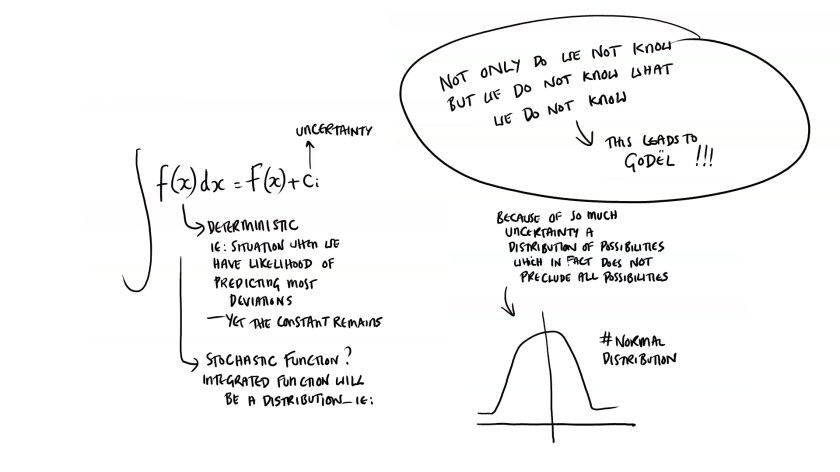
I was asked to give out prizes this year, and this is the text of the speech I gave. I also had projections and the accompanying images give an idea of these though they were also animated.
I want to congratulate all those who won prizes today- and also, as Fr President observed this morning, those who did not- but who clearly have been working very hard. And Anna- I don’t want to sound like Simon Cowell but this afternoon, you have made that Sondheim song entirely your own. Congratulations one and all!
Now, I want to talk about change.
We often find it hard to adjust to demands for change. But we are all as any mathematician, – or indeed as Heraclitus or Pocahontas might have said, in a state of flux. We cannot step in the same river twice. You know the song, “Once more round the river bend” – frankly, Disney says it just as well as the ancient greeks.
The demand OF constant change is uncertainty. Check out the Maths which is appearing on the screen to my right! Maths might help us understand what is happening but it is often experiences from the past that can help negotiate this uncertainty.
So, I hope you will indulge me, if I talk about an event when I was a boy here at Ratcliffe. When I was doing the Oxbridge exams and in the same week a production of Merchant of Venice, and I was caught shouting at the cricket pavilion. This was not an architectural statement. Rather, a pointless and a slightly loud display of fury and the then headmaster, Fr Anthony Baxter, took me into his office and suggested I should accept as providential things that I could not control. (Incidentally, I cannot quite control the projection of the maths – those of you who have just finished the Maths A level will agree that maths happens at its own pace. We must be patient.)
Fr Baxter urged me to follow the example of Rosmini, the man who imagined setting up this school in the first place. Antonio Rosmini was really a tremendous writer who incidentally had irritated Vatican bigwigs and had made powerful enemies. but it was the march of history that was his chief adversary. A few years before his death, he was due to be created Cardinal secretary of state by Pius IX but even as he received a set of buttons specially embossed with his family coat of arms, The pope went into exile and Rosmini’s preferment went up in smoke. Now this is the point: and I checked it yesterday with Fr Ted but neither he nor I could remember the exact words of the account, so here is the gist, in Fr Ted’s words, Rosmini took a little time time getting his head round it and then he moved on – and it is that time for pause that is important. So is the fact that he accepted the reality of the new situation. Over the next few years, it simply got worse, by the way, and his his life’s work, his writings were condemned, yet at the end of his life he says, “Be still, adore and rejoice”.
a cloud of suspicion hovered over Rosmini’s work until Vatican II. Today, He is accorded the respect he is due, and even quoted in Papal encyclicals. But it took a century, at least, for his ideas to be accepted. It takes time. Change takes time. A phrase we will get very familiar with in “post referendum”.
So, I was told to accept things that did not go to order. “Be still, adore and rejoice!” Well, I was far from rejoicing, and, by the evening, I was seething. I explained this to another one of the Rosminian priests, a man called Fr Basil, who made me a cup of tea, listened very politely and then gave me a book with a bookmark on which he had hastily inscribed the words “Ephesians 4.26”. I looked it up the following morning: “Never let the sun go down on your wrath.” So, that was a bit late! Here were two principles- to accept providence and curb anger. Let’s put that another way- to work with reality and to do it with kindness.
Nurture your own talents because that is what you will be good at. Think of Rosmini- his writings: two of his books were placed on the INDEX, the list of books no good Catholic should read, (these books- his life’s work) were forbidden and yet he never stopped writing. We are not meant to bury our talents but to develop and use them – as we heard in Church this morning St Paul says we must fight the good fight, or as I recall the wonderful Doc Orton used to point out- and some of you received prizes today in his name – Winston Churchill simply told the country during the dark days of world war 2 to “keep soldiering on” (or words to that effect).
There is a danger to determination, of course. Some years ago, I was directing Hamlet and had this insane idea that fish should play a major part. I would like to think I was inspired by the old baldicchino in the church here which was covered in fish- But we did a deal with a salmon farm and every night, the stage manager’s last job was to defrost a fish, put it in a bucket of cold water, for the following day. It all came from the line, “you are a fishmonger” (act II, sc 2) which had a slightly different meaning for Shakespeare. Anyway, the fish made its first appearance when Hamlet was feigning madness, and he produced the fish and slapped it around Polonius’ head; he dissected the fish in the big “To be or not to be” speech and then later the fish was brought on stage on a dog-lead by the mad Ophelia. We won’t do anything new unless we are prepared to take a risk. But being prepared is a key part of the process!
Sadly, one day the stage manager forgot to defrost the fish so it was hastily done with a kettle of boiling water about 10 minutes before it was due onstage. and that meant that the fish was not so much defrosted as cooked, and it fell to pieces, bits of fish here and bits of fish there. The place stank of fish and I had to spend much of our profits paying for the theatre to be professionally cleaned. Sometimes, we take unnecessary risks – just as fish seemed a great idea before it was cooked and scattered around on stage, so it’s always good to pause before a risky decision.
In other words, our understanding of providence needs to be active rather than passive. We must do our best at everything- Providence is no excuse for indolence- we must work at our future; we must be prepared, we should throw our hearts into it (some of you are looking a bit sleepy: I nevertheless want you to throw your hearts into life) whatever you do and however many hearts you may have! I think there are no “Time Lords” here, but do you know that a worm has more than one heart? (It has five) and can anyone tell me how many hearts a cockroach has (This is one of those useless bits of information that I promise you will remain with you for the rest of your life!) It has 13 hearts! That is why it is such a survivor I suppose. You should be as cunning, as determined and as resilient as a cockroach!
Exams are one way we can test the value of what we have learnt, but we also test our ideas every day simply by discussing them with our friends. Believe me, I would rather hear a friend tell me that I have a really loopy idea before I act on it. That is real kindness. And, frankly, it was fairly kind back then to tell me to stop screaming at the cricket pavilion.
Let’s go back to Rosmini for a moment, because even at the end of his life, Rosmini is talking about action- rejoice is something that we have to do fairly actively. We could bring Rosmini’s words into everyday usage- “stop, be kind and be creative.” Indeed, Providence without kindness is simply fatalism.
Kindness is something I remember about Ratcliffe. and I know that Mr Lloyd today sees kindness as a great feature of this school and a great tool for communication. “Be still, adore and rejoice”
To be still is very important. I worked for a director of an animated film who thought we should all work in silence. He went around the studio unplugging people’s radios. I thought he was wrong then. I think he is right now.
Stillness is something that can be encouraged in school, but the place where it is also needed is back at home. You cannot listen unless you are silent, and – you know I have been setting up an educational faculty in a University in Moscow, and I do occasional lectures, in English. My Russian is execrable, so they started to provide me with a translator and then gave up. These days I just vigorously wave my arms around – but I noticed that when students of any age put up their hands, they tend to stop listening. They are only thinking of what they plan to say. The same is true in politics. I was at a referendum debate a few weeks’ ago and three fairly robust councillors in a row, all asked exactly the same question. They also happened to be in three different parties. Nice to know they were thinking the same thing, but interesting that they were not listening to one another.
We need to change that. We need to listen to each other much more.
Rejoicing or happiness is again difficult, particularly in times of crisis, and we need to practice it a lot for it to be natural. This is about positive thinking and creativity but it is also about discipline and about confidence. We need to keep alive a spirit of optimism and hope, in small things and in big. We do not need to rejoice just about the past- we should enter the future in that self-same spirit of optimism.
The role of parents at home is vital to the well-being of a school like Ratcliffe. we expect there to be Inspiration and discipline at school, but we also need it at home – there may even be a place for distraction, but in my experience, children are perfectly good at doing that themselves, beginning with Minecraft, then warcraft and even game of thrones or call of duty. We need to be ever encouraging, always rejoicing in what children are learning. The more they learn, quite frankly the more we learn too, and that is no bad thing.
For the last few years I have been an academic guardian, looking after children, often from other countries while they plough ahead with their education in the UK. Sometimes they make mistakes, and I think it is my job to try to keep them focused on the goal despite these mistakes. Frankly, if English is not your native language, it is very easy to get confused. I want to tell you about –let’s call him George- who is doing an exam this evening so even as I am speaking, I am slightly on tenterhooks. He badly wanted to study Astronomy for GCSE. The school said this was impossible, that his timetable would not work, that the subject was only available to a very small select number. George really wanted to do it, his parents said, and so I spoke to the housemaster and the director of studies on his behalf. After negotiations which might well put Mr Junker to shame, George got his way. However, it soon became clear that there had been a misunderstanding.
Fuelled by Harry Potter, George’s interest, it turned out, was rather more in Astrology than in Astronomy, and quite frankly, he would have been better off with a subscription to the Daily Mail. Still, to his credit, and with a lot of encouragement, he has persevered. That means, we have spent a lot of time discussing astronomy: and this morning, just after I got out of Church, he rang me for a last minute revision test- so as I speak to you, I am also still thinking of the dwarf planet Pluto, its twin Eris, and its moon Dysnomia – this was never a subject I expected to enjoy. But you remember the line from “The King and I”, “When you become a teacher, by your pupils you’ll be taught.”
And more broadly, if we are teaching children the skills of analysis and evaluation, then maybe we should not forget that all forms of entertainment can and should be open to examination, and who knows, it may only be a matter of time before we see Assassins creed on an A level syllabus, but I trust and hope that this will not be at the expense of Shakespeare, Milton and Chaucer. As parents, teachers and children, we need to practice celebrating the unexpected and we should perhaps reflect that an idea not worth examining is not really worth having.
I want to finish with a few words of praise in the same spirit – the past 6 years at Ratcliffe have seen great change and stupendous leadership. I have got to know Ratcliffe again under the robust headship of Mr Lloyd and we can all be very proud in what Mr Lloyd has achieved. I have mentioned the kindness which I knew in my day and I know that same kindness is treasured today. I have also mentioned providence and the idea of rejoicing both in what has past and rejoicing in what is to come.
This year, Gareth, as you enter your final year at Ratcliffe, you can be assured you will go forward in the sure knowledge that the ideals of the school are secure, that your future is sound and you will look back, I assure you, with great pride on your days as a Ratcliffian.
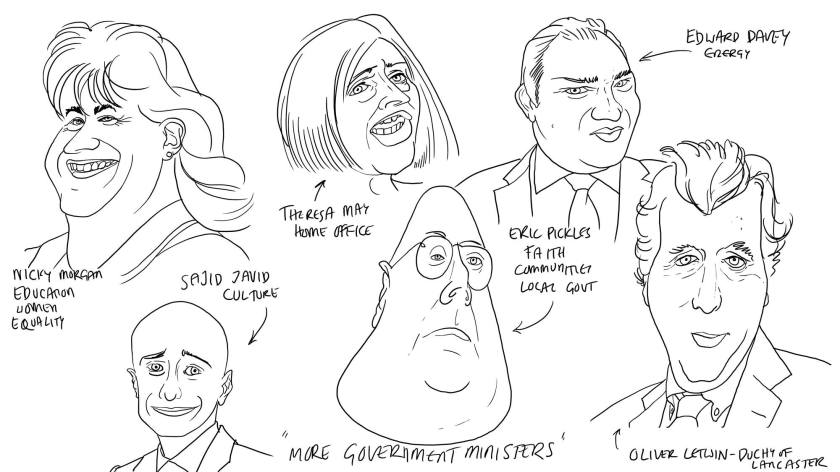
Now the Conservative Leadership campaign is to be fought between two women, there seems to be competition to look as much like Mrs Thatcher as possible. Last night, Theresa May and Andrea Leadsom both gave interviews and I did a quick drawing of each. This is the result, but look how much they resemble the Lady herself! I think Mrs May has the edge.
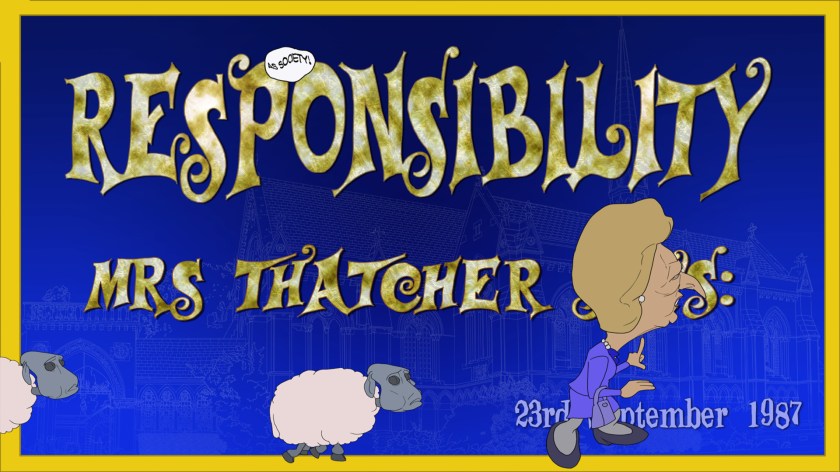
Here is a scene from my film, “How to be Boss” where I am quoting Mrs T’s famous dictum made to Women’s Own in 1988: “There is no such thing as society. There are individual men and women and there are families. And no government can do anything except through people, and people must look after themselves first. It is our duty to look after ourselves and then, also, to look after our neighbours.”
Johnson, the charismatic former mayor of London, dropped out of the Conservative leadership election after his fellow “Leave” campaigner, Michael Gove, said he was not fit for office. In fact, I understand that Boris was stabbed in the back by his own manager, the MP for Stamford, Nick Boles, another Oxford man. I had been in touch with Nick Boles, indeed, a few weeks ago about an educational project, and I got the impression then that he had not been actively involved in the Referendum campaign. I was right. He was probably busy plotting political assassination. The day before he resigned, Boris had been besieged by telephone calls and texts and Nick apparently suggested he took away the mobile phone which Boris, trusting animal as he is, gave to him. In his possession, Boles had the power to send a number of deeply foolish messages in Boris’s name, one indeed to Angela Leadsom which Boris knew nothing about. This is what led to his decision to withdraw. The lesson is very simple: never lend anyone your mobile phone!
For weeks, Gove and Johnson looked like great friends, but it is now clear that although Michael Gove was underhand, is openly disliked and arguably dishonest, in fact, the groundwork for Gove’s brutality was actually laid by Boles who was a much closer friend. It is still not clear whether Boles’ telephone antics were stupidity or malice but they provided enough ammunition for Gove. The chaotic mess that surrounds Boris’s departure, however, does not lessen his achievement which has been spectacular. So, on Friday night, Boris made his own oblique reference to the Boles/Gove assassination when he spoke with some detachment about his success as Mayor in London bringing down crime levels- though he added, he had not quite dealt with “knife crime” in Westminster. Only a man as schooled as Boris in classical allusions could have got away with such a reference. Not only was Boris stabbed in the back, but it was done by one of his closest university friends.
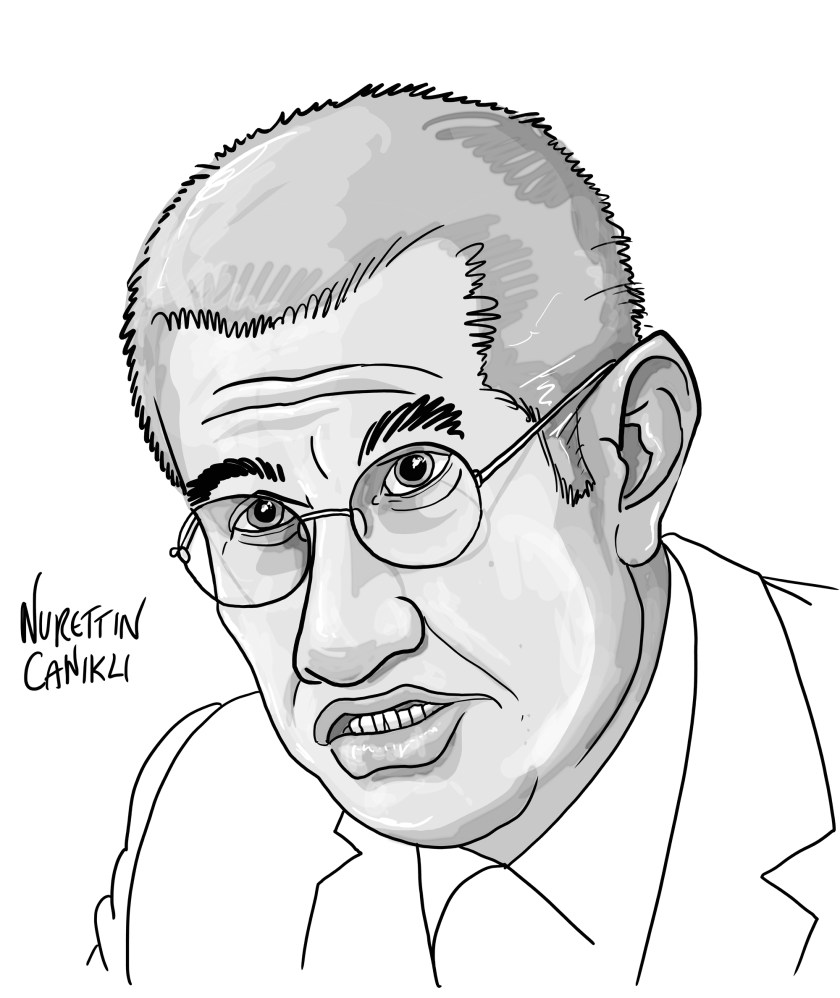
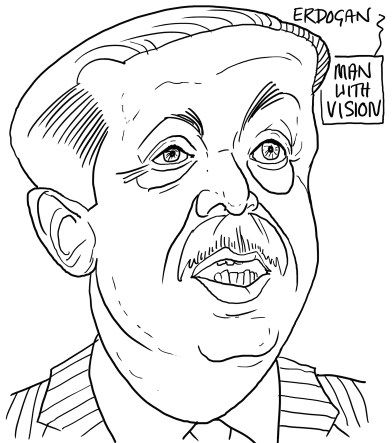
in contrast to Deputy Prime Minister Nurettin Canikli’s twitter comments that Brexit would fragment the EU and that “Britain was the first to abandon ship,” Brexit may well heal Europe and at the same time, help Turkey’s EU bid. After dragging its feet for months, I expect the EU to finally pay up the cash promised on 18th March and also grant the visa-free access promised in return for discouraging irregular migration across the Aegean sea. Already, a week after BREXIT, the EU has opened a new chapter in Turkey’s accession talks, entitled “financial and Budgetary provisions”. The EU will be looking to replace Britain with another weighty nation and Turkey is a prime candidate. The “Christianity” claim is rubbished by the accession of Bosnia and the planned accession of Albania so the key objections to Turkish accession are fading.
We now face an exciting time as two women contend for the Premiership, and I hope as Andrea Leadsom adjusts to being in the media spotlight, there will be a real discussion about the way forward. I am personally very proud that we, as a Nation have put forward two women, without any attempt at an “all woman shortlist” or positive discrimination. Andrea and Theresa are there on merit.
In the meantime, as Economy Minister Nihat Zeybekci has urged, we should be cementing our common interests as two countries on the edge of Europe and build up our mutual investments and trade.
Turkey has been variously criticised by the EU and pilloried in the recent Referendum debates, but as Ramadan ends, it has announced that over 3 million Syrian refugees are to get automatic Turkish citizenship: this goes much further than Merkel’s demands for harbouring returned migrants and it is a statement of solidarity with the dispossessed that should make the whingers in our own referendum debate hold their heads in shame.
The care for victims of warfare is a feature of all three of the great religions that come from the middle east and it has been shocking how slowly we have dragged our feet while still whittering on about Christian values.
As Ramadan finishes tomorrow, therefore, we can celebrate with some satisfaction that at last there is a proper response.
More worryingly, there is news coming from Athens that former German Transport Minister, Peter Ramsauer, part of a delegation headed by the German Vice Chancellor, and already linked to allegations of anti-semitism, apparently told a photographer, I understand, both in German and in english, “don’t touch me, you filthy Greek”. I suppose his bilingual effort was to ensure no one thought this was an accidental bit of racism.
Peter Ramsauer is known to want to refuse Greek any further bailout money, and he is also famous for making a fuss, rather like the French have occasionally done, about borrowed english words used in modern german, so it is odd he should have translated his bilious comments, if indeed he ever uttered them. He went on to facebook yesterday to claim that he had said nothing. It is all the fault of the photographer “who later appeared to be obviously Greek” and who had pushed him. I wonder how this photographer can have appeared so obviously greek at a later stage? had he not appeared so Greek earlier? The good Dr Ramsauer would be well advised to avoid using the word “obviously” in all instances- as a rule of thumb, if something is “obvious”, it does not need to be mentioned and if it is not “obvious”, then the word is inappropriate.
I had dinner a few nights ago with a German minister who is married to a Greek. Both deeply charming! I wonder how Herr Ramsauer deals with that couple in the vaulted corridors of the Reichstag? The story of this exchange makes some of our own British bigots look positively cuddly.
AC Grayling is the founder and first master of what Terry Eagleton earlier called the “odious” Independent university NCH which was one of the projects advanced by Anthony Seldon, now vice chancellor of University of Buckingham, and welcomed by Boris. Current academics at NCH include Peter Singer, Richard Dawkins Vernon Bogdanon Trevor Nunn and Christopher Peacock. Frankly, Eagleton who championed opportunity for all and objected to private education in principle was a bit rich making his comments as he was then teaching at one of the more expensive private universities in the US. The first students enrolled in 2013 and a wide range of scholarships and bursaries ensured a fairly broad intake, in Grayling’s words, “elitist” but not “exclusive.” These words are often interchangeable and I got into trouble once for using the term elite as a synonym for “best”. People can be very quick with their interpretation of words and there are fashions in the way they are used and abused.
Here is the text of Grayling’s letter to MPs:
29 June 2016
At the urging of many of my students – who come both from the United Kingdom and the European Union – and my own conscience, I write to you to express a respectful but strongly held view that, for the reasons set out below, Parliament should not support a motion to trigger Article 50 of the Lisbon Treaty. It is within your democratic remit and duty as a Member of our Parliament to vote on whether to initiate that procedure. By voting not to do so, you will keep the UK in the EU.
The non-binding referendum, its circumstances, and its slim majority achieved in those circumstances, is not an adequate ground for the UK to leave the EU.
The relevant factors and reasons are as follows.
In order for the UK to begin the process of leaving the EU, Parliament has to vote in favour of invoking Article 50. It is possible that complex constitutional issues might have to be settled in advance of such a vote, for example repeal of the 1972 European Communities Act. This is a matter that legal expertise is required to settle. But the key matter in the end is a vote on whether to initiate the Article 50 procedure.
Parliament as presently constituted has a substantial majority in favour of remaining in the EU. Given the following factors:
that the referendum was advisory only and non-binding,
that the majority for ‘Brexit’ was small (3.8%),
that there are major questions about the circumstances of the respective Remain and especially Leave campaigns regarding probity of information, claims and promises made to voters,
that a serious risk of break-up of the UK impends upon a ‘Brexit,’
that the economic consequences of a ‘Brexit’ are not in the UK’s favour,
that a ‘Brexit’ would damage our neighbours and partners in Europe,
and that the future of the young of our country is focally implicated in the decision,
For all these reasons and more, there is a powerful case for Parliament to use its discretion to determine that it is not in the UK’s interests to leave the EU.
No doubt this will cause anxiety among those MPs who think that a simple majority in a referendum confers a moral, even though not legal, obligation to treat the referendum outcome as prescriptive and binding. This is far from being so, for the following reasons.
First, in most jurisdictions major constitutional change requires a supermajority or two-thirds majority to effect them (as e.g. in the USA and Germany), whether in a legislature or in referendums. In Switzerland, which alone among developed nations employs frequent referendums in its ‘semi-direct’ democracy, major decisions require a double majority of the electorate and the cantons.
For a very major change such as exiting the EU, it is not acceptable to have matters decided by a small simple majority. So great a change requires a significant degree of genuine consensus, at the minimum such as a 60% majority would reflect.
Second, a referendum is in essence a decision by crowd acclamation. You will of course well understand that there is an excellent reason why most advanced and mature polities do not have systems of ‘direct democracy’ but instead have systems of representative democracy, in which legislators are not delegates sent by their constituents but agents tasked and empowered to investigate, debate and decide on behalf of their constituents. This reason is that rule by crowd acclamation is a very poor method of government.
Consider: suppose that every item of proposed legislation were decided by referendums, which would therefore occur very frequently. Bills on health and safety in manufacturing industry, on reform of higher education, on the use of chemicals in water treatment plants, on regulation of air traffic over the nation’s airports – bills proposed by government and drafted in detail by civil servants – would be presented to the public, who would then vote. Would that work?
Very obviously, not. The expertise, patience and time that most of the public could bring to the task would be extremely limited; the lack of expertise, especially, would be a serious, perhaps disastrous, handicap. And very soon turnouts in referendums would plummet to single figures, rendering their democratic value nugatory.
Now I beg: really do consider the implications of the foregoing thought. Referendums are snapshots of sentiment at a given point in time. Government by referendum is government by crowd acclamation: not democracy, but ochlocracy. That is exactly why we have representative democracy. If referendums would be a poor way to decide on health and safety, air traffic control, or education, they are an exceedingly poor way to decide a matter as momentous as membership of the EU. This is and should be a matter for Parliament, taking all factors into account.
Moreover: the circumstances of the campaigns and the consequences of the vote itself must be considered. There was a great deal of misinformation, distortion, and false promises, much of it quickly revealed in the immediate aftermath of the vote, and resiled upon even by those who had made those claims and promises. Tabloid urgings for Brexit were followed, in the very same tabloids, immediately after the vote by information on its consequences which shocked readers. We have seen much reported about the post-vote regrets of people who had voted for ‘Brexit,’ – including some high-profile individuals who before the vote had been urging it in their newspapers.
These factors add up to this: that there are grave doubts about whether the basis on which votes were cast, especially among many who voted for ‘Brexit,’ are good grounds for Members of Parliament to resign their competence and duty to consider whether the UK should leave the EU. On the contrary: these considerations make it all the more imperative that Parliament should exercise its sovereign responsibility in the matter.
There is a formal online petition requesting a second referendum. If this petition is genuine and not the result of fraudulent computer hacking, it is the most extraordinary phenomenon: as I write these words it stands, only a few days after the vote itself, at over four million signatures. However if Parliament were to exercise its responsibility in voting down a proposal to trigger the Article 50 procedure, no second referendum would be necessary.
Some have suggested that a following general election, in which each MP made clear his or her standpoint on Remain or Leave, would provide a definitive conclusion to Parliament’s decision on the matter. However this is not constitutionally necessary: Parliament is sovereign: an election would merely prolong uncertainty.
One of the most important reasons why Parliament must take a bold sovereign stand on the outcome of this small-majority advisory referendum, is the interests of the young. We know that the Remain and Leave votes divided along the fault lines of age, educational level, and geography. There is every reason to urge that the wishes and interests of the young – the younger, more aspirational creators of the country’s future – should be given most weight. Parliament should protect those interests and respect those wishes. Some say that any among the young who could vote but did not, have only themselves to blame. This argument will not do. Those young people might have legitimately thought that their elders would not be so foolish as to betray the future by a ‘Brexit’ vote. But punishing them with a ‘Brexit’ is not the right response. The sober judgment of Parliament should be on their side.
You might think that Parliament’s discretion not to trigger the Article 50 procedure would leave matters hanging in the air, with continued uncertainty and the instability and political upheaval that it would bring.
Not so.
In debating and voting on whether to trigger the Article 50 procedure, it can be made clear that Parliament has noted
the outcome of the advisory referendum,
the small size of the majority of actual votes cast (thus, not the majority of the electorate),
the circumstances of the campaigns,
the consequences both already actual and in prospect, for the future interest, unity and prosperity of the UK,
and the impact on our neighbours in Europe:
and that it is exercising its democratic duty to take a view and to vote accordingly. If the vote is to not trigger the ‘Brexit’ procedure, our partners in Europe can be informed and normality can be restored.
The EU is flawed and has problems. But as a powerful member of one of the three great blocs in the world, the UK can do much to help it get better, and to work within it to help all its members realize the great ideals of peace, prosperity and co-operation for which the EU exists.
Let us not absent ourselves from this beautiful endeavour. Let us not injure it by refusing to be part of it, thereby also damaging ourselves and the hopes of our young.
Please – you have both the ability and the duty to use your own discretion in this matter. I very respectfully urge you to use the first and obey the second. The future truly depends on it.
I attended an exhibition day on Wednesday at my old school, Ratcliffe College, and I was able to publicly thank the outgoing headmaster Gareth Lloyd for the spectacular turnaround in the School’s fortunes over the 7 years he has held the post. I will post some of my talk at a later date but the key point in all the speeches throughout the day made by the Headmaster, Fr President, the Chairman of the Governors and coincidentally by me too, was the importance of kindness. That is something that has been conspicuously absent in the referendum debate and the subsequent and chaotic fallout as politicians have scrambled over one another to sabotage the future.
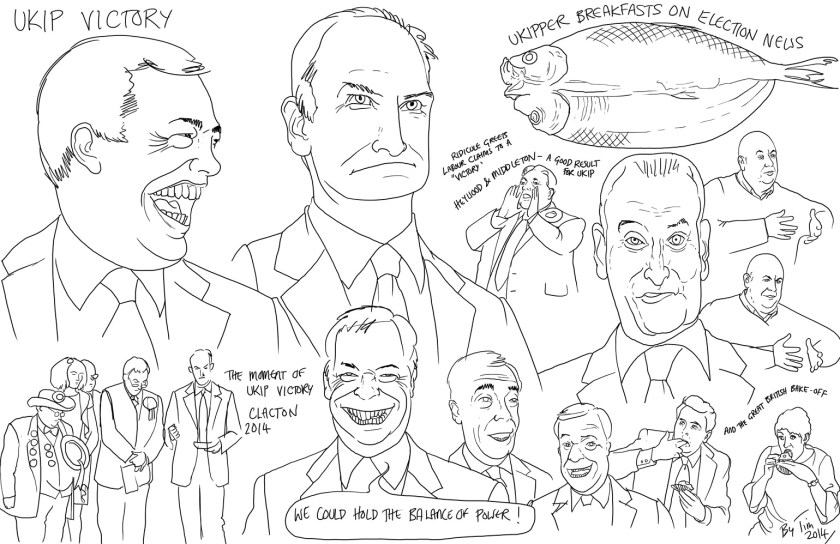
The occasion at Ratcliffe was, of course, dominated by talk of Brexit and quite alot of discussion about UKIP and my role in the UKIP story. (I think some people had rather cleverly checked me out on the internet) I was fairly honest in my response: while there are many good people attracted to UKIP and while its leader remains one of the few great orators in the country, it is, nevertheless, controlled by a balding militant thuggery snatched from the BNP and NF. This may have been a party ruled by bullies and twits, but it also attracted spectacular and honourable people like Douglas Carswell and Councillor Sean Connors. I count Sean as a good friend and a very honourable man. I also have time for Mark Reckless, now a member of the Welsh assembly. Credit where credit is due.
I joined UKIP with the intention of playing a leading role in the way it developed, or identifying and exposing the racism that everyone told me was there. In fact, I was offered both opportunities at about the same time. I chose to expose the racism.
The rise in racist and extremist abuse since the Referendum means that there are many who believe the racism in UKIP is endorsed by the “Leave” result. It is not, and there are many people in UKIP, who would be appalled by the suggestion that they have anything to do with, or would ever condone racism. More than that, there is extremism on both sides: my point is that it feels it has been sanctioned, and that is a message that needs to be addressed and condemned.
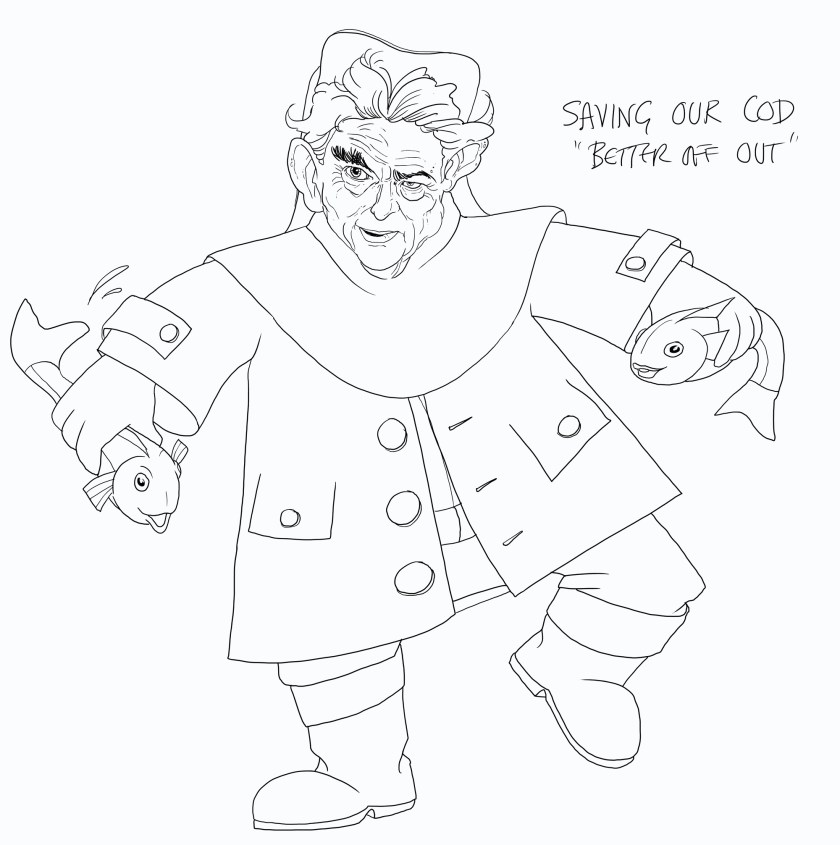
As a Conservative, I find the libertarian aims of UKIP fairly laudable, but this is mixed with long-standing and often ill-considered ravings about the EU that in the end informed and dictated the tone of the recent referendum as well as giving structure to Conservative euro-scepticism, whether Farage was part of the official Leave campaign or not. I was in some difficulty throughout the campaign because I believed and continue to believe that, while the EU is seriously damaged, the European project, nevertheless, and because of our shared history, remains a fundamentally sound one. I felt that the Remain campaign was emphasising the wrong things (fear and greed), appealing to the wrong people (experts) and singing to a songsheet promoted by Farage. In the few debates I attended, the “remain” pitch was made by people peddling weak claims about something that had long since been dismissed as folly. In contrast some brilliant people, particularly our local MP Chris Heaton Harris, made a reasoned and impassioned case for “Leave”. And Chris was fairly unique in specifically saying he would not play the immigration card. If Chris had dictated the terms of the debate, I would have been a “Be-Leaver”. Indeed, at Chris’s encouragement, I contributed animated adverts at no cost specifically to draw attention to the appalling treatment by Europe of our fishing industry, something we must address whether we are “in” or “out”.
I was also appalled and have spoken and written about the abuse of Greece by Germany in particular (Greece had a referendum and Europe made it have another when the result was judged to be “wrong”). Our debate about Sovereignty was made clearer by seeing the sovereignty of Greece ripped away.
But it was Farage’s silence over racism and his indulgence of the powerful thugs in his party that convinced me this campaign would head in the wrong direction and that we might threaten or might leave Europe for the wrong reasons sending a very confused message. This has proven to be the case. The overall debate was controlled by Farage, and while Boris fought hard to wrestle the mantle from his shoulders, he must have found it tough to swallow the nonsense about Turkey’s accession and the £350 million that now Farage says he never endorsed (It was, nevertheless, in the literature I was given a year ago by UKIP). Believe me, I would have done the same thing – Boris had no choice and to his credit, I think, and in the end, Boris made the Leave campaign his own. More than that, he managed personally to avoid any hint of racism and indeed, as far as he was able, temper the debate.
I feared that whoever brought down a man as powerful as Farage was unfortunately doomed. And my fears have been fulfilled. Boris is a brave and noble man. He has taken one for the team.
BECAUSE there could have been nothing worse than giving Farage a place at the negotiating table or rewarding him with a role in government. Knight him and let him leave!
Farage demonstrated to me last year very clearly that he is a man wholly without honour and that those who follow his lead, also abandon honour and integrity. When one of his elected cronies made a foul and public racist comment against a sitting politician, Farage dismissed it as a joke.
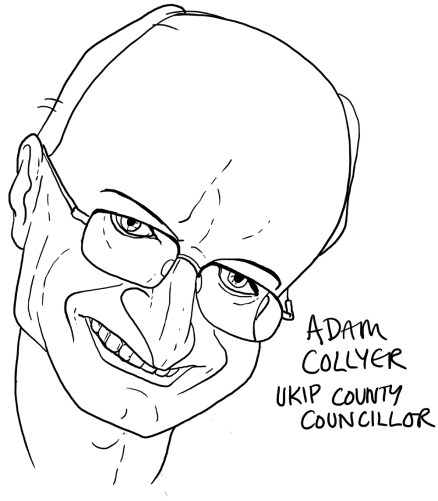
More than that, when I took a stand to support Humza Yousaf, the Scottish minister for Europe, my family was attacked by a sinister local UKIP councillor who thought that a smear and a distortion of facts was an effective and proper response to my resignation. He offered no apology, and nor did his master, Farage.
Both promised to write to me after the election and neither did. Both promised to resign and neither did. Both said exactly what they thought the public wanted to hear at the time and then they did their own thing. This is demagogy and not democracy.
Referendums
People do not always read the lessons of history. For example, both Napoleon and Hitler turned to the Plebiscite, today’s “referendum” to justify their actions. It may be a tool for democracy but it is also a weapon of tyranny. Today, the web is filled with cries of “foul”, and whimpers from people who felt they voted the wrong way, and now regret their vote, or claim that 63% of the youth vote simply did not bother to vote. Some people blame Jeremy Corbyn and others blame the Glastonbury festival for that!
A blueprint for tomorrow
But the Leave vote has happened and we should be looking forward to finding solutions that reflect the reality – ensuring at the same time that Scotland, Ireland and Gibraltar are fully anchored to the UK, and also keep their place in Europe. There is even a case for London to retain its place as the financial hub of the EU while at the same time, pulling back the tide of EU bureaucracy from the shires. The EU is either a supra-national entity or it is dependent on the Nation-state. I think this is an opportunity to show the way the EU can work around Nationality and work with rather than against National and regional sovereignty. It should not be a case of choosing the EU over our nation but of accommodating both if necessary and at various levels of association. This is also a blueprint for establishing fully devolved and fully accountable local parliaments. I wrote a few days ago about the absurdity of pitching Nationalism against Federalism. Actually, with some flexibility and some grace, we can embrace the best of both.
Our contribution to the EU
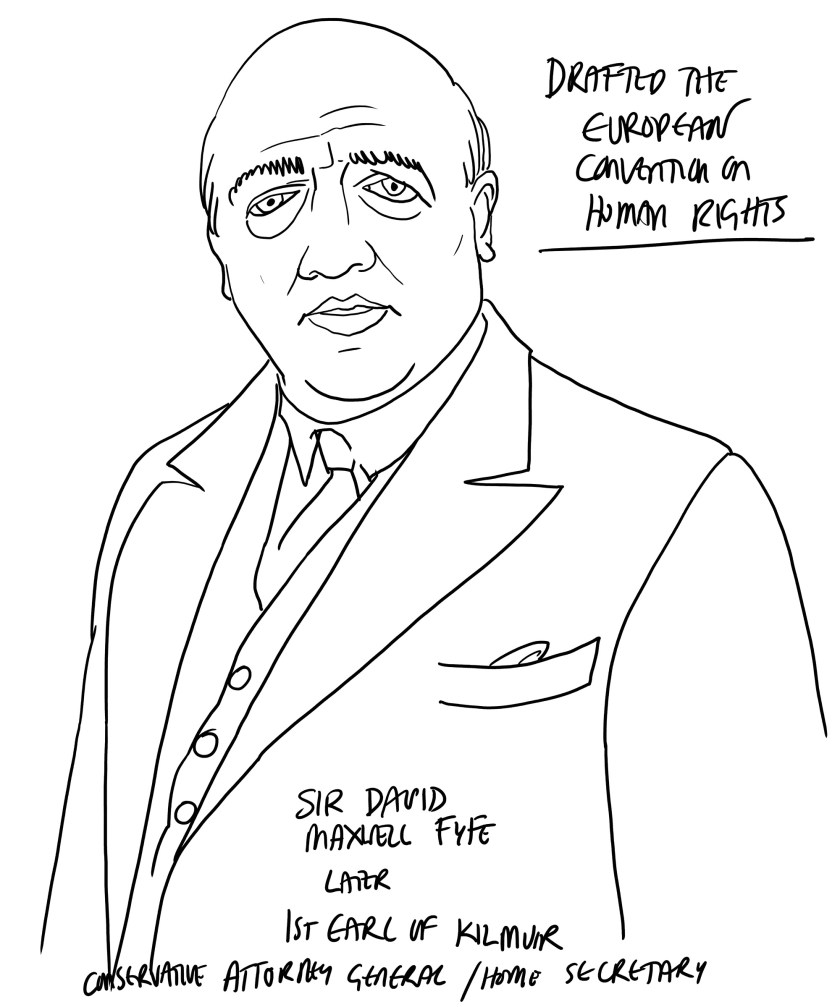
There are points to be made in favour of Europe and we may have to visit these over the negotiations. We need to look at ways to effect reconciliation rather than to drive a hard-bargain and we need to emphasise our overall contribution to the European project rather than posture as Farage has done and claim that European ministers have never had proper jobs. At the top of the list of contributions we have made to Europe is the Charter of human rights, the very thing that irritated so many people in my own party. The draft for this was written by a man called Maxwell Fyfe who became the Conservative Home secretary in Churchill’s peace-time cabinet. This was seen as the bedrock of a new EU-wide set of values, and it became our own in time. It was a British vision that anticipated the repeal of hanging, the institution of equality laws and the eradication of torture. This is a cornerstone to the modern Europe and I have successfully taken a case through the ECHR and helped to redefine the way the law is interpreted both internationally and nationally. I have a personal stake in this Charter.
Our role in History
More than that, I believe we have consistently gone to the aid of Europe in crisis, and to that end, fought two wars in Europe. Today, the Greek sovereignty issue is demonstration enough of the depth of crisis in Europe. Immigrants come and go and the immigration issue is actually a passing problem while the sovereignty issue drives to the heart of current EU abuse. It is not a time to be turning our back on Brussels but a time to engage fully with what happens across the channel and ensure that a long term-view, and that fairness, common-sense and goodwill are paramount. When Lord Fyfe wrote the charter, we were not a member of the EU. That clearly did not prevent us from playing a decisive role in the way the EU was established and the values it promoted.
Our Future
Whatever our legal relationship with the EU project, I think we should be determined to play a pivotal role in securing the values we hold dear. It is in Europe’s interest and in ours to see that Europe works properly. It is not working properly now and nor are we. We can both do better and we need to work together.
The ‘wiser’ generations, generally speaking, have a keener ear for nonsense. The EU, no doubt, a mushy construct of liberal ideology, bureaucracy, and hubris, must register on their radar with the footprint of some alien mega-spaceship – the stuff of Independence Day. The babbling of the ‘young’ can be dismissed as endearing but deluded naivety. So the grey voters crowded into the voting booths, walking sticks and all.
The tragedy is that now, in the wake of ‘having it their way’, this wiser generation has apparently paused, ‘realized’ its terrible mistake and, equipped with a wandering index finger, on the closest keypad, and in half an hour, has found an ‘online petition’ and signed it. Today, that petition is upwards of 3 million votes.
The most irresponsible part of this process is the lack of conviction.
Meanwhile, the lacklustre response that we have had from the EU means that they are still bureaucratic. The fact is that Juncker hasn’t yet resigned and that Merkel is still throwing her weight around as if nothing had happened, while Hollande and Tusk wallow in repeating useless platitudes; and instead of begging the UK to sit at the table and discuss reasonable demands, these lords of Europe remain as supercilious and hubristic as ever. The fact that they claim to have looked at all options, mock Cameron for failing to prepare for Brexit, and yet have no contingency plans in place and that they insist on walking blindfolded to a political crisis of epic proportions means that they are as liberal and self-obsessed as they have ever been.
But the EU’s moves are being carefully watched by those young economists and young social commentators who voted stay, but who are now starting to think they might have voted the wrong way.
Those working for the markets wonder, what country will follow Britain’s exit. Greece? Portugal? Italy? Will we see the partitioning of Spain with the Catalonian vote only 3 weeks away? How will the EU negotiate further fiscal consolidation between the Eurozone members, when each member can now play the Exit card?
Those with more of a cynical edge who write blogs wonder- how will a divided EU stand up to Russian aggression and export its principles of democracy beyond Europe? Can Europe really afford or allow the break-up of the United Kingdom? What happens to the UK’s seat as a permanent member of the UN Security Council? Should the UK’s permanent membership, in any case, or in the near future, be substituted for England and would Scotland, independently have its own claim?
There is, of course, the matter of greed: France and Germany, jealousy watched London become the financial capital of the World and profit from the riches that came with it. The French sacrificed their national pride to keep Paris beautiful, unharmed by German planes – so why aren’t American Investment banks flocking to Paris or to Frankfurt for their European headquarters? The answer is that investment bankers too have a keen sense for nonsense.
The UK will undoubtedly face economic consequences. It is widely expected that asset prices will fall, starting with house prices. The housing market has received two shocks this year, firstly, when Osborne (welcomingly) increased stamp-duty for second-time buyers, which so far has led to a 5% downward correction in house prices and secondly, with the Brexit vote. Real Estate Funds like JJL and CBRE have already started postponing their planned UK investments. CBRE only invested £180 this year, compared to £650 in 2013. Many leading investors are predicting a correction averaging 10% in the commercial real estate sector, particularly in London.
The DAX, CAC and FTSE, which are all very good indicators of economic expectations, have dropped to 2011 prices. The pound and Euro are both taking a beating against the dollar and other currencies, while bonds yields have dropped to record lows; which together with an appreciation in the price of gold, indicate investment is drying up.
It is perhaps too early to tell how the general economy will react, but a correction downwards in GDP figures is widely expected. The low exchange rates might improve exports, but that is expected to more than be countered by the fall in investment and consumption.
However, this isn’t all bad news. The fall in asset prices will provide much-needed relief to some social anxiety. Housing might, in this way, become cheaper for first-time buyers. Wages in the lower thresholds will probably increase as unskilled European labour goes home. The NHS will have fewer patients and doctors may have an easier time working, maybe only 10 hours a day. Parents will scarcely have to worry about getting places in schools.
The real losers might still be the EU. The money that was flowing out of depressed continental assets and into the UK, won’t stop flowing out. Switzerland and Norway will probably have their hands full in the near future. The hostility to investors remains a core principle of French liberalism (thus the EU); simply ask Emmanuel Macron.
Greece remains a troubled asset, (property of the German state – before Tsipras came along, whoever knew you could actually buy a country?) and fiscal unity seems to claim exponentially more of Draghi’s seemingly infinite life-line. The EU may just survive Brexit and is determined to do so; it may even survive another shock like Brexit (should we call that Catalonia?), but it won’t be able to avoid a third shock.
Nothing is written in stone. The will of ‘the people’ might change and a second referendum, whether Blair proposes it or not, may become a political necessity given the weight of the UK in the global political arena. However, rather than turn around and backtrack, we should be further convinced that the outcome of the referendum was the right one. If the EU buries it’s multi-headed self in the sand and refuses to acknowledge that we didn’t leave on a whim, let the olds have it; the olds have it.
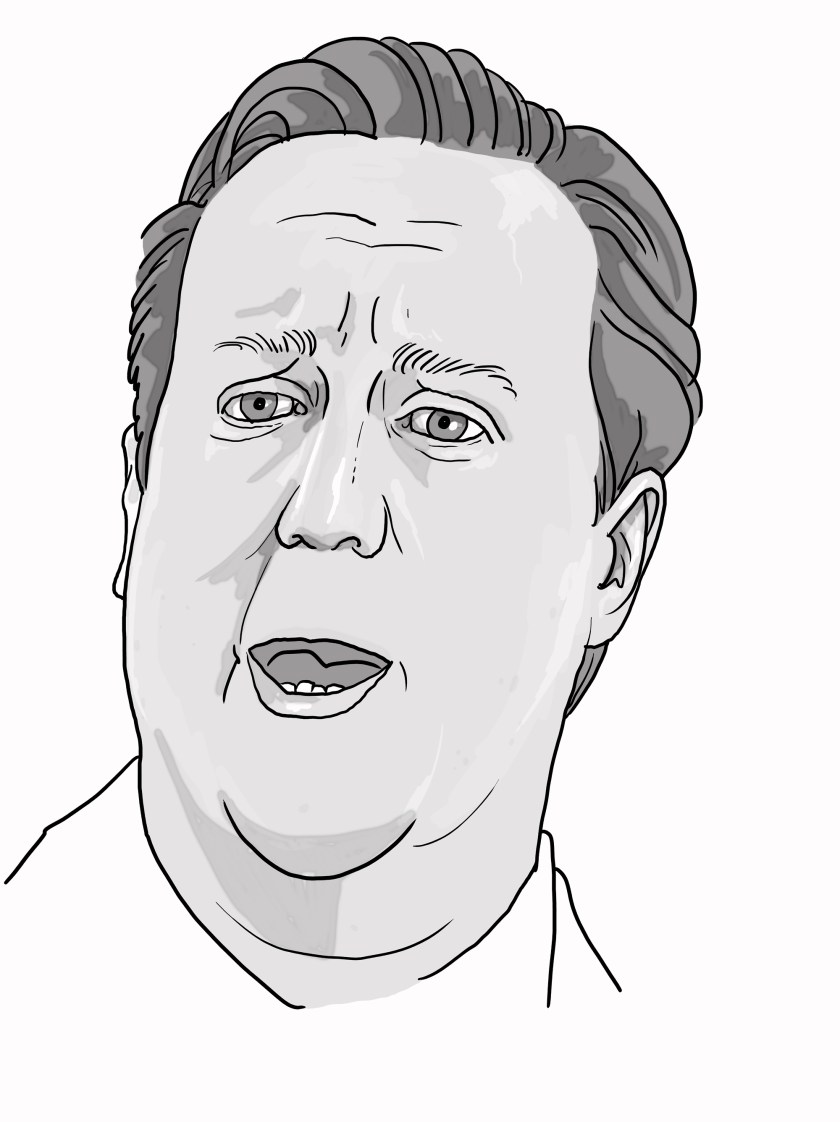
Not a triumphal end to Cameron’s tenure sadly, but there are many things we can be proud of- not least the fastest growing Western Economy and his social vision which saw Gay marriage pushed through despite the whinging of many backbench MPs in the party who saw fit to misquote scripture (see my previous blog on this!). Against the odds, Cameron won the last election and secured Scotland in the UK. Triumphal! It now falls to someone else, maybe, and I hope, Boris, to patch up the problems left behind. A great man who has achieved great things leaves behind a problem that is perhaps even bigger than any of his successes.
I am inclined to think that, despite the serious wobble with the pound as Brexit hit the headlines, we can still work with Brexit. And, moreover, I think there is a future outside the EU. The debate certainly puts issues firmly on the table, and now I hope Europe will also take these same issues seriously, because if the EU fails to reform under this pressure, then we have made an even bigger miscalculation and we have given even more backbone to the monster growing on our doorstep or at least across the channel! Let’s be frank, the EU has had and has ignored warnings in the past- Greece should have been a wake-up call, but the response from Merkel and her cronies was arrogant and wrong. Brexit is altogether a bigger thing and cannot or should not be so lightly tossed off. Barking orders at Britain, as she barked at Greece, will simply not do. (And we thank God we do not have Varoufakis to make a case to Merkel, the man who might have a charismatic presence but who thought Game theory should ever be taken seriously).
The negative legacy that Cameron leaves behind is the one, however, that will probably enter the history books, particularly if Nicola Sturgeon follows through- Cameron will be the man who fractured the EU and who broke up the United Kingdom. The double whammy in union-break-ups! Going back a bit to the infamous “purring” story, there is a hint of hubris in this story that must be evident to a man like Boris steeped in the classics. I hope that was partly in his mind when he was paying tribute to the PM yesterday. Nobility will emerge! And I wonder whether there is room to consider a salvage operation that leaves Scotland and Northern Ireland in the EU? As nothing is clear, nothing can be ruled out!
The EU debate had been going on even before Cameron entered politics as an advisor, but he witnessed the damage it did at first-hand to the tail-end of the Thatcher Government and throughout the Major administration. Blair had a better ride but some close calls from Europe too, especially in 2006 when other EU countries acted fast enough to spare Blair his own Referendum chaos; Blair was lucky in power in a way that the last two Conservative Prime Ministers have not been but I hope, and I presume, nevertheless, that Cameron, like Sir John Major, and in contrast to Blair, will mature into a Statesman of stature once he leaves office. To this end, Cameron sent a letter round today with the following, which I think makes it clear he already has his eye on the bigger picture:
The British people have made a choice. That not only needs to be respected, but those on the losing side of the argument, myself included, should help to make it work.
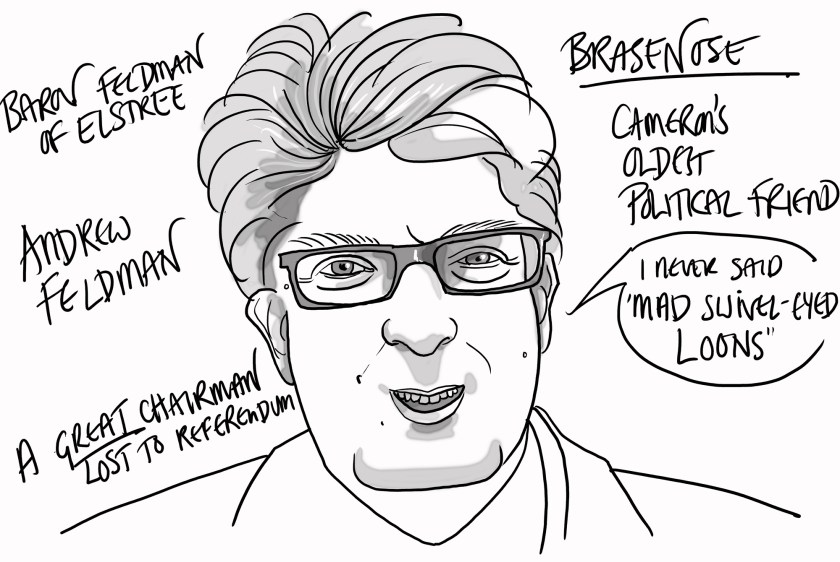
As I write, I note that Lord Feldman is stepping down as Chairman of the Conservative party at the same time David Cameron quits in October. Their successors will have quite a juggling act ahead, because whatever Britain does next, the mess in our own backyard across the channel shows no signs of going away. They are victims of something that has been going on for about 20 years now.
Today’s BREXIT news is just one example, albeit a dramatic one, of the collision between Federalism and Nationalism that has been building up for a few years now across the EU, and looks set to continue with the Spanish referendum, as well as calls in France for a referendum and a revival in Greece of GREXIT ambitions as a third bailout inches forward.
We could try some cod-psychology and say that the rise of Nationalism is a response to some wider global phenomenon, but the truth is that we have no way, at the moment, of judging where it comes from, except that across Europe and beyond, there is a genuine wave of far-right activism, seen most strikingly in the recent Presidential election in Austria, while Jobbik has had tremendous success in Hungary (where it organises a uniformed guard to police Roma areas), as has Poland’s “Law and Justice” Government which came to power in October, the Swiss People’s party, Marine Le Pen’s Front national, the “Freedom party”in the Netherlands, and the Danish People’s party scoring 21% in the last election- Then there are “The Finns”, the Sweden Democrats and down in Greece, the abominable Χρυσή Αυγή as well as our own UKIP here in the UK. I am not sure about how Nationalist is “Our Slovakia” but it did quite well in the last election, and, of course, Germany has its own Nationalist party called “Alternative for Germany” AfD, led by a fairly ferocious woman called Frauke Petry who thinks it is legitimate to shoot refugees (“the use of armed force is there as a last resort”) and that women (I assume she means German women) should have at least three children. there are less successful but equally vocal right wing movements in Italy (the Northern League), the IRL in Estonia, the LDPR in Russia, Slovak Nationalists, Attack, Svoboda, Serbian Radicals and the HČSP, otherwise known rather worryingly as theCroatian “Pure” Party founded by war criminal Ante Pavelic which currently says it is against “NATO, the EU and Gay Marriage”.
There has also, oddly, at about the same time, been a surge in committed socialism as seen in the rise of Tsipras and Corbyn, two people who I am sure mean well but who manage power with a spectacular mix of arrogance and incompetence. The arrogance comes from the size of the popular vote that thrust them into office (we should be careful not to confuse legitimacy with popularity) and the incompetence- well, that is clearly a natural gift in each case. Both have a certain charm. I might enjoy having these men round for tea, and I am sure their conversation would be tremendous fun, but I would not trust either to run my country. Indeed, I think neither Tsipras nor Corbyn ever expected to be elected and so both could offer all manner of promises and absurdities to their respective electorate that they now have to make good and neither was fully prepared for the job. Today, both men seem mostly committed to dithering or forgetting to wear a proper tie.
Modern Europe has also seen a rise in political idealism, what I imagine Mrs Thatcher would have called “Federalism”, most notably in the personnas of Tusk, Jean-Claude Juncker and of Frau Merkel, all of whom, I think, are deeply mistaken in the way they see the European project and their own roles within it. Of course, with hindsight, I am sure they might have surrendered more to David Cameron in the months before the Referendum, but that is the problem with so many of these people- they are locked into a belief that their own ideology, and their own authority moreover, whether European, far Right or far left, is of paramount importance to their overall identity. People are bigger than these passing belief structures, and the only way to tackle such ideologues is to be big enough to bend slightly. The EU was defeated by BREXIT because it was perceived to be undemocratic and inflexible, which quite bluntly is a valid belief.
I think it does not automatically now fall to others within the EU to sort out its future. We still have a role to play in what happens, and we have an interest in the way our neighbours operate. It can no longer be “business as usual” and it is not just about our future!



 There is a danger to determination, of course. Some years ago, I was directing Hamlet and had this insane idea that fish should play a major part. I would like to think I was inspired by the old baldicchino in the church here which was covered in fish- But we did a deal with a salmon farm and every night, the stage manager’s last job was to defrost a fish, put it in a bucket of cold water, for the following day. It all came from the line, “you are a fishmonger” (act II, sc 2) which had a slightly different meaning for Shakespeare. Anyway, the fish made its first appearance when Hamlet was feigning madness, and he produced the fish and slapped it around Polonius’ head; he dissected the fish in the big “To be or not to be” speech and then later the fish was brought on stage on a dog-lead by the mad Ophelia. We won’t do anything new unless we are prepared to take a risk. But being prepared is a key part of the process!















 Not a triumphal end to Cameron’s tenure sadly, but there are many things we can be proud of- not least the fastest growing Western Economy and his social vision which saw Gay marriage pushed through despite the whinging of many backbench MPs in the party who saw fit to misquote scripture (see my previous blog on this!). Against the odds, Cameron won the last election and secured Scotland in the UK. Triumphal! It now falls to someone else, maybe, and I hope, Boris, to patch up the problems left behind. A great man who has achieved great things leaves behind a problem that is perhaps even bigger than any of his successes.



 animate-tim.com